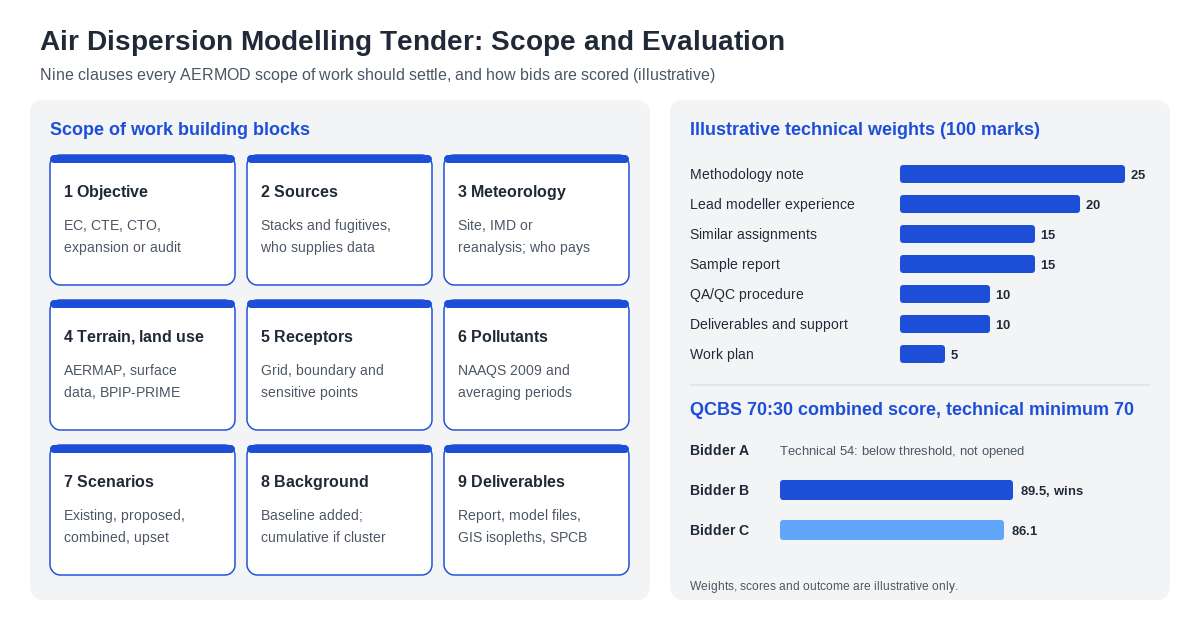
Quick answer: An air dispersion modelling tender should buy a defined, reviewable study, not just "AERMOD modelling". The scope of work needs to fix the objective (EC, CTE, CTO, expansion or audit), the sources and who supplies emission data, who provides meteorological data and for which period, terrain and land use, receptors, pollutants and averaging periods, scenarios, how background is added, and exactly which files and maps are handed over. Evaluate bidders on modelling experience, sample reports and QA/QC as well as price, and set a minimum technical score so the lowest bid cannot win with a weak method.
An air dispersion modelling tender is often written in a hurry, copied from an older environmental tender, and evaluated by a committee that has never opened an AERMOD input file. The result is familiar: a one-line scope ("carry out AERMOD modelling as per CPCB norms"), bids that differ by a factor of three because each bidder imagined a different study, and a report that reaches the State Pollution Control Board (SPCB) or the Expert Appraisal Committee (EAC) without the files needed to answer a single follow-up question.
This guide is for procurement, EHS and environment teams at public sector undertakings (PSUs) and large companies who write or evaluate tenders and requests for quotation (RFQs) for air dispersion modelling, and for the consultants who bid on them. It covers why these studies are tendered, a model AERMOD scope of work, evaluation criteria, common mistakes, how bidders should price and respond, timelines, and a worked evaluation matrix.
For background on the method itself, start with air dispersion modelling for industries in India or the explainer on how AERMOD works.
Why PSUs and Large Companies Tender Air Dispersion Modelling
Most organisations do not keep a dispersion modeller on the payroll. Studies are needed in bursts, around a project or a regulatory event, so they are bought as a service. For a PSU or a large company that usually means a formal route: an open tender, a limited tender to empanelled firms, an RFQ, or a purchase through the Government e-Marketplace (GeM) or the Central Public Procurement Portal (CPP portal), following the organisation's purchase manual and, for central PSUs, the General Financial Rules and the Ministry of Finance procurement manuals.
| Trigger | What the study must show | Typical regulator |
|---|---|---|
| Environmental Clearance (EC) for a new project or expansion | Predicted ground-level concentration (GLC) increments added to baseline, compared with NAAQS 2009 | MoEFCC EAC (Category A) or SEIAA/SEAC (Category B) |
| Consent to Establish (CTE) | Stack heights, controls and predicted impact for the proposed plant | SPCB |
| Consent to Operate (CTO) or renewal | Impact of the plant as built and operated | SPCB |
| Environmental audit or EC compliance review | Whether current emissions and stack design are consistent with air quality limits | SPCB, MoEFCC regional office, internal board |
| Legacy stack review | Whether older stacks meet current height guidance and give acceptable GLCs | SPCB or internal |
| Fuel change, uprating or new control equipment | Before and after comparison of impact | SPCB |
Under the EIA Notification 2006, the Terms of Reference (ToR) for most industrial sectors ask for air quality modelling of project emissions, with predicted maximum GLCs superimposed on baseline. That single clause is why many EC-linked tenders exist. See air quality modelling for Environmental Clearance and air quality modelling for Consent to Establish for the regulatory context.
Environmental audit tenders are the other large group. A combined "environmental audit and air dispersion modelling tender" usually bundles stack monitoring, ambient monitoring, a compliance review and a modelling study. Bundling is sensible, because the audit generates the emission data the model needs, but only if the scope says so explicitly.
Who Usually Bids
Bidders are EIA consultancies (which need QCI-NABET accreditation for the sector if they prepare the EIA report), environmental laboratories that also offer modelling, and specialist modelling firms working directly or as subcontractors. If you allow sub-contracting of the modelling, require the bidder to name the modelling team. See what an AERMOD modelling subcontractor does.
What a Good AERMOD Scope of Work Must Settle
A scope of work for air dispersion modelling has one job: make every bidder price the same study. If two competent modellers would read your scope and build materially different models, it is not finished. In practice that means settling nine things, which the template below takes in turn: objective, sources, meteorology, terrain, receptors, pollutants, scenarios, background and deliverables.
Model Scope of Work Template for an Air Dispersion Modelling Tender
The clauses below can be pasted into a tender and edited; square brackets need site-specific values. The template assumes AERMOD, which most Indian ToRs and SPCBs expect for industrial sources. If a long-range or complex coastal case needs another model, read AERMOD versus CALPUFF first.
1. Objectives
State the purpose in one or two sentences. For example: "To predict incremental ground-level concentrations of PM10, PM2.5, SO2, NO2 and CO from the existing plant and the proposed [capacity] expansion at [site], using the latest regulatory version of US EPA AERMOD, and to assess compliance with NAAQS 2009 after adding measured baseline, for submission with the EIA report." Add secondary objectives such as recommending stack heights or comparing two control options.
2. Sources and Emission Inventory
List every source, or require the bidder to prepare the list from site data, and say who supplies the data for each.
| Source type | Data required | Normally supplied by |
|---|---|---|
| Stacks (point sources) | Location, base elevation, height, diameter, exit velocity, exit temperature, emission rate per pollutant | Owner, from design basis or stack monitoring |
| Fugitive area sources (stockpiles, yards, pits) | Footprint, release height, emission rate per unit area | Owner, or bidder estimates from emission factors |
| Volume sources (transfer points, crushers, vents) | Location, release height, initial dimensions, emission rate | Owner, or bidder estimates |
| Line sources (haul roads, conveyors) | Alignment, width, traffic or throughput | Owner traffic data, bidder estimates |
| Buildings near stacks | Footprint and height for downwash | Owner drawings |
Require an emission inventory workbook that shows the origin of every number and flags estimated values. See emission inventories for dispersion modelling and AERMOD source types explained.
A useful clause: "The Contractor shall review the emission data supplied by [Owner] within [5] working days of award and report missing, inconsistent or implausible values in writing. Modelling shall not proceed on unresolved data without written approval."
3. Meteorological Data
This is the clause most tenders get wrong, and it has the largest effect on cost and timeline. The scope must say who provides hourly meteorology and for which period.
| Option | When it fits | Points for the scope |
|---|---|---|
| Site station run during baseline monitoring | EC studies where the ToR expects a site station for the baseline season | Specify parameters (wind speed and direction, temperature, humidity, cloud cover or solar radiation), logging interval and data capture target |
| India Meteorological Department (IMD) station data | A representative IMD station exists | State who procures and pays, and allow for procurement time |
| Reanalysis or prognostic data (for example ERA5, or WRF output processed for AERMOD) | No representative station, or a full year is needed | Require the bidder to justify representativeness and describe processing |
Two points matter in 2026. NOAA's legacy Integrated Surface Database files stopped updating in late August 2025, so "use ISD data for the nearest airport" may be impossible for a recent period; see NOAA ISD and meteorological data for AERMOD. And AERMET needs upper-air data or a substitute, so ask the bidder to state its source.
Specify the period: the baseline season for an EC study, or at least one full year for a CTO review, audit or stack height study. See meteorological data for air modelling in India and the AERMET preprocessing guide.
4. Terrain, Land Use and Buildings
Require terrain from a stated digital elevation model processed through AERMAP, unless flat terrain is justified. Require surface characteristics (albedo, Bowen ratio, roughness) derived by sector and season, and building downwash with BPIP-PRIME where stacks are near tall buildings. See terrain and land use data for AERMOD and building downwash with BPIP.
5. Receptors
Define the study area (for EC studies normally 10 km around the project, matching the baseline study area) and require a nested grid finer near the sources, receptors along the plant boundary, and discrete receptors at each baseline monitoring location and at sensitive locations such as villages, schools and hospitals, all with terrain elevations. The bidder should show that the maximum is captured; see receptor grid design.
6. Pollutants, Averaging Periods and Standards
List the pollutants and periods explicitly. The usual starting list, with NAAQS 2009 limits for industrial, residential, rural and other areas, is:
| Pollutant | Averaging periods | NAAQS 2009 limit |
|---|---|---|
| PM10 | 24-hour, annual | 100 and 60 µg/m³ |
| PM2.5 | 24-hour, annual | 60 and 40 µg/m³ |
| SO2 | 24-hour, annual | 80 and 50 µg/m³ |
| NO2 | 24-hour, annual | 80 and 40 µg/m³ |
| CO | 1-hour, 8-hour | 4 and 2 mg/m³ |
Add sector pollutants where the ToR or process demands it, such as benzene, ammonia, lead, fluoride or odour. State how NOx is converted to NO2, because the choice changes the result; see NO2 modelling and NOx conversion, AERMOD averaging periods and NAAQS compliance and the NAAQS India reference.
7. Scenarios
Name each scenario. A typical expansion set is: existing plant; proposed sources only; existing plus proposed; an upset or control-failure case if the ToR or SPCB asks; and any alternative being compared, such as two stack heights. Each scenario adds runs, tables and maps, so naming them stops arguments later.
8. Background and Cumulative Impact
Say how background is added. The usual approach adds measured baseline (for example the 98th percentile of 24-hour values at each station) to the predicted increment there and reports the total against NAAQS. If the project sits in an industrial cluster, state whether neighbouring sources are modelled and who obtains their data. Cumulative modelling can double the effort, so never leave it implied. See cumulative air quality impact assessment in India.
9. Deliverables
The deliverables clause protects the buyer more than any other.
| Deliverable | Format | Why it matters |
|---|---|---|
| Modelling report with method, inputs, results, NAAQS comparison and conclusions | PDF and editable Word | The document submitted to the regulator |
| Emission inventory workbook | Excel | Traceability of every emission rate |
| AERMOD, AERMET, AERMAP and BPIP input and output files, met and plot files | Native text files in a zip | Lets you rerun, check or change the study later |
| Isopleth maps for each pollutant, period and scenario | PNG or PDF, plus shapefile, KML or GeoTIFF | Lets GIS teams or the regulator overlay results |
| Receptor results tables | Excel or CSV | Answers queries about specific villages or stations |
| Presentation to the SPCB, EAC or SEAC, with the modeller attending | Slides and attendance | Many queries are raised at the meeting |
| Responses to regulator queries | Written replies and reruns | Defines post-submission support |
See AERMOD isopleth maps in QGIS and air dispersion modelling report contents. Fix the support, for example "up to two rounds of written queries and one presentation within twelve months of report acceptance".
Technical Specifications Bidders Should Be Asked to Confirm
A short "dispersion modelling technical specifications" annexure, filled in by each bidder, makes evaluation far easier. Ask for the model version and confirmation of regulatory defaults, the met data source, period and upper-air source, terrain and land-use data sources, the downwash approach, the receptor design, the NO2 conversion method, the background and cumulative approach, and the software used.
On software, a caution. AERMOD, AERMET and AERMAP are public domain programs from the US EPA, so "licensed AERMOD software" makes little technical sense. Commercial interfaces are useful, but the regulatory engine is the same. Ask which interface the bidder uses and require native input files, so the study does not depend on one vendor's format. See is AERMOD free? and air quality modelling software in India.
Technical Evaluation Criteria and Qualifications to Ask For
Score the things that make a study survive appraisal.
Modeller Experience
Ask for CVs of the named lead modeller and reviewer, and score experience with the relevant source types, terrain and downwash. One experienced modeller with a reviewer beats a large team with no named lead. Prevent substitution of the lead without written approval.
Similar Assignments and Sample Report
Ask for comparable studies by sector, source type and regulator. Client names may be confidential for subcontracted work; a description and the regulator are often enough. Ask for one redacted sample report and read it: look for a clear input table, justified met data, legible maps, a NAAQS comparison with background and stated limitations.
QA/QC Procedure and Methodology Note
Ask for a written QA/QC procedure covering input checks, independent review of model files and a sign-off record; our QA/QC checklist for air dispersion reports and common AERMOD mistakes help build the scoring note. Ask also for a site-specific methodology note of two to five pages. A bidder who has thought about your sources and met data will show it; a generic note is easy to recognise.
Eligibility Criteria to Keep Proportionate
Turnover and years-in-business thresholds are normal for PSU tenders, but should match the job. A very high turnover requirement for one modelling study excludes specialist firms and pushes the work to generalists who subcontract it anyway. If the EIA report is in scope, the EIA consultant must be QCI-NABET accredited; the modelling can be done by a named sub-consultant if your rules allow.
Common Mistakes in Air Dispersion Modelling Tenders
| Mistake | What happens | Fix in the tender |
|---|---|---|
| Vague scope ("AERMOD modelling as per norms") | Bids are not comparable; the cheapest bidder models the least | Use the template and name sources, pollutants and scenarios |
| No responsibility for meteorological data | Delays, or an unrepresentative data set | Name the met source, period and who pays |
| No file handover | The plant cannot answer later queries or change consultant | Require native files and GIS layers |
| Emission data not addressed | Guessed values the regulator questions | Assign responsibility per source; require an inventory workbook |
| Background and cumulative impact unclear | Totals missing or the cluster case skipped | State the method and whether neighbours are modelled |
| Post-submission support undefined | Extra charges for every query, or no response | Fix query rounds and meetings |
| Pure lowest-price award | A minimal study that fails appraisal | Use QCBS or a technical threshold |
| Unrealistic timeline | Rushed QA and errors | Allow time for data review and met processing |
The Lowest-Price Trap
Lowest-price (L1) selection is easy to defend in an audit but often poor value for modelling. A study priced well below the field has usually dropped something: a full year of met data replaced with a few weeks, fugitives omitted, terrain assumed flat, a coarse grid, or no QA review. The report still looks complete until the EAC or SPCB asks for a rerun.
If your rules require L1, make the scope tight enough that a minimal study is non-compliant, apply a pass or fail technical stage, and require file handover. If quality and cost based selection (QCBS) is allowed, it is usually the better choice. See the cost of air dispersion modelling in India and AERMOD modelling cost.
How Bidders Should Price and Respond
For consultants, a clear response wins more often than a low one when evaluation is done properly, and protects the bidder when it is not.
Price From the Drivers, Not From a Rate Card
Identify each effort driver from the tender and price it explicitly:
- Sources. Ten stacks with good data are quicker than three fugitive sources needing emission estimates.
- Meteorological data. IMD procurement, a site station or a reanalysis data set each carry different effort and third-party cost.
- Terrain and downwash. Complex terrain and many buildings add preprocessing and checks.
- Receptors, pollutants and scenarios. Each combination adds runs, tables and maps.
- Cumulative modelling. Collecting and checking neighbours' data is often the largest variable.
- Deliverables, support and timeline. GIS layers, presentations, travel, query rounds and compressed programmes all cost time.
Where the tender is silent, state your assumption, for example "Meteorological data: one season of site data supplied by the Owner in hourly format".
Respond Specifically and Use Pre-Bid Queries
Fill in the technical annexure clause by clause, name your proposed met source and why it represents the site, and show a draft receptor layout if you can. Use the pre-bid window to ask who supplies met and emission data, whether cumulative modelling is required, and how many query rounds are included; answers usually go to all bidders as a corrigendum. Include a redacted sample report, a QA/QC procedure and CVs for the actual team. Our guide on how to outsource air dispersion modelling describes the arrangement from the buyer's side.
Timelines for Tendered Modelling Studies
| Phase | Typical duration (indicative) |
|---|---|
| Drafting scope and approvals | 2 to 6 weeks |
| Tender publication to bid submission | 2 to 4 weeks |
| Technical and financial evaluation | 2 to 6 weeks |
| Award, kick-off and input data review | 2 to 3 weeks |
| Meteorological data | Days to a full baseline season |
| Modelling, mapping and reporting after complete inputs | 2 to 6 weeks |
| Regulator review and queries | Variable |
The model run takes minutes to hours; data, review and reporting take the time. See AERMOD turnaround time. For EC projects that need a site met station, award the modelling before monitoring starts, or put the station in the baseline monitoring contract with a clear data handover.
Worked Example: An Illustrative Evaluation Matrix
The weights, scores and prices below are invented to show the method and do not represent any real tender or bidder. A company procures an AERMOD study for an expansion needing EC, using QCBS with a 70:30 technical to financial weighting and a minimum technical score of 70 out of 100.
Technical Criteria and Scores
| Criterion (maximum marks) | What earns full marks | Bidder A | Bidder B | Bidder C |
|---|---|---|---|---|
| Lead modeller experience (20) | Named lead with comparable regulatory studies and an independent reviewer | 10 | 17 | 18 |
| Similar assignments (15) | Several comparable studies, clearly described | 9 | 12 | 14 |
| Site-specific methodology note (25) | Met plan, source treatment, receptors, NO2 method, background | 12 | 22 | 23 |
| Sample report quality (15) | Clear inputs, justified met data, legible maps, limitations | 9 | 13 | 14 |
| QA/QC procedure (10) | Documented checks, independent review, sign-off | 5 | 8 | 9 |
| Deliverables and support (10) | Native files, GIS layers, presentation, query rounds | 6 | 9 | 8 |
| Work plan (5) | Realistic programme with data dependencies | 3 | 4 | 4 |
| Technical score (100) | 54 | 85 | 90 |
Bidder A falls below the threshold and its financial bid is not opened. Under a pure L1 rule it might have won, because its methodology showed it planned the simplest possible study.
Financial and Combined Scores
Prices are shown as an index, with the lowest qualifying price set to 100. The financial score is the lowest qualifying price divided by the bidder's price, times 100.
| Bidder B | Bidder C | |
|---|---|---|
| Technical score (T) | 85 | 90 |
| Price index | 100 | 130 |
| Financial score (F) | 100.0 | 76.9 |
| Weighted technical (0.7 x T) | 59.5 | 63.0 |
| Weighted financial (0.3 x F) | 30.0 | 23.1 |
| Combined score | 89.5 | 86.1 |
Bidder B wins: C's slightly stronger technical bid does not justify a 30 per cent higher price at this weighting. For a complex terrain or large cumulative study the buyer might use 80:20, giving 88.0 for B and 87.4 for C, still B but much closer. The lesson is not the numbers but the discipline: fix weights, threshold and scoring notes before bids are opened, publish them in the tender, and give the methodology note and sample report real weight.
Before publishing, check your draft against our AERMOD input data checklist and the page on inputs required for air dispersion modelling.
How DSTechnoverse Helps
DSTechnoverse runs regulatory AERMOD studies from Indore for industries and EIA consultancies across India, covering point, area, volume, line and open-pit sources, AERMET meteorology, AERMAP terrain, BPIP-PRIME downwash, NAAQS comparison, isopleths and reports ready for EC, CTE and CTO submissions. For tendered work we can help an owner draft a clear scope of work and technical annexure, or support a bidding consultancy as the named modelling team. Every study is delivered with native model files and GIS layers. See our AERMOD air dispersion modelling service, air quality analysis and EIA data analysis outsourcing, or contact us with your draft scope.
Frequently Asked Questions
What should an air dispersion modelling tender include?
It should state the objective and regulator, list sources and who supplies emission data, name the meteorological data source and period, specify terrain, downwash and receptors, list pollutants and averaging periods, name the scenarios, explain background and cumulative treatment, and define deliverables, including native model files, GIS isopleths, a presentation and a fixed number of query rounds.
Who should provide meteorological data for an AERMOD study?
Either party can, but the tender must say which. For EC studies the site station run during baseline monitoring often supplies it, so the monitoring contract must hand over hourly data in a usable format. For audits or CTO reviews the modeller may procure IMD data or use reanalysis. Leaving this unassigned is the most common cause of delay.
Is lowest-price selection suitable for AERMOD studies?
Only if the scope is detailed enough that a minimal study is non-compliant and a technical pass or fail stage comes first. Otherwise the lowest bid often omits fugitive sources, terrain or a full met data set. Quality and cost based selection with a minimum technical score usually gives better value for modelling work.
Should the tender require licensed AERMOD software?
No. AERMOD, AERMET and AERMAP are public domain programs from the US EPA. Commercial interfaces help productivity, but the regulatory engine is the same. Ask instead for the model version, confirmation of regulatory default options, and native input and output files, so the study can be rerun or reviewed without a particular vendor's software.
What files should be handed over at the end of the study?
Ask for AERMOD, AERMET, AERMAP and BPIP input and output files, processed surface and profile met files, plot files, the emission inventory workbook, receptor tables in Excel or CSV, and isopleths as shapefile, KML or GeoTIFF as well as images. With these the owner can answer queries, update the study or change consultant.
How long does a tendered air dispersion modelling study take?
The study usually takes two to six weeks after complete inputs, longer for cumulative or complex terrain cases. Procurement adds several weeks to a few months. If a site meteorological station is needed, the baseline season sets the pace, so award the modelling before monitoring starts or put the station in the monitoring contract.
Can the modelling be subcontracted by the winning bidder?
That depends on your procurement rules. Many tenders allow the modelling to be performed by a named sub-consultant, especially where the main bidder is an EIA firm or laboratory. If you allow it, require the modelling team to be named in the bid with CVs, and prevent substitution without written approval.
What technical evaluation criteria matter most?
The site-specific methodology note and the sample report reveal most about a bidder's method, so give them real weight. Next come the named modeller's experience with comparable sources and terrain, a documented QA/QC procedure, and firm commitments on deliverables and query support. Turnover and years in business are eligibility filters, not measures of modelling quality.
Does the tender need to cover cumulative impact?
Only if the project is in an industrial cluster, the ToR asks for it, or the SPCB has raised it. Cumulative modelling can greatly increase effort because neighbouring sources' data must be collected and checked. State clearly whether it is required and who obtains the neighbours' data; never leave it implied.
Can an environmental audit tender include dispersion modelling?
Yes, and it often should. The audit's stack and ambient monitoring provide the emission and background data the model needs. Write the modelling as a separate section of the scope with its own deliverables, and make sure the monitoring schedule produces data in the form and period the modeller requires.
Need an AERMOD study or AERMOD software? DSTechnoverse runs regulatory AERMOD modelling studies for EC, CTE and expansion applications, for industries and as a white-label partner for EIA consultancies, and provides AERMOD Studio, our AERMOD software, personalised for your firm. We are based in Indore, Madhya Pradesh and work across India. Talk to our team.
Related articles
- Air Dispersion Modelling for Refineries and Petrochemical Plants: AERMOD Guide for India
- Air Dispersion Modelling for Steel Plants in India: Sources, Pollutants and AERMOD Setup
- Air Dispersion Modelling for Industries in India: A Compliance Guide
- Air Dispersion Modelling for Pharmaceutical and Chemical Plants in India