
The biggest objection to outsourcing modelling is not cost — it is control. If your name is on the report, you need to trust the numbers. The good news: with the right process, an outsourced study can be more controlled than a rushed in-house one, because the workflow is deliberate and documented.
Step 1: Write a tight scope
Ambiguity is where outsourced work goes wrong. Before any modelling starts, agree in writing on:
- Sources and their parameters (stack height, diameter, exit velocity, temperature, emission rates)
- Pollutants and averaging periods (1-hour, 24-hour, annual)
- The receptor grid and any discrete sensitive receptors
- The standards to screen against (NAAQS, WHO, site-specific)
- The output format and report template
Step 2: Hand over clean inputs
Most modelling delays are input delays. Give your subcontractor:
- Verified stack and emission data (ideally from the source or design basis)
- Accurate site coordinates and a base map
- Any existing monitoring or baseline data
- The regulator's terms of reference
A good partner will handle meteorological data, terrain, and land use themselves — but they cannot invent your stack parameters.
Step 3: Insist on a QA checkpoint
Ask for an inputs review before the full run: a short summary of sources, parameters, met data, and grid for you to approve. Catching a wrong emission rate at this stage costs minutes; catching it after the report is written costs days.
Step 4: Review the outputs like a regulator
When results arrive, sanity-check them:
- Do peak concentrations occur where you would expect (near the source, downwind)?
- Are exceedances plausible given the emission rates?
- Are the standards and averaging periods applied correctly?
- Is every figure traceable to an input?
Step 5: Keep the relationship, not just the transaction
The best outsourcing relationships are ongoing. A partner who already knows your templates, standards, and preferences delivers faster and with fewer revisions each time.
Outsourcing is not handing over the wheel — it is delegating the driving while you navigate. Done well, you get regulatory-grade modelling, on time, without the fixed cost of a modelling team.
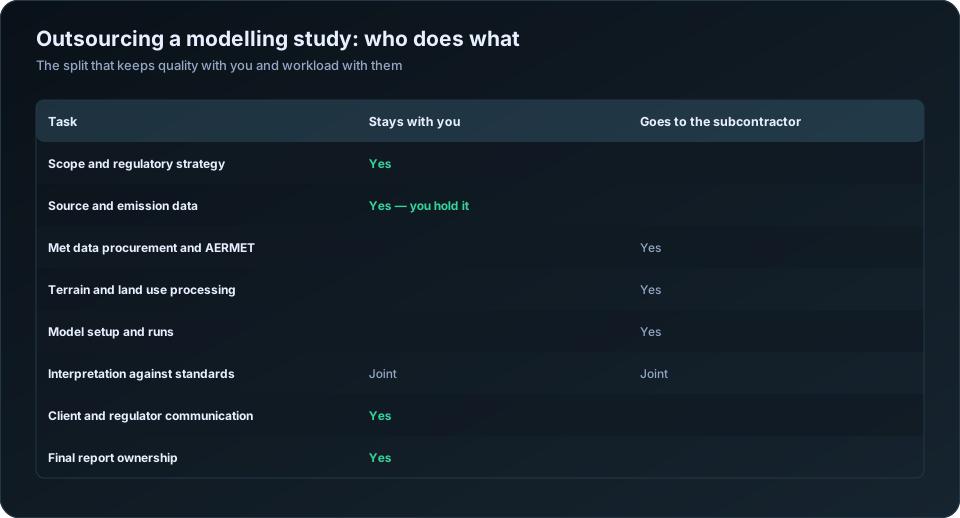
The split that keeps quality with you
Outsourcing goes wrong when the boundary is vague. This division works because it puts execution with the specialist and judgement with the person who answers to the client.
| Task | Stays with you | Goes to the subcontractor |
|---|---|---|
| Regulatory scope and strategy | Yes | |
| Source and emission data | Yes — you hold it | |
| Building layout and site plan | Yes | |
| Meteorological data procurement and AERMET | Yes | |
| Terrain, land use, AERMAP, AERSURFACE | Yes | |
| BPIP-PRIME and model configuration | Yes | |
| Model runs and iteration | Yes | |
| Post-processing, contour maps, receptor tables | Yes | |
| Interpretation against standards | Joint | Joint |
| Client and regulator communication | Yes | |
| Final report ownership | Yes |
The row that causes most friction is interpretation. A modeller can tell you the predicted 24-hour PM10 increment is 21 ug/m3. Whether that is acceptable depends on background, on the consent conditions, on what was committed at scoping and on how the regulator has treated comparable projects — context you hold and they do not. Treat interpretation as a conversation rather than a deliverable.
Writing the scope so the quote means something
| Specify | Example |
|---|---|
| Model required | AERMOD, with justification if CALPUFF is proposed instead |
| Pollutants | PM10, PM2.5, SO2, NO2 |
| Averaging periods | 24-hour and annual per NAAQS |
| Sources | 3 point sources, 2 area sources, haul road |
| Met data | 3 years, subcontractor to procure and justify the station |
| Receptor grid | 10 km domain, 100 m spacing to 2 km |
| Sensitive receptors | 6 named locations, coordinates supplied |
| Deliverables | Contour maps, receptor tables, technical report, all input files |
| Scenarios | Project alone, and project plus background |
| Revision rounds | Two, defined |
| Timeline | Draft in 15 working days from complete inputs |
Two clauses save the most trouble later. All input files delivered — without them you cannot answer a regulator's question, respond to a query, or run a variation without going back to the subcontractor. Timeline from complete inputs — this makes explicit that the clock starts when you have supplied everything, which is fair to both sides and prevents the argument about whose delay it was.
Handing over clean inputs
Delays in outsourced modelling are overwhelmingly caused by incomplete input packs. Assemble these before engaging:
| Item | Common gap |
|---|---|
| Stack height, inner diameter, exit velocity and temperature | Outer diameter supplied; height above MSL not grade |
| Emission rates with units and basis | mg/Nm3 given with no flow rate |
| Source coordinates and base elevations | Mixed projections, or plant-local coordinates |
| Building footprints and heights | Tiered buildings averaged to one height |
| Site plan with north arrow and scale | Missing scale |
| Operating hours and load profile | Assumed continuous when it is not |
| Applicable consent conditions | Not supplied at all |
| Sensitive receptor coordinates | Named but not located |
| Existing ambient monitoring | Held by a different team |
Send an input table with a units column and a source column for every value. A good subcontractor will query inconsistencies; the ones that do not query anything are the ones to worry about, because internal inconsistencies in stack data are common and someone should be catching them.
The QA checkpoint that prevents rework
Insert a mandatory checkpoint after inputs are loaded and before the full run. What you are checking:
| At the checkpoint | Confirm |
|---|---|
| Input echo | Every parameter as entered, against your source table |
| Met station chosen | With the justification for it |
| Data recovery | Stated per year |
| Surface characteristics | By sector and season |
| Receptor grid | Extent and spacing shown on a map |
| Buildings included | Which structures, and the BPIP output |
| A single test run | Contours that look physically sensible |
This costs perhaps two days and routinely saves two weeks. An error caught here is a corrected input; the same error found after the full run, mapping and drafting means redoing all of it. For subcontractors this checkpoint is also welcome, because it converts an ambiguous brief into a confirmed one.
Reviewing the deliverable
Review the output as a regulator would, not as a relieved client. The four-layer approach in how to QA/QC an air dispersion modelling report applies directly, and three checks matter most for outsourced work:
Reproduce two numbers yourself. Pick a receptor from the table and confirm you can trace it back through the output files. If you cannot, the traceability standard has not been met.
Compare against a screening estimate. AERSCREEN or a hand calculation should land within a factor of a few. An order-of-magnitude gap points to a unit error.
Check that the maximum is not on the grid boundary. If it is, the domain was too small and the study is incomplete regardless of everything else.
Building a relationship rather than a transaction
The economics of subcontracted modelling improve considerably with continuity. A partner who has run three of your studies knows your report format, your regulator's expectations, your review standards and your input conventions. The fourth study costs less and takes less of your time than the first.
Practical steps: use the same input template each time, keep a shared record of the queries that arose, agree a standard report structure, and give feedback after each project rather than only when something goes wrong. Where the volume justifies it, a retainer or framework agreement removes the per-project negotiation entirely — the arrangement described in scaling your consultancy with a white-label air modelling partner.
For expected timelines see turnaround time for outsourced AERMOD studies, and for the economics, how much does AERMOD modelling cost. Our AERMOD air dispersion modelling service works to the split and checkpoint described above.
Frequently Asked Questions
What should I keep in-house when outsourcing dispersion modelling?
Regulatory scope and strategy, all source and emission data, the site plan and building layout, communication with the client and regulator, and ownership of the final report. Interpretation of results against standards should be a joint conversation, not a handed-over deliverable.
What data do I need to supply to a modelling subcontractor?
Stack dimensions and exit conditions, emission rates with units and basis, source coordinates and elevations, building footprints and heights, a scaled site plan, operating hours, applicable consent conditions, sensitive receptor coordinates, and any existing ambient monitoring data.
Should I ask for the model input files?
Always, and it belongs in the contract. Without the input files you cannot answer a regulator's follow-up question, run a variation, or demonstrate reproducibility — and you are permanently dependent on the subcontractor for any change.
How do I check the quality of outsourced modelling work?
Reproduce two receptor values from the output files, compare the result against a screening estimate such as AERSCREEN, and confirm the maximum concentration falls inside the receptor grid rather than on its edge. Then apply a full four-layer review.
When should the QA checkpoint happen?
After inputs are loaded and before the full production run. Confirm the input echo against your source table, the met station and its justification, data recovery, surface characteristics, receptor grid and buildings — plus one test run. Two days here saves two weeks of rework.
How do I make sure the timeline is realistic?
Define it as working days from receipt of complete inputs, not from the date of engagement. That makes the dependency explicit, and it is the single clearest way to avoid a dispute about whose delay caused a missed date.
Need a modelling or EIA data desk without the overhead? DSTechnoverse works as a confidential, white-label subcontractor for air and water dispersion modelling and EIA data analysis. Get in touch to scope your next project.