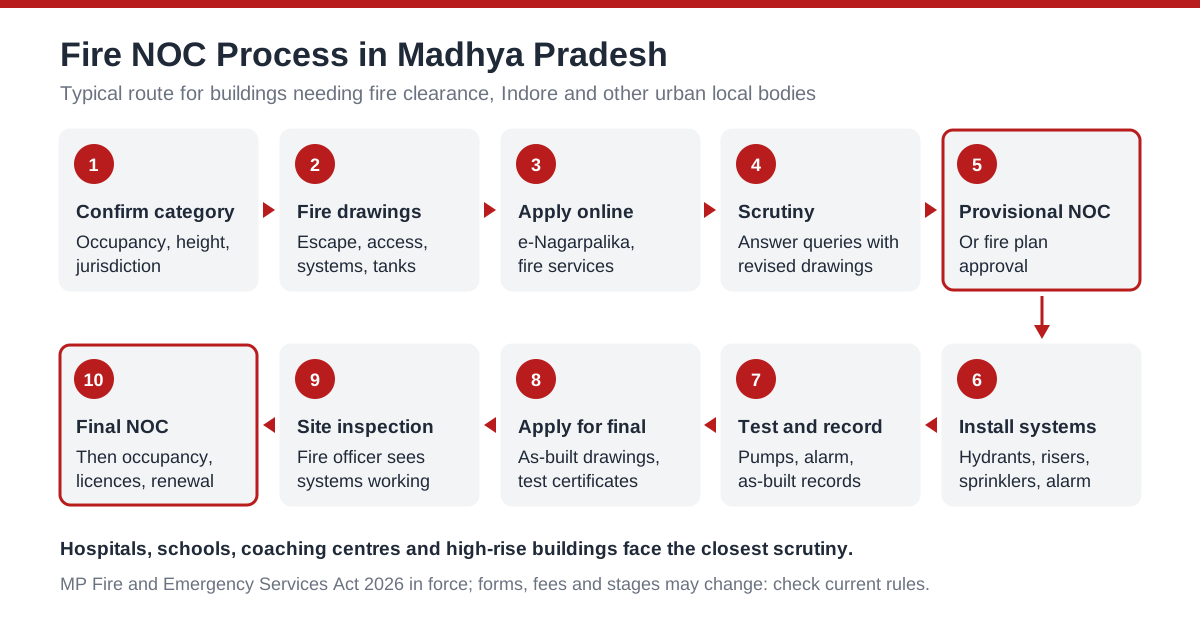
Quick answer: To get a fire NOC in Indore or anywhere in Madhya Pradesh, you apply to the fire department of your urban local body, usually online through the state's e-Nagarpalika portal. Buildings that need fire clearance typically go through two stages: a provisional NOC (or fire plan approval) at building permission stage, and a final NOC after the fire systems are installed and the fire officer has inspected the building. Hospitals, schools, high-rise and commercial buildings face the closest scrutiny, and the rules are being updated, so check the current requirements before you file.
Getting a fire NOC in Indore, Bhopal, Pithampur, Dewas, Ujjain or any other town in Madhya Pradesh follows a broadly common route, because fire services in the state are run largely through urban local bodies using shared rules and a shared online system. Yet applicants regularly lose weeks to avoidable problems: filing under the wrong building category, uploading drawings that do not match the sanctioned plans, or calling for an inspection before the pumps and alarm have been properly tested.
This guide explains the fire NOC Madhya Pradesh process step by step: who issues it, which buildings need it, how the online application on e-Nagarpalika works in outline, what the fire officer checks during inspection, how the process differs for hospitals and other sensitive occupancies, and what has been changing in state law. The detailed documents checklist and the renewal process have their own guides, which we link to rather than repeat.
Who Issues a Fire NOC in Madhya Pradesh
In Madhya Pradesh, fire services in towns and cities are primarily run by urban local bodies: municipal corporations, municipalities (nagar palika parishads) and nagar parishads. The fire department or fire branch of the local body reviews fire safety aspects of building plans, inspects buildings and issues fire NOCs. In Indore that is the fire department working under the Indore Municipal Corporation (IMC); in Bhopal it is the Bhopal Municipal Corporation; Ujjain, Dewas and other towns have their own municipal fire set-ups. Industrial areas such as Pithampur may involve the local body or the industrial development authority depending on location, so confirm which office has jurisdiction for your plot.
The technical standard behind decisions is a combination of:
- The National Building Construction Standards 2026 (NBCS 2026, SP 7:2026), Part F (Fire and Life Safety), which replaced NBC 2016 Part 4 from 30 April 2026. It classifies buildings into occupancy groups A (residential) to J (hazardous) and sets out escape and fire-fighting requirements by occupancy and height. NBC 2016 defined high-rise buildings as 15 m or more in height, and state rules, including the Madhya Pradesh Bhumi Vikas Rules, may still refer to the 2016 edition until they are updated.
- The Madhya Pradesh Bhumi Vikas Rules, 2012 (as amended), the state's development rules, which carry fire safety provisions for building permission.
- Relevant Indian Standards for each system, such as IS 2190 for the selection, installation and maintenance of portable extinguishers, IS 2189 for fire detection and alarm systems, and IS 15105 for sprinkler systems.
- State orders, circulars and guidelines on fire safety issued by the Urban Development and Housing Department from time to time.
Madhya Pradesh now also has a dedicated fire law: the Madhya Pradesh Fire and Emergency Services Act, 2026 (Madhya Pradesh Agnishaman Evam Apatkalin Sevayen Adhiniyam, Act 16 of 2026). The Act is in force, and rules under it are being notified, with general rules reportedly notified on 12 October 2026. Press coverage of the Bill described fire plan approval and a fire NOC as mandatory before construction of buildings that need them, a state-level fire and emergency services set-up, and penalties of up to ₹5 lakh for operating a building without a fire NOC. Forms, fees, validity periods and even the provisional and final stages described below may change as the rules take effect, while the Bhumi Vikas Rules 2012 and NBC continue to set the building requirements. We check each case against the rules in force at the time of application.
Which Buildings Need a Fire NOC in MP
Not every building needs a fire NOC. A single-family house on a small plot generally does not. Most buildings where many people gather, sleep, receive care, work with hazardous materials or are at height do. In practice in Madhya Pradesh, expect the following categories to need fire clearance, subject to the thresholds in the current rules.
| Building type | NBC occupancy group | Fire NOC usually needed? | Notes |
|---|---|---|---|
| High-rise residential (15 m and above) | A | Yes | Height drives wet riser, sprinkler and refuge requirements |
| Hotels, lodges, hostels | A | Yes, above threshold | Sleeping risk raises scrutiny |
| Schools, colleges, coaching centres | B | Yes, above threshold | Coaching centres have faced enforcement drives |
| Hospitals, nursing homes, clinics with beds | C | Yes | Close scrutiny; health registration depends on it |
| Cinemas, banquet halls, auditoriums | D | Yes | Occupant load and exits are critical |
| Offices and business buildings | E | Yes, above threshold | Height and area driven |
| Malls, showrooms, large shops | F | Yes, above threshold | Basements and storage add requirements |
| Factories and workshops | G | Yes, typically | Process hazard decides systems |
| Warehouses and storage | H | Yes, typically | Storage height and commodity matter |
| Hazardous occupancies | J | Yes | Specialised suppression often needed |
"Above threshold" means the requirement is triggered by height, built-up area, number of floors or occupant load as defined in the state rules. Thresholds have been revised over the years and may change under the 2026 Act and its rules, so confirm the trigger for your building category with the fire department or a fire consultant. The fire safety requirements by building type guide explains which systems NBC requires for each group.
Provisional and Final Fire NOC in MP
Buildings that need fire clearance in Madhya Pradesh have traditionally gone through two stages.
- Provisional fire NOC at the building permission stage, based on drawings and the proposed fire-fighting arrangements.
- Final fire NOC after construction, once the fire systems are installed, tested and inspected on site, and before the building is occupied or the occupancy certificate is issued.
These stages may change under the Madhya Pradesh Fire and Emergency Services Act, 2026 and the rules being notified under it. News reports have also described plans to phase out the provisional NOC for institutional buildings, especially hospitals, in favour of an approved fire plan, and a state directive requiring fire plan approval for buildings of 15 m and above and for hospitals and hotels; treat both as reported items until confirmed in the current rules. Treat any older provisional NOC as a design-stage approval only, and check the current rules on what your building now needs. The provisional vs final fire NOC guide explains the two stages in depth.
The Fire NOC Process in Indore and MP, Step by Step
The process below describes the typical route for a building that needs fire clearance. Menu names, form titles and sequence on the portal change from time to time, so treat this as an outline and check the current portal screens.
Step 1: Confirm Category, Height and Jurisdiction
Before anything else, fix three facts: the occupancy group of the building under NBC, the building height measured as the rules define it, and the local body (and fire office) that has jurisdiction. A large share of avoidable delay comes from applications filed under the wrong category or with a height figure that differs from the building permission drawings.
Step 2: Prepare Fire Drawings and Design Basis
A fire consultant or engineer prepares the fire-fighting layout on the architectural plans: escape routes, staircases, fire tender access, compartmentation, and each system required for the occupancy and height (extinguishers, hose reels, wet riser or downcomer, yard hydrants, sprinklers, detection and alarm, public address, exit signage, emergency lighting, pump room and fire water storage). The drawings must match the plans submitted for building permission.
Step 3: Register and Apply Online on e-Nagarpalika
For e-Nagarpalika fire NOC applications, the applicant registers on the state's e-Nagarpalika portal, selects the urban local body, and opens the fire services section to file the fire NOC application for the relevant stage. The form captures owner and property details, building use, height, floors and areas, and asks for the drawings and supporting documents to be uploaded. Fees, where applicable, are paid online. An application or request number is generated; keep it, as it is used to track status. If the portal does not accept your building category or stage, contact the local body's fire office directly rather than filing under a different category.
Step 4: Scrutiny and Queries
The fire department reviews the drawings and documents. Queries are common: an escape route that discharges through a lobby, a missing pump room section, an access road that does not show turning space, or a mismatch between declared and drawn heights. Responding quickly and with revised drawings, rather than explanations, keeps the file moving.
Step 5: Provisional NOC or Fire Plan Approval
If the design is acceptable, the provisional fire NOC (or the equivalent approval under the current rules) is issued, often with conditions. These conditions are effectively the checklist for the final inspection, so circulate them to the architect, contractor and fire installer.
Step 6: Construction and Installation
During construction the fire contractor installs the approved systems. Pipework is pressure tested before concealment, pumps and valves are installed in the pump room, the alarm system is wired and programmed, and extinguishers and signage are placed. Any change to height, floors, layout or use should be assessed for fire impact and, where needed, approved before it is built. See fire fighting system installation for what a complete installation involves.
Step 7: Testing, Commissioning and Records
Before calling for inspection, run full tests: pump auto start and pressure at the highest and remotest outlets, hose reel and landing valve operation, sprinkler flow tests, alarm device-by-device tests, fire door closing, emergency lighting on battery. Compile test certificates, commissioning reports and as-built drawings in one file.
Step 8: Apply for the Final Fire NOC
File the final fire NOC application on the portal with the as-built drawings, test records and the reference of the earlier approval. Documents typically include ownership and building permission references, drawings, system test certificates and an undertaking about maintenance; the full list depends on the building and is set out in our fire NOC documents required guide.
Step 9: Site Inspection by the Fire Officer
The fire officer visits, compares the building with the approved drawings, walks the escape routes, and has the systems demonstrated. Deficiencies are recorded, and you may be asked to rectify and request re-inspection.
Step 10: NOC Issue, Occupancy and Ongoing Compliance
Once satisfied, the department issues the final fire NOC, which can usually be downloaded from the portal. This then supports the occupancy or completion certificate and licences from other departments. From here, maintenance, records and renewal are the owner's responsibility.
What the Fire Officer Checks During Inspection
The inspection is where most of the effort before it pays off. Inspectors in Indore and elsewhere in MP generally look at the following.
| Area | What is checked | Common failure |
|---|---|---|
| Plans vs building | Floors, height, layout, use match approval | Extra floor, enclosed parking, change of use |
| Access | Fire tender approach, setbacks clear | Setbacks used for parking, sheds or ramps |
| Escape routes | Staircases clear, fire doors self-closing, exit signs and emergency lights working | Stair storage, wedged fire doors, dead batteries |
| Pumps | Main, standby diesel and jockey pumps start and hold pressure | Low pressure at top floor, weak diesel battery |
| Hydrants and risers | Landing valves, hoses, branch pipes, couplings | Missing hoses, leaking valves |
| Sprinklers | Coverage, control valves, flow test | Heads blocked by false ceilings or ducts |
| Detection and alarm | Devices respond, panel identifies location, sounders audible | Unprogrammed devices, panel faults |
| Extinguishers | Type, rating, location, refill and test dates | Wrong type near electrical panels, expired refills |
| Water storage | Fire reserve available and protected | Fire reserve shared with domestic draw-off |
| Records | Test certificates, as-built drawings, maintenance arrangement | Missing paperwork |
Our service pages for hydrants and wet risers, sprinklers, fire alarms and extinguishers cover how each system is installed and tested so it is ready for inspection.
Fire NOC for Hospitals in Indore and MP
Hospitals and nursing homes deserve their own section, because they are where fire NOC enforcement in Madhya Pradesh has been most visible. After hospital fires in the state, including the August 2022 fire at a private hospital in Jabalpur that prompted wider reviews, authorities ran inspection drives and health departments asked private hospitals to produce valid fire NOCs. News reports from Indore described the district administration and health officials issuing notices and deadlines to private hospitals without fire NOCs, and state-level reports described the suspension of registration of private hospitals and nursing homes that did not comply with fire safety norms. The Madhya Pradesh High Court has also heard matters on hospital fire safety and building permission in Indore.
For a fire NOC for a hospital in Indore, expect these points to matter more than for an ordinary commercial building.
- Patient evacuation. Bed-bound and ICU patients cannot use stairs quickly. Horizontal compartmentation, protected lobbies, bed lifts and staff evacuation plans receive close attention.
- Detection and alarm. Addressable detection that pinpoints the device location is common in hospitals because staff must find the fire fast; see our fire alarm system types guide.
- Sprinklers. Most hospital buildings of any size will need automatic sprinklers; coverage above false ceilings and in service areas is checked.
- Medical gases and electrical risk. Oxygen manifold rooms, medical gas pipelines, UPS rooms and electrical panels need appropriate separation and suitable extinguishers or suppression. See fire suppression systems.
- Kitchens and laundries. Hospital kitchens often need kitchen suppression; laundries carry lint and heat risks.
- Converted buildings. Many smaller hospitals in Indore operate in buildings designed as residential or commercial. These often lack a second staircase, adequate exit widths or space for a pump room, and need a structured gap assessment before an application.
- Linked registrations. Health department registration and renewal typically ask for a valid fire NOC, so a lapse can affect the hospital's ability to operate.
A pre-application fire safety audit is particularly valuable for existing hospitals, because it identifies structural limitations early and lets the owner discuss alternative measures with the fire authority before investing in equipment.
Indore Municipal Corporation Fire NOC: Local Notes
For an Indore Municipal Corporation fire NOC, a few local points are worth knowing.
- Building permission and fire clearance run together. IMC processes building permission online through the state portal, and buildings that need fire clearance must have it addressed at plan stage. Make sure the plans uploaded for building permission and those used for fire clearance are identical.
- Enforcement is active. IMC has sealed buildings and imposed fines for fire safety violations in recent drives, and commercial buildings, coaching centres and hospitals have received notices. Operating without a valid NOC is a real business risk, not a paperwork technicality.
- Older commercial stock. Indore's older commercial areas include many buildings constructed before current fire rules applied, or extended later. These often need retrofit of wet risers, alarms and exit routes before a final NOC is possible.
- Industrial belt. Pithampur, Sanwer Road and Dewas industrial areas involve factories and warehouses where process and storage hazards drive requirements, and jurisdiction may sit with a different authority from IMC.
Worked Example: A Commercial-Cum-Coaching Building in Indore
The example below is illustrative. Figures are invented to show the process and are not rules for any specific building.
The building. An existing ground plus four storey commercial building in Indore, about 17 m tall, with shops on the ground floor, offices on the first floor and coaching classrooms on floors two to four. It was built some years ago with a single staircase and has only portable extinguishers. The owner receives a notice during a fire safety drive asking for a valid fire NOC.
Step 1: Category and gaps. The building is above 15 m, so it is high-rise for NBC purposes, and the coaching floors are educational occupancy with a high occupant load. A gap assessment finds: one staircase where two are needed, no wet riser or hose reels, no detection and alarm, no fire water storage or pump, exit signage missing, and setbacks partly used for parking.
Step 2: Remediation plan. The fire consultant and architect develop a plan: an external fire escape staircase meeting the rules, a wet riser with landing valves and hose reels, an underground fire tank and pump room in the rear setback, an addressable alarm system with manual call points, exit signs and emergency lighting, and extinguishers matched to each risk area. Parking in the access route is relocated. Because adding a staircase changes the building, the architect checks what approvals are needed for the structural addition.
Step 3: Application. With drawings ready, the owner applies through e-Nagarpalika under the correct category, attaching the drawings and a statement of the works planned. The fire department raises a query on the width of the new staircase and the tank capacity, which is answered with revised drawings.
Step 4: Installation and testing. The works are carried out. Before the inspection request, the team tests the pump auto start, records pressure at the top-floor landing valve, tests every alarm device, and runs emergency lighting on battery for the required duration. Two issues are found and fixed: a classroom detector is mislabelled on the panel and an exit sign on the third floor is obscured by a banner.
Step 5: Inspection and NOC. The fire officer inspects, runs the pump, operates a manual call point and checks both staircases. The final NOC is issued. The owner signs an annual maintenance contract and schedules quarterly checks and an annual evacuation drill for the coaching floors.
The example shows how an existing building moves from a notice to a valid fire NOC: assess, design, apply, install, test, inspect. It also shows that the hardest items, a second escape route and space for water storage, are building issues, not equipment issues.
Owner Responsibilities After the NOC Is Issued
A fire NOC is a snapshot of the building on the day of inspection. Keeping it valid in practice is the owner's or occupier's job, and inspectors in Madhya Pradesh increasingly check what happens after the certificate is issued. At a minimum, plan for the following:
- Routine testing. Run fire pumps weekly, test alarm devices on a rotating schedule, and check hose reels, landing valves and sprinkler control valves periodically.
- Extinguisher upkeep. Keep refilling and pressure testing up to date and replace units that are damaged or past their service life.
- Records. Maintain a log of tests, faults and repairs, signed by whoever carried them out. These records are what you show at renewal or during a surprise inspection.
- People. Nominate a responsible person, train staff in using extinguishers and raising the alarm, and hold evacuation drills.
- Change control. Before altering layouts, adding floors or changing use, check the fire impact with a consultant.
An annual maintenance contract is the usual way to cover the technical side, while training and drills stay with the management.
Documents and Renewal: Summary
Documents. A typical fire NOC file in MP includes the applicant's identity and ownership or lease documents, the building permission reference or sanctioned plans, site plan, floor plans, sections and elevations, the fire-fighting layout, pump room and water storage details, and, for the final stage, test certificates, commissioning records and as-built drawings, plus any affidavit or undertaking the authority prescribes. The full checklist by building type and stage is in our fire NOC documents required guide.
Renewal. Final fire NOCs are issued for a fixed period that depends on the occupancy and current rules, and must be renewed before expiry. Renewal involves showing that systems are maintained and working, usually with fresh test records and sometimes a re-inspection. The fire NOC renewal guide covers timelines, documents and common issues.
Fees, Timelines and Validity
Fire NOC fees, processing timelines and validity periods in Madhya Pradesh depend on the building category and the rules in force, and different sources give conflicting figures. We do not quote numbers here because they are set by the authority and are confirmed per building; check current rules on the portal or with the fire office. The Madhya Pradesh Fire and Emergency Services Act, 2026 and the rules being notified under it may also change fees, introduce new charges or change how approvals are structured. What you can control is the completeness of your file and the readiness of your systems, which together decide whether the process takes one inspection or three.
Fire NOC Online in MP: Practical Tips
These tips come from the common causes of delay in fire NOC online MP applications.
- Use one set of drawings. The plans for building permission, fire clearance and as-built must reconcile. Version mix-ups cause queries.
- Declare height carefully. Use the definition in the rules. A difference of half a metre around the 15 m mark changes the requirements.
- Name every system on the drawings. Do not rely on notes such as "as per NBC". Show the riser, valves, pump room, tanks, alarm panel and devices.
- Keep scanned files legible. Upload readable drawings at a sensible scale and size.
- Track the request number. Check status regularly and respond to queries promptly.
- Test before you request inspection. A failed inspection resets the clock.
- Prepare the site. Clear staircases and setbacks, label valves and panels, and have someone who knows the systems present.
- Plan for maintenance. Inspectors ask who maintains the systems. A maintenance arrangement in place helps.
Fire NOC in Other Cities of Madhya Pradesh
The process for Bhopal, Ujjain, Dewas, Jabalpur, Gwalior and smaller towns follows the same structure, because it runs through urban local bodies on the same state platform and the same rules. Differences you may notice are local: the officer's inspection practice, the availability of fire officers for smaller towns, and local enforcement priorities. Industrial plots in development authority areas may follow a different office. Outside Madhya Pradesh, each state has its own fire services law and portal, so the steps here are a guide to the logic rather than the forms.
How DSTechnoverse Helps
DSTechnoverse is based in Indore and manages fire NOC work across Madhya Pradesh, including Pithampur, Dewas, Ujjain and Bhopal. Our fire NOC and installation work is led by Mohit Malviya, our accredited fire engineer. We prepare fire drawings, file on e-Nagarpalika and answer queries. We also design, install, test and commission hydrants, sprinklers and alarms, and we liaise with the fire department until it issues the NOC after its own inspection. Start with our Fire NOC service, a fire safety audit or contact us.
Frequently Asked Questions
How do I apply for a fire NOC in Indore?
Applications for a fire NOC in Indore are generally made online through the Madhya Pradesh e-Nagarpalika portal, selecting Indore Municipal Corporation and the fire services section. You upload building details, fire drawings and supporting documents, pay any applicable fee, and track the request number. For buildings needing fire clearance, the provisional stage runs with building permission and the final stage follows installation and inspection.
Who issues the fire NOC in Madhya Pradesh?
In towns and cities, the fire department or fire branch of the urban local body issues fire NOCs: municipal corporations such as Indore and Bhopal, and municipalities and nagar parishads elsewhere. Industrial areas may involve other authorities. The Madhya Pradesh Fire and Emergency Services Act, 2026 is now in force with rules being notified, and it may change which office handles your application, so check the current rules for your location.
Is the fire NOC application in MP fully online?
The application, document upload, fee payment where applicable, and status tracking are generally handled online through e-Nagarpalika. The process still includes physical inspection of the building by a fire officer before the final NOC is issued, and sometimes a site visit at plan stage. If the portal does not show your building category or stage, contact the fire office before filing under another category.
Does a hospital in Indore need a fire NOC?
Yes, hospitals and nursing homes are among the buildings most closely checked in Madhya Pradesh. Health department registration and renewal usually require a valid fire NOC, and authorities in Indore have issued notices and deadlines to hospitals without one. Hospitals face extra scrutiny on patient evacuation, compartmentation, detection, sprinklers, medical gas areas and electrical rooms, so plan a gap assessment before applying.
What happens if a building in MP operates without a fire NOC?
Buildings without a required fire NOC can face notices, fines, sealing and loss of other licences or registrations. Indore Municipal Corporation has sealed buildings in enforcement drives, and hospitals have lost registration elsewhere in the state. Under the Madhya Pradesh Fire and Emergency Services Act, 2026, penalties were reported at up to ₹5 lakh for operating without a fire NOC. Beyond penalties, the main risk is to occupants and to insurance cover after a fire.
How long does it take to get a fire NOC in Madhya Pradesh?
Timelines depend on the building category, completeness of the file, number of queries and inspection scheduling, and official service timelines may change under the 2026 Act and its rules. Check current rules. In practice the biggest delays come from incomplete drawings, mismatches with sanctioned plans, and failed inspections. Testing all systems and compiling records before requesting the inspection usually saves more time than anything else.
Is a provisional fire NOC still required in MP?
Provisional NOCs at building permission stage have been part of the MP process for years. The Madhya Pradesh Fire and Emergency Services Act, 2026 is now in force with rules being notified, so the stages may change. Reports have also described a phase-out of provisional NOCs for institutional buildings such as hospitals. Check the current rules for your category, and never treat a provisional NOC as permission to occupy.
Can an existing building without fire systems get a fire NOC?
Often yes, but only after a gap assessment and upgrade works. Typical retrofits include wet risers, hose reels, alarms, exit signage, emergency lighting, extinguishers and fire water storage. Harder issues are structural, such as a missing second staircase or no space for a tank and pump room, and may need architectural changes. A fire safety audit before applying clarifies what is achievable.
Does the fire NOC need to be renewed?
Yes. Final fire NOCs are valid for a set period that depends on the occupancy and current rules, and must be renewed before they lapse. Renewal normally needs evidence that systems are maintained and working, such as test and maintenance records, and may involve re-inspection. Our renewal guide covers the process in detail and the common reasons renewals are delayed.
Need a Fire NOC or a fire safety installation? DSTechnoverse handles provisional and final Fire NOC applications and renewals, and designs, supplies, installs and commissions fire fighting systems: hydrants, sprinklers, fire alarms, extinguishers and suppression systems. Work is led by Mohit Malviya, our accredited fire engineer, from our base in Indore, Madhya Pradesh. Talk to our team.
Related services
Related articles
- Documents Required for Fire NOC: Complete Checklist by Stage and Building Type
- Fire Alarm System Types: Conventional vs Addressable, Detectors and IS 2189
- Fire NOC Renewal Guide: Validity, Documents, Testing and Expired NOCs
- Fire Safety Requirements for Buildings: NBC Occupancy Groups, Height and Systems by Building Type