
One of the most under-appreciated effects in air dispersion modelling is building downwash — and ignoring it is a frequent reason near-source concentrations get badly under-predicted. The tool that handles it is BPIP-PRIME.
What building downwash is
When wind hits a building, it creates a turbulent wake on the downwind side — a zone of recirculating, cavity-like flow. If a stack releases its plume into or near that wake, the building can drag the plume down toward the ground much sooner than it otherwise would. The result: higher concentrations close to the source, exactly where people often are.
When it matters
Downwash becomes significant when:
- The stack is short relative to nearby buildings — a common rule of thumb flags stacks shorter than about 2.5 times the height of an adjacent building
- Buildings are close to the stack (within a few building heights)
- The plume does not have enough momentum or buoyancy to escape the wake
For a tall, isolated stack on open ground, downwash is usually negligible. For a modest stack among process buildings, it can dominate the near-field result.
What BPIP-PRIME does
BPIP (Building Profile Input Program) with the PRIME algorithm takes the dimensions and positions of nearby buildings and the stack, then calculates direction-specific building parameters. These describe, for each wind direction, the effective building dimensions that influence the plume. AERMOD reads those parameters and adjusts dispersion accordingly.
The inputs it needs:
- Building heights, footprints, and locations
- Stack location and height
- All coordinates in a consistent system
The practical workflow
- Identify every structure tall or close enough to matter
- Digitise their dimensions and positions
- Run BPIP-PRIME to generate direction-specific parameters
- Feed those into the AERMOD control file
- Confirm the near-source concentrations now reflect the wake effect
Why it is easy to get wrong
Downwash analysis depends on accurate building geometry and correctly identifying which structures are relevant. Omit a nearby building and you understate impacts; include the geometry wrong and you distort them. This is detailed, spatial work — and precisely the kind of step a dedicated modelling desk never skips.
The Good Engineering Practice rule
The question of whether downwash matters has a formal answer. GEP stack height is the height above which a stack is considered tall enough to escape the aerodynamic wake of nearby structures.
The rule of thumb is that a stack should be at least 2.5 times the height of a nearby influencing building, or, using the more complete form, the building height plus 1.5 times the lesser of building height or projected width.
| Situation | Downwash treatment |
|---|---|
| Stack taller than GEP height | Downwash generally not significant |
| Stack below GEP height, buildings within 5L | Must run BPIP-PRIME |
| No structures within 5L of the stack | Not applicable |
| Stack on top of a building | Almost always significant |
| Short vent or roof stack | Almost always significant |
Here L is the lesser of the building height or its maximum projected width. The 5L radius is the practical screening distance: structures beyond it are unlikely to influence the plume, structures within it must be assessed.
The physics is straightforward. Air flowing over and around a building forms a turbulent cavity and wake downstream. A plume released into that region is captured, mixed rapidly downward, and brought to ground close to the source at concentrations that can be several times what an undisturbed plume would produce. This is why downwash almost always increases predicted concentrations, and why omitting it is not a conservative simplification.
What BPIP-PRIME calculates
BPIP-PRIME does not simulate airflow. It computes, for each of 36 wind direction sectors in 10-degree increments, the direction-specific building dimensions that AERMOD's PRIME algorithm needs.
| Output per sector | Meaning |
|---|---|
| Building height | The height of the controlling structure for that wind direction |
| Projected width | The width the building presents to the wind from that direction |
| Projected length | The along-wind dimension |
| Along-flow and across-flow offsets | Stack position relative to the building |
The direction dependence is the point. A rectangular building 60 m by 20 m presents a 60 m face to wind from one direction and a 20 m face from the perpendicular direction. The wake is very different in each case, and so is the effect on a stack sitting beside it.
When multiple structures are present, BPIP identifies which one controls for each wind direction, and can combine adjacent structures into a single effective building where they act aerodynamically as one.
Preparing building inputs
| Input | Requirement |
|---|---|
| Building footprint corners | Coordinates in the same projection as sources and terrain |
| Building height | Above the same base elevation as the stack |
| Tiered structures | Entered as separate tiers, not an average height |
| Which structures to include | All within 5L of any modelled stack |
| Stack coordinates | Exact position, in the same coordinate system |
| Stack base elevation | Consistent with the building base |
Two things go wrong regularly.
Mixed coordinate systems. Building corners taken from a site plan in local plant coordinates, with stacks in UTM, places the buildings kilometres from the stack. BPIP runs, produces output showing no influence, and the study reports no downwash. Everything must be in one projection.
Averaging tiered buildings. A boiler house with a 30 m main structure and a 45 m section should be entered as two tiers. Averaging to 37 m misrepresents the wake, and AERMOD's PRIME algorithm is designed to handle tiers properly.
Include tanks, silos, cooling towers and material handling structures — not just buildings in the ordinary sense. Anything solid and substantial within 5L affects the flow.
Design implications
Because downwash effects are so strong, they belong in the design conversation rather than only in the assessment.
| Option | Effect |
|---|---|
| Raise the stack above GEP height | The cleanest solution; escapes the wake entirely |
| Move the stack away from the structure | Beyond 5L, the effect disappears |
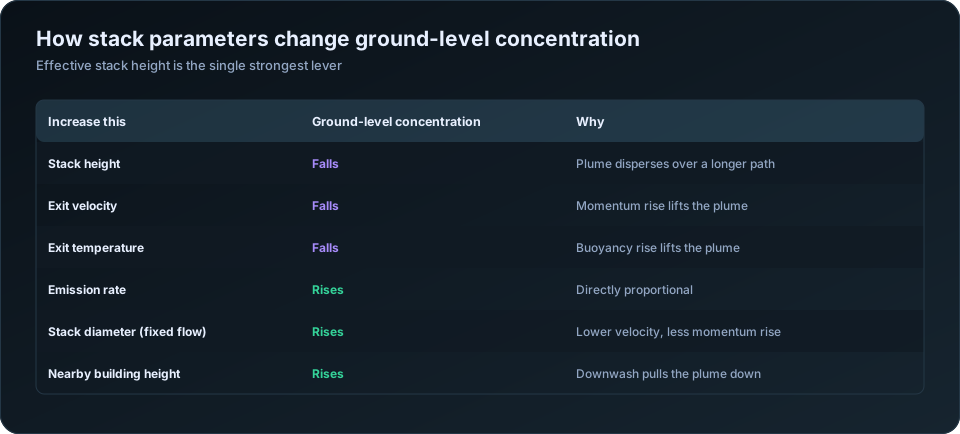
| Increase exit velocity | More momentum rise; may lift the plume clear |
| Reduce building height | Rarely feasible, but changes GEP |
| Combine multiple small stacks | A single taller stack often outperforms several short ones |
Raising the stack is usually the most effective and often surprisingly cheap relative to the alternatives, particularly if identified during design rather than after a modelling study returns exceedances.
Note the interaction with exit velocity. A plume with strong momentum can punch through the wake region; a low-velocity plume from a short stack beside a tall building is the worst case. This is why the stack parameters and building geometry have to be assessed together rather than separately — see the AERMOD input data checklist.
Checking that downwash was handled
| Check | What to confirm |
|---|---|
| BPIP-PRIME output file present | Or a written justification for its absence |
| All structures within 5L included | Cross-check against the site plan |
| Coordinate system consistent | Buildings, stacks and terrain in one projection |
| Tiers entered separately | Not averaged |
| Maximum concentration location | Close to the stack suggests downwash is active |
| Comparison run without downwash | Documents the magnitude of the effect |
The last row is worth doing even though it is not required. Running the model with and without downwash quantifies its contribution, and a report that states "including building downwash raised the predicted 24-hour maximum from 18 to 41 ug/m3" demonstrates the analysis was done properly and pre-empts the question.
For the errors that most often fail review, see 10 common AERMOD modelling mistakes; for terrain handling, terrain and land use in AERMOD. Our AERMOD air dispersion modelling service runs BPIP-PRIME on every study with structures present. The US EPA BPIP-PRIME user guide documents the input format and GEP determination.
Frequently Asked Questions
What is building downwash in air dispersion modelling?
The capture of a plume in the turbulent wake formed downwind of a building or structure. Instead of dispersing normally, the plume is mixed rapidly toward the ground close to the source, producing much higher local concentrations than an undisturbed plume.
When do I need to run BPIP-PRIME?
Whenever structures lie within five times L of a modelled stack, where L is the lesser of the structure's height or its maximum projected width, and the stack is below GEP height. Stacks on rooftops and short vents almost always require it.
What is GEP stack height?
Good Engineering Practice stack height — the height at which a stack escapes the aerodynamic influence of nearby structures. The common rule of thumb is 2.5 times the height of the influencing building, or building height plus 1.5 times the lesser of height or projected width.
Does building downwash increase or decrease concentrations?
It almost always increases them, often substantially, by bringing the plume to ground much closer to the source. Omitting downwash is therefore not a conservative simplification — it understates impact.
Which structures should be included in BPIP?
Every solid structure within 5L of a modelled stack, including tanks, silos, cooling towers and material handling structures, not only conventional buildings. Tiered buildings must be entered as separate tiers rather than averaged to a single height.
How can building downwash be avoided in design?
Raise the stack above GEP height, relocate it beyond 5L from the influencing structure, or increase exit velocity so the plume has enough momentum to clear the wake. Raising the stack is usually the most effective and is far cheaper if identified during design.
Need a modelling or EIA data desk without the overhead? DSTechnoverse works as a confidential, white-label subcontractor for air and water dispersion modelling and EIA data analysis. Get in touch to scope your next project.