
"How fast can you turn this around?" is the first question most consultancies ask a modelling subcontractor. The honest answer: the model run is quick — it is everything around it that sets the timeline. Here is what actually drives turnaround, and a realistic schedule.
The model run is not the bottleneck
A configured AERMOD run finishes in minutes to hours. What takes time is the work on either side of it: assembling inputs, processing meteorology and terrain, QA, and reporting. Understanding this reframes how you manage the deadline.
What drives turnaround
- Input completeness. A verified data package on day one is the single biggest accelerator. Missing stack parameters stall everything.
- Meteorological data. If representative processed met data already exists for the area, you save days. If it must be sourced and run through AERMET, add time.
- Complexity. A single point source on flat terrain is fast. Multiple sources, complex terrain, building downwash, and cumulative scenarios each add effort.
- Standards and receptors. More pollutants, averaging periods, and sensitive receptors mean more analysis and reporting.
- Revisions. Regulator queries after submission extend the overall timeline, even if each response is quick.
A realistic timeline
For a standard single-source study with a complete input package, a dedicated desk can typically deliver a draft in a handful of working days. More involved studies — complex terrain, multiple sources, cumulative assessment — run one to a few weeks depending on scope.
Rush turnarounds are possible when inputs are clean and the scope is fixed, but genuine quality cannot be compressed indefinitely — QA takes the time it takes.
How to get the fastest turnaround
- Send a complete, verified input package up front (use an input checklist)
- Fix the scope before work starts — mid-study changes reset the clock
- Approve the inputs review promptly so modelling can proceed
- Batch your feedback into a single consolidated review
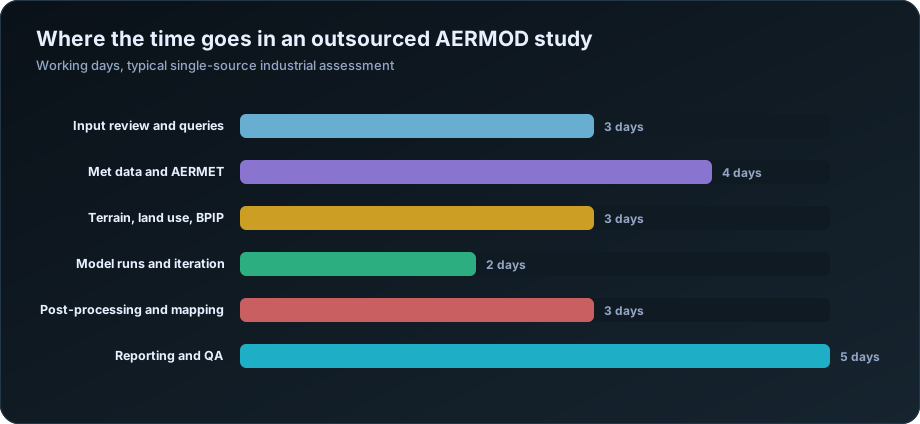
Where the days actually go
The model run itself takes minutes to hours. Everything around it takes weeks, and knowing the distribution lets you plan properly.
| Stage | Working days | What it involves |
|---|---|---|
| Input review and queries | 2 to 4 | Checking supplied data, resolving inconsistencies |
| Meteorological data and AERMET | 3 to 6 | Procurement, quality audit, three-stage processing |
| Terrain, land use, BPIP | 2 to 4 | AERMAP, AERSURFACE, building geometry |
| Model configuration and runs | 1 to 3 | Setup, execution, iteration |
| Post-processing and mapping | 2 to 4 | Statistics extraction, contour maps, receptor tables |
| Reporting and QA | 4 to 7 | Drafting, independent review, corrections |
| Total | 14 to 28 | For a standard single-facility study |
Meteorological data is the largest genuinely variable item. If a suitable dataset is already held and processed, this stage is two days. If it must be requested from IMD, or a procurement decision is pending, it can stretch to weeks — and that wait is entirely outside the modeller's control.
What changes the total
| Factor | Effect on schedule |
|---|---|
| Met data already processed for the site | −4 to 6 days |
| Met data must be procured from IMD | +5 to 20 days |
| Fugitive and area sources to inventory | +3 to 6 days |
| Multiple scenarios required | +1 to 2 days each |
| Cumulative assessment, neighbouring sources | +5 to 15 days |
| CALPUFF rather than AERMOD | +10 to 20 days |
| Incomplete inputs at the start | +5 to 15 days |
| Client review cycles | +3 to 10 days each |
| Water or noise modelling added | +5 to 10 days |
Two of these are worth dwelling on.
Incomplete inputs are the single largest avoidable delay, and they are avoidable. The pattern is familiar: the study begins, the modeller queries a stack diameter, the query goes to the client, the client goes to the plant, the plant goes to the design consultant, and eleven days pass. Meanwhile the modeller has moved on to other work and needs to reschedule.
Cumulative assessment slows things for a reason that surprises people: the modelling is straightforward, but obtaining emission data for neighbouring facilities from consent filings and clearance documents is slow, uncertain administrative work. Budget for it separately.
Compressing the timeline legitimately
| Action | Days saved |
|---|---|
| Supply a complete, verified input table upfront | 5 to 15 |
| Procure meteorological data before engaging | 5 to 20 |
| Nominate one person to answer queries | 3 to 8 |
| Agree the report template in advance | 2 to 4 |
| Confirm the receptor grid and scenarios at the start | 2 to 5 |
| Book capacity ahead of the input pack being ready | 3 to 7 |
| Run the QA checkpoint promptly | 2 to 5 |
The first two are worth more than everything else combined. A client who arrives with verified stack parameters, emission rates with a stated basis, building geometry and a met dataset already in hand can realistically expect a draft in twelve to fifteen working days. The same study with inputs trickling in over three weeks takes six weeks regardless of who runs it.
Nominating a single point of contact matters more than it sounds. Queries routed through a project manager to a plant engineer to a design consultant take days each; a nominated engineer who can answer directly turns each query around in hours.
What cannot be compressed
Being honest about this prevents the wrong kind of pressure.
Meteorological processing. AERMET's three stages require a full year of data to be audited and processed. There is no fast version, and shortcuts here compromise the entire study.
Independent QA. The review must be done by someone who did not run the model, and it takes the time it takes. Cutting review is where errors reach the regulator, and a re-run after rejection costs four to six weeks against the two days saved.
Regulatory review itself. Once submitted, the appraisal timeline is not yours to manage. This is the strongest argument for starting modelling early rather than fast.
Planning modelling into an EIA schedule
Modelling depends on inputs that arrive late in an EIA — final stack design, confirmed emission rates, site layout — and feeds a chapter needed before submission. That combination is what puts it on the critical path.
| Milestone | Recommended timing |
|---|---|
| Confirm modelling scope | At ToR stage |
| Procure meteorological data | Immediately after ToR |
| Freeze stack design and emission rates | 8 weeks before submission |
| Engage the modeller | 7 weeks before submission |
| QA checkpoint | 5 weeks before submission |
| Draft results | 4 weeks before submission |
| Final report | 2 weeks before submission |
Procuring meteorological data straight after the Terms of Reference are issued is the highest-value scheduling decision available. It is the longest lead-time item, it does not depend on final plant design, and having it processed and waiting removes the largest source of schedule risk from the whole exercise.
For getting the input pack right first time see the AERMOD input data checklist and how to outsource air dispersion modelling; for the cost side, how much does AERMOD modelling cost. Our AERMOD air dispersion modelling service quotes turnaround from receipt of complete inputs.
The bottom line
Outsourcing does not just add capacity — it adds predictable capacity. A partner who models daily can commit to a timeline and hit it, precisely because their workflow is built for throughput. Give them clean inputs and a fixed scope, and turnaround stops being a gamble.
Frequently Asked Questions
How long does an AERMOD study take?
Fourteen to twenty-eight working days for a standard single-facility assessment, measured from receipt of complete inputs. The model run itself takes minutes; meteorological processing, terrain preparation, post-processing and reporting account for the rest.
What causes delays in dispersion modelling projects?
Incomplete input data is the largest cause, followed by meteorological data procurement, slow query resolution when no single point of contact is nominated, and cumulative assessments requiring emission data from neighbouring facilities.
Can an AERMOD study be done in a week?
Only when meteorological data is already processed for the site, inputs are complete and verified, the scope is a single simple source, and reporting is minimal. It is achievable but leaves no room for the independent QA that makes a study defensible.
How long does meteorological data take to obtain?
Anything from immediate, if a suitable processed dataset already exists, to three or four weeks if it must be requested from IMD. This is the longest lead-time item and should be started as soon as the Terms of Reference are issued.
When should modelling start in an EIA timeline?
About seven weeks before submission, with stack design and emission rates frozen a week earlier. Meteorological data procurement should begin much sooner — right after the Terms of Reference — since it does not depend on final plant design.
What is the fastest way to speed up a modelling study?
Supply a complete, verified input table at the outset and have meteorological data already procured. Together these typically save ten to thirty days, far more than any compression of the modelling work itself could achieve.
Need a modelling or EIA data desk without the overhead? DSTechnoverse works as a confidential, white-label subcontractor for air and water dispersion modelling and EIA data analysis. Get in touch to scope your next project.