Quick answer: CORSIA verification is the independent, reasonable-assurance check of an aircraft operator's annual emissions report by a verification body accredited to ISO 14065 for CORSIA, working to ISO 14064-3. The verified emissions report and the verification report typically go to the State, for Indian operators the DGCA, by 30 April of the year after the reporting year. Choose the body on accreditation scope, DGCA acceptability, aviation experience, independence and capacity, and appoint it before your year closes.
CORSIA verification is the step that turns an aircraft operator's annual emissions report into a figure the State, and ultimately ICAO, can rely on. It is carried out by an accredited third party that is independent of you and of anyone who helped you prepare the report, and its opinion cannot be negotiated. Every operator inside the scheme, which means every operator emitting more than 10,000 tonnes of CO2 a year on international flights with aeroplanes above 5,700 kg maximum take-off mass, needs one every year.
This guide covers emissions report verification as a whole: what is verified, the verification timeline, how the engagement runs and what a verified emissions report contains. The main section deals with how to select and appoint a CORSIA verification body, with particular attention to Indian operators and the DGCA.
What CORSIA Verification Is
CORSIA verification is an independent assurance engagement against the requirements of ICAO Annex 16, Volume IV, and against your State-approved emissions monitoring plan. The verification body forms an opinion, at a reasonable assurance level, on whether the reported emissions are free from material misstatement and whether you monitored in line with your plan.
Three features define it.
It is assurance, not advice. The verifier cannot design your monitoring plan, build your data flow or write your procedures and then verify them, because that would destroy independence. A verifier can tell you that something does not meet the requirement; they cannot tell you how to build it. Operators therefore use two separate suppliers: one to help prepare, one to verify.
Reasonable assurance is a high bar. It is the stronger of the two common assurance levels. Limited assurance asks whether anything suggests the figure is wrong; reasonable assurance requires enough evidence to state positively that it is materially correct. In practice that means sampling, tracing individual figures to source documents and testing whether your controls actually operated.
Materiality is defined, not negotiated. Annex 16, Volume IV sets the materiality threshold that the verifier applies. In the text we have seen, it is 2% of reported emissions for operators with annual emissions above 500,000 tonnes of CO2, and 5% for operators at or below that level. Check the current edition of the Annex before relying on those figures, but plan on the basis that the threshold is fixed and that larger operators face the tighter one.
For the wider monitoring, reporting and verification framework, see the knowledge-base explainer on CORSIA MRV. This page concentrates on the V.
What Gets Verified
Depending on where you are in the compliance cycle, more than one document may need an independent opinion.
| Document | When it arises | What the verifier checks |
|---|---|---|
| Emissions report | Every year | Completeness, scope, fuel data, calculation, conformity with the monitoring plan |
| CORSIA eligible fuels claims | Years in which you claim emissions reductions from SAF or lower carbon aviation fuels | Sustainability certification, batch records, purchase and blending evidence, double-claim controls |
| Emissions unit cancellation report | At the end of each compliance period, when offsetting requirements are settled | That the units cancelled are eligible, were cancelled in your name and match the report |
Fuel claims add a distinct evidence trail, covered in our guide to sustainable aviation fuel and CORSIA. The cancellation report connects verification to the registry side of compliance, explained in the CORSIA cancellation runbook.
Operators using the ICAO CORSIA CERT tool, which many smaller emitters do, still need their report verified. The tool simplifies how emissions are estimated; it does not remove the verification requirement. See the CERT tool for small emitters for where it fits.
The CORSIA Verification Timeline
The annual cycle is fixed by the Annex and by your State, and verification sits in a narrow window between the end of your reporting year and the submission deadline.
| Point in the cycle | What happens | Who acts |
|---|---|---|
| Before year end (Q4) | Verification body appointed; contract and independence check completed; strategic analysis can begin | Operator and verifier |
| 1 January to 31 December | Reporting year: fuel use monitored under the approved plan | Operator |
| January to February | Emissions report compiled and internally reviewed | Operator |
| February to March | Fieldwork, data testing, findings raised and closed | Verifier and operator |
| March to April | Independent technical review inside the verification body; verification report issued | Verifier |
| By 30 April (typically) | Verified emissions report and verification report submitted to the State | Operator, and the verifier where the State requires it |
| By 31 July (typically) | State submits aggregated emissions data to ICAO | State |
Two points matter. The 30 April date is the deadline for the verified report, not for starting verification: a straightforward report usually needs fieldwork by early March, and an operator expecting findings should start earlier. Also, Annex 16, Volume IV allows for the verification body to send the verification report to the State as well as the operator, and some States require it. Confirm the DGCA's current arrangements and format each year.
For the full month-by-month view of the compliance year, including where offsetting and cancellation enter, see the CORSIA compliance calendar. If a deadline has already slipped, the late submission remediation path sets out what to do.
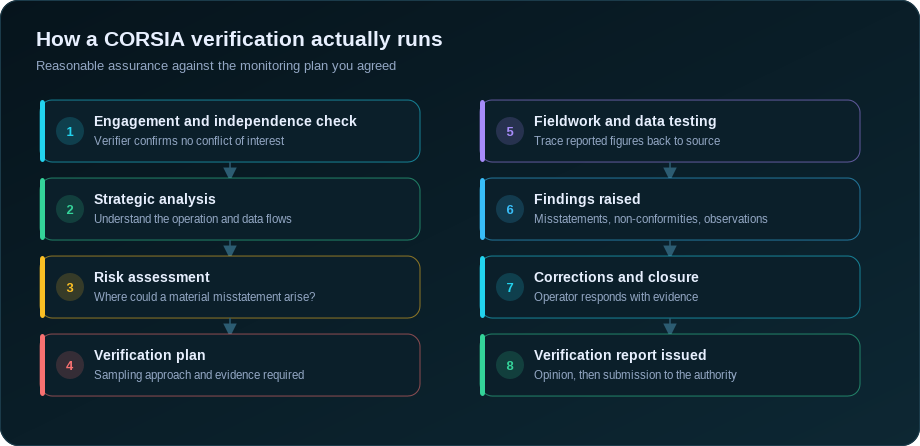
How CORSIA Verification Works: The Eight Stages
Every accredited body works to ISO 14064-3 and the Annex, so the shape of the engagement is broadly the same whichever body you appoint.
| Stage | What happens | What the operator provides |
|---|---|---|
| 1. Engagement and impartiality check | The body confirms it can act without conflict and agrees scope | Group structure, AOCs, list of advisers used |
| 2. Strategic analysis | The verifier learns the operation: fleet, routes, data systems, fuel suppliers | Monitoring plan, system descriptions, organisation chart |
| 3. Risk assessment | Where could a material misstatement arise? | Answers on known weaknesses, changes in the year |
| 4. Verification plan | Sampling approach, evidence required, site visits | Access to people and systems |
| 5. Fieldwork and data testing | Tracing reported figures back to source; testing controls | Evidence pack, flight and fuel records, interviews |
| 6. Findings raised | Misstatements, non-conformities, observations | Responses with evidence |
| 7. Independent technical review | A reviewer not on the team checks the work and the opinion | Usually nothing, unless queries arise |
| 8. Verification report issued | The opinion statement and supporting report | Submission to the State |
The stages that surprise first-time operators are the first four. A substantial part of the engagement happens before any data is tested, because the verifier must understand the operation well enough to sample intelligently. Time spent explaining your data flow clearly at strategic analysis reduces the sampling that follows.
Stage 7, the independent technical review, is often forgotten in planning. A team that finishes fieldwork on 25 April cannot reliably deliver a reviewed report by 30 April.
Choosing a CORSIA Verification Body
The body you appoint determines who tests your data, how well they understand aviation, whether they are available when needed, and whether your State accepts their opinion. A poor choice is rarely fatal, but it is expensive to correct mid-cycle.
Accreditation: ISO 14065 for CORSIA
A CORSIA verification body must be accredited by a national accreditation body to ISO 14065, the standard for bodies that validate and verify environmental information, with a scope that specifically covers CORSIA. The verification itself is conducted to ISO 14064-3, and the competence of verification teams is assessed against ISO 14066. Annex 16, Volume IV names the editions that apply, and accreditation bodies assess against those.
Three practical points follow.
- ISO 14065 accreditation alone is not enough. A body accredited for GHG verification of industrial installations, or for voluntary carbon project validation, is not automatically accredited for CORSIA. The scope must name the scheme.
- The accreditation body matters. It should be a signatory to the relevant International Accreditation Forum arrangement, which is what allows an accreditation from one country to be recognised elsewhere.
- Check the register, not the brochure. Look up the body on the accreditation body's public register and read the scope. Do not accept a logo on a proposal.
ICAO publishes, through the CORSIA Central Registry, information that States provide on the verification bodies accredited in their jurisdiction. It is a useful starting point for a shortlist, not a substitute for checking accreditation.
Recognition in India: The DGCA Position
For an Indian operator, the State is India and the competent authority is the Directorate General of Civil Aviation. The question is not only whether a body is accredited somewhere, but whether the DGCA will accept a verification report from it.
India's national accreditation body for certification and inspection bodies is NABCB, under the Quality Council of India, and it accredits greenhouse gas validation and verification bodies under ISO 14065. Whether a particular body holds a CORSIA scope from NABCB, or from a foreign accreditation body whose accreditation the DGCA accepts, is a fact to establish for each candidate rather than assume. Ask the DGCA directly which accreditations it accepts for CORSIA verification of Indian operators, and record the answer. Our guide to working with the DGCA on CORSIA covers how to raise that kind of question, and the ICAO CORSIA pages and the DGCA website carry the official material.
The knowledge-base page on CORSIA in India notes a practical constraint: the number of accredited bodies active in the region is limited, and demand clusters in the same weeks of the year. That makes early appointment more important for Indian operators than for operators in markets with a deeper verifier pool.
Aviation Experience and Team Competence
A body can be properly accredited and still have limited experience of aircraft operators. Aviation data has specific features: fuel uplift recorded in volume at many stations, density conversions, block-off and block-on times, leased aircraft, state-pair classification and exempt flights. A team that has verified only industrial sites will learn these at your expense.
Ask for:
- The number of CORSIA aircraft operator verifications the body has completed, without needing names
- The named lead verifier, team members and technical reviewer, with their aviation experience
- Whether any team member has worked on operators with a similar profile: cargo, regional turboprop, business aviation or a multi-AOC group
- How the team handles fuel monitoring methods, particularly if you use block-off/block-on or fuel allocation with block hour, covered in choosing a CORSIA fuel monitoring method
Capacity, Timing and Location
Capacity in the February to April window is the constraint that catches most operators. Ask each candidate when fieldwork would take place, how many CORSIA engagements they expect to run in parallel in that window, and who covers if the lead verifier is unavailable.
Location affects cost and logistics. Verification usually involves at least some on-site work, especially in the first year, and the operator normally bears travel cost. A body with staff in India is often easier to schedule; one without local presence may rely more on remote work.
The Selection Criteria in One Table
| Criterion | What to check | Red flag |
|---|---|---|
| Accreditation scope | ISO 14065 with CORSIA named in scope, from an IAF-recognised accreditation body | Only general GHG or voluntary-market scope |
| DGCA acceptability | Written confirmation that the DGCA accepts this accreditation | "Should be fine" without evidence |
| Aviation experience | Completed CORSIA operator verifications | Industrial-only track record |
| Team | Named lead verifier and technical reviewer | Team "to be confirmed" close to fieldwork |
| Independence | No advisory work for you on this scope, no conflicts at individual level | Bundled "compliance support and verification" |
| Capacity | Fieldwork dates committed in the proposal | Vague availability in March and April |
| Location and travel | Clear plan for on-site and remote elements | Open-ended travel billing |
| Fee basis | Fixed fee or day rate with estimate; cost of re-testing stated | Low base fee with undefined extras |
Independence and Impartiality
The verification body must be independent of the preparation of the report and of the monitoring arrangements it is verifying. In practice:
- Your consultant cannot verify their own work, and neither can any entity in the same group that advised on the same scope
- The verification body cannot have provided consultancy on your monitoring plan, data systems or emissions report
- Individual verifiers must be free of conflicts, not only the firm: a team member who recently worked for you, or whose family member works in your fuel department, is a conflict
- Annex 16, Volume IV limits how many consecutive years the same verification team can verify the same operator, after which a break is required, so long relationships need planning for rotation
The common trap is a firm offering "compliance support and verification" as a package. That combination cannot be delivered by the same entity on the same scope. Where a large firm offers both through separate divisions, the separation must be genuine, and it is your obligation to confirm it. Ask for the body's impartiality procedure and its written conflict-of-interest declaration for your engagement.
A consultant can help you prepare, review your report and respond to findings, but cannot verify or influence the opinion. The guide to choosing a CORSIA consultant explains how to keep those roles separate in contracts.
Appointing a Verification Body: Step by Step
The following process works for a first appointment and for re-tendering.
- Define the scope (September). List the AOCs, the reporting year, whether fuel claims or a cancellation report are in scope, and any changes in fleet or monitoring method in the year.
- Confirm the DGCA position. Establish which accreditations the DGCA accepts and whether it expects the verifier to submit the report directly.
- Build a shortlist of three to five bodies. Use the CORSIA Central Registry listing, accreditation body registers and peer operators' experience.
- Check accreditation scope on the register. Discard any candidate whose scope does not name CORSIA.
- Issue a request for proposal. Include your monitoring plan summary, fleet size, approximate sector count, number of fuel suppliers and stations, and your target fieldwork window.
- Ask the independence question in writing. Require each candidate to declare any past or current relationship with you, your group and your consultant.
- Evaluate proposals against weighted criteria. Use the table above, weighted to your situation; see the worked example below.
- Meet the proposed lead verifier. A short call tells you more about aviation competence than any proposal.
- Sign the engagement letter by October or November. Confirm fieldwork dates, the technical review period, deliverables, fee basis and what triggers extra cost.
- Start strategic analysis before year end. Share the monitoring plan and process descriptions so the verifier understands your operation before the data arrives.
Appointing in the fourth quarter gives better availability, an early start on strategic analysis and early sight of mismatches between plan and practice. That does not compromise independence: a verifier stating that your plan and your stations differ is stating a fact, not designing your system.
Worked Example: Scoring Three Proposals
All figures in this example are illustrative and do not describe any real verification body.
An Indian regional operator with one AOC, around 14 aircraft, international flights to five neighbouring States and an estimated 60,000 tonnes of CO2 on international flights receives three proposals. Its weights reflect its main risks: limited internal data maturity and a tight March window.
| Criterion | Weight | Body A | Body B | Body C |
|---|---|---|---|---|
| Accreditation scope and DGCA acceptability (pass/fail) | Gate | Pass | Pass | Fail |
| Aviation experience | 30% | 4 | 3 | n/a |
| Named team and reviewer | 20% | 4 | 2 | n/a |
| Capacity in fieldwork window | 25% | 3 | 5 | n/a |
| Independence declaration | Gate | Clear | Clear | n/a |
| Fee clarity and re-test terms | 15% | 4 | 3 | n/a |
| Travel and logistics | 10% | 3 | 4 | n/a |
Body C has a well-known name and the lowest fee, but its accreditation covers GHG verification without a CORSIA scope, so it fails the gate and is not scored.
Weighted scores, out of 5:
- Body A: (4 x 0.30) + (4 x 0.20) + (3 x 0.25) + (4 x 0.15) + (3 x 0.10) = 1.20 + 0.80 + 0.75 + 0.60 + 0.30 = 3.65
- Body B: (3 x 0.30) + (2 x 0.20) + (5 x 0.25) + (3 x 0.15) + (4 x 0.10) = 0.90 + 0.40 + 1.25 + 0.45 + 0.40 = 3.40
Body A wins narrowly. Before signing, the operator asks Body A to commit to fieldwork dates in the first half of March, which addresses its weaker capacity score. Had Body A refused, Body B would have been the better choice: a late verification is a compliance problem, a less experienced team only a cost problem.
The materiality threshold that would apply here, at around 60,000 tonnes, is the 5% level in the Annex text we have seen. It is assessed on aggregated errors, so a systematic density error across all stations can reach it quickly.
What Fieldwork Involves
Expect the verifier to:
- Trace a sample of flights end to end, from reported figure back to uplift document and flight log
- Test controls by asking for evidence that a monthly reconciliation or review actually happened
- Review the data gap log and test whether the substitution method in your plan was applied consistently
- Reconcile totals against fuel purchase invoices and finance records
- Check scope, meaning that flights in and out of scope were classified correctly by state pair and exemption
- Examine plan conformity, whether practice matches the approved emissions monitoring plan
- Interview staff at several levels, including the people who enter data at stations
Interviews matter more than operators expect: asking a station coordinator how they record an uplift shows whether the documented process is the real one.
Most fieldwork issues start months earlier as data issues; the pages on fuel data quality, fuel density discrepancies and missing fuel uplift records deal with the most common ones. Your monitoring plan is the benchmark, so read the knowledge-base page on the CORSIA emissions monitoring plan and the section-by-section plan guide before fieldwork begins.
The Verified Emissions Report and the Verification Report
You end with two distinct documents.
The verified emissions report is your report, in the template the State requires, after any corrections agreed during verification. It remains your document and your responsibility.
The verification report is the verifier's document. It typically sets out:
- The scope of the verification and the reporting year
- The criteria used, including the Annex, the monitoring plan and ISO 14064-3
- The level of assurance and the materiality threshold applied
- A summary of the work done and the sampling approach
- Any misstatements and non-conformities, and whether they were corrected
- The verification opinion statement, signed by the body
- Confirmation of the independent technical review
The opinion is the part the State reads first. A positive opinion states, with reasonable assurance, that the emissions report is free from material misstatement. Where material misstatements remain uncorrected, or the verifier could not obtain sufficient evidence, the opinion will say so, and the State will treat the report accordingly. How findings are classified, corrected and closed so that you reach a positive opinion is covered in depth in CORSIA verification findings: how to resolve them properly, and a real-world pattern is described in the case study of fourteen findings.
Once submitted, the State performs its own checks on the verified report, which may include an order-of-magnitude check against other data, before aggregating figures for ICAO. Keep the evidence pack intact for later DGCA questions.
Preparing for CORSIA Verification
Preparation is the part the operator controls: the verifier tests what exists and cannot help build what does not.
| Preparation task | Timing | Further reading |
|---|---|---|
| Confirm the monitoring plan reflects current practice | Q3 to Q4 | Monitoring plan changes |
| Monthly fuel reconciliation and gap log | Throughout the year | Data gap procedures |
| Internal dry run of verifier sampling | January | Preparing for a CORSIA audit |
| Structured review of the draft report | January to February | Emissions report review checklist |
| Evidence pack organised by sample type | Before fieldwork | CORSIA data systems |
| Staff briefed on interviews | Before fieldwork | CORSIA training for airline teams |
An internal dry run is the single most useful exercise. Pick 20 to 30 flights at random, trace each from reported figure to source, and record how long it takes and what was missing. If your team cannot trace a flight in minutes, neither will the verifier.
What Verification Costs
Verification is priced as a professional assurance engagement. The drivers are familiar from any audit.
| Driver | Effect on fee |
|---|---|
| Fleet size and sector count | More sampling and more testing |
| Number of entities or AOCs | Each may need its own report and opinion |
| Data quality and system maturity | Poor data means more sampling and more queries |
| First verification versus repeat | Year one carries the full strategic analysis |
| Additional documents | Fuel claims or a cancellation report add scope |
| Site visits and travel | Outstation visits add cost |
| Findings raised | Re-testing and re-review after correction |
| Timing | Late or peak-window engagements tend to price higher |
Two points are worth planning around. A cheaper quote does not buy a lighter opinion. The testing required is set by the assurance standard, so a materially lower quote usually reflects a smaller assumed scope or an optimistic view of your data.
Data quality moves this fee as much as it moves any consultant fee.
Ask three things of every quote: what is included in the base fee, what triggers additional cost, and what a repeat year would cost. The last question tells you whether the body expects your systems to mature. For the wider budget, see managing the cost of CORSIA compliance.
Making the Next Cycle Easier
- Close findings properly rather than cosmetically, because repeat findings cost more each year
- Keep the evidence pack structure the verifier used and populate it monthly
- Update the monitoring plan for anything the verification exposed, and get approval where the change requires it
- Keep the same verification body where impartiality rules permit, so strategic analysis is not rebuilt each year, and plan ahead for the required rotation
Operators approaching the second phase from 2027, when participation becomes mandatory for most States, should also expect more operators competing for the same verifier capacity. That is covered in CORSIA second phase readiness.
How DSTechnoverse Helps
DSTechnoverse is not a verification body and does not verify emissions reports. We help aircraft operators prepare for CORSIA verification so that the independent engagement runs smoothly. That includes reviewing monitoring plans against actual practice, building fuel data reconciliations and gap logs, running internal dry runs of verifier sampling, organising evidence packs, reviewing draft emissions reports, and helping you respond to findings with evidence. We can also help you structure the request for proposal when you select a verification body, while the choice and the opinion remain independent. See our CORSIA carbon credit services or contact us about your reporting year.
Frequently Asked Questions
Who can carry out CORSIA verification? Only a verification body accredited by a national accreditation body to ISO 14065 with a CORSIA scope, working to ISO 14064-3, and acceptable to the operator's State. It must be independent of the operator and of anyone who prepared the emissions report or monitoring plan. For Indian operators, confirm with the DGCA which accreditations it accepts before appointing.
What is ISO 14065 accreditation and why does it matter? ISO 14065 sets requirements for bodies that validate and verify environmental information, covering impartiality, competence and process. Accreditation means a national accreditation body has assessed the verifier against it. For CORSIA, the accreditation scope must name the scheme specifically; a general greenhouse gas or voluntary carbon market scope is not sufficient on its own.
Can our CORSIA consultant also verify our emissions report? No. Verification must be independent of whoever prepared the report and the monitoring arrangements. A consultant can help you prepare, review the report and organise evidence, but cannot verify it. Plan from the start for two separate suppliers, and check that no team member at the verification body has advised you on the same scope.
What is the CORSIA verification timeline? The reporting year runs from January to December. The emissions report is compiled early in the following year, verified in roughly February to April, and the verified emissions report and verification report are typically submitted to the State by 30 April. States then report to ICAO, typically by 31 July. Confirm the DGCA's operative dates each year.
What assurance level and materiality apply? CORSIA verification is a reasonable assurance engagement. Annex 16, Volume IV sets the materiality threshold; in the text we have seen it is 2% for operators emitting more than 500,000 tonnes of CO2 a year and 5% for operators at or below that level. Check the current edition before relying on these figures.
When should we appoint a verification body? Ideally in the fourth quarter, before the reporting year closes. Early appointment secures fieldwork dates in a crowded window, allows strategic analysis to begin before the data arrives and gives you early sight of mismatches between your plan and practice while they can still be fixed.
What does a verified emissions report contain? It is your emissions report in the State's template, after any corrections agreed during verification, accompanied by the verifier's report. That verification report records scope, criteria, assurance level, materiality, work performed, any misstatements or non-conformities and the signed opinion statement confirming whether the report is free from material misstatement.
Does the verifier need to visit our offices? Usually, at least in the first year. Fieldwork commonly combines remote document review with on-site work at headquarters and sometimes at stations, including interviews with staff who record fuel data. The extent of site work depends on your risk profile and the body's approach, and travel cost normally sits with the operator.
Do small operators using the CERT tool still need verification? Yes. The ICAO CORSIA CERT tool simplifies how emissions are estimated for eligible smaller operators, but the emissions report still has to be verified by an accredited body before submission. Verification of a CERT-based report is usually simpler, because there is less fuel data to test.
What happens if the verifier raises findings? You respond with evidence, correct the figure or the process, and the verifier closes the finding before issuing the opinion. Material misstatements must be corrected for a positive opinion. Our separate guide to resolving CORSIA verification findings covers classification, root cause and closure in detail.
This article is general information, not legal or regulatory advice. CORSIA rules, thresholds, deadlines and accreditation arrangements change. Verify the current position against ICAO Annex 16, Volume IV and with the DGCA before acting.
Running your first CORSIA compliance cycle? DSTechnoverse supports Indian aircraft operators with applicability assessment, emissions monitoring plans, fuel data quality management and verification readiness — and hands the annual cycle back to your team. We are based in Indore, Madhya Pradesh and work with clients across India. See our CORSIA carbon credit services, our carbon credit portal at carboncredit.dstechnoverse.com, or talk to our team about your reporting year.
This article is general information, not legal or regulatory advice. CORSIA rules, thresholds and participating-state lists change — verify the current position with ICAO and the DGCA before acting.
Sources and Further Reading
Official and primary sources for the standards, rules and data discussed on this page.
- IATA: CORSIA: airline industry guidance and fact sheets on CORSIA.
- Bureau of Energy Efficiency (BEE): the administrator of India’s Carbon Credit Trading Scheme.
- Science Based Targets initiative (SBTi): corporate net-zero standards and the role of credits for residual emissions.
- UNFCCC: The Paris Agreement: the treaty behind Article 6 and corresponding adjustments.