Choosing a CORSIA Fuel Use Monitoring Method
· DSTechnoverse · CORSIA & Carbon Markets
Five methods plus the CERT tool, each with a different data burden. How to choose one your systems can actually sustain for a decade, rather than the most accurate one on paper.
The monitoring plan must name a fuel use monitoring method, and the choice binds the operator for years. Changing it later is a material amendment requiring resubmission and approval, so it is worth getting right the first time.
The instinct is to choose the most accurate method available. The better question is which method the operator's data systems can sustain every day, at every station, for a decade — because a method that is accurate in principle and unsupported in practice produces gaps, and gaps produce findings.
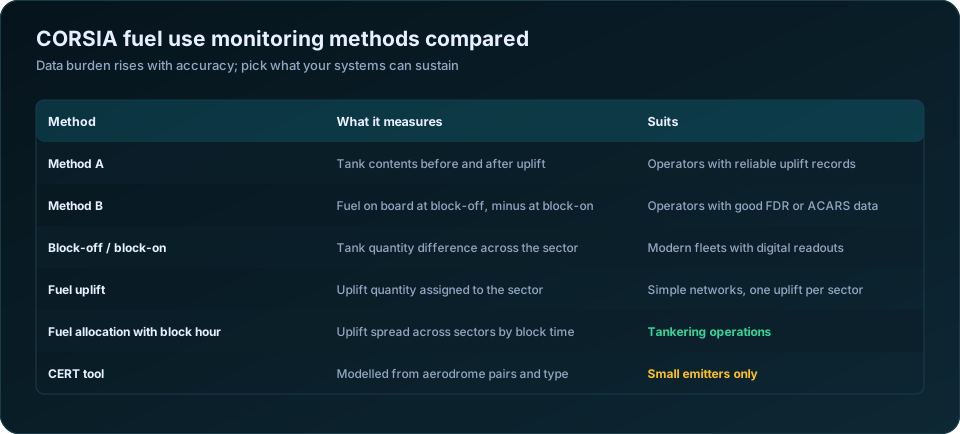
The methods, and what each demands
| Method | What it measures | Data required at every sector |
|---|---|---|
| Method A | Tank contents before and after uplift, plus remaining fuel at the next block-off | Uplift quantity, fuel remaining at two points |
| Method B | Fuel on board at block-off minus fuel on board at block-on, plus uplift | Fuel on board readings at both ends |
| Block-off / block-on | Tank quantity difference across the sector | Reliable digital tank readings |
| Fuel uplift | Uplift quantity assigned to the sector it fuels | Uplift records only |
| Fuel allocation with block hour | One uplift distributed across several sectors by block time | Uplift records plus block times |
The practical distinction is between methods that depend on uplift records and methods that depend on aircraft readings. Operators with strong supplier relationships and reliable dockets are better served by the first; operators with modern fleets reporting fuel on board digitally are better served by the second.
Mixed fleets frequently need different methods for different aircraft types, which is permitted if the plan describes it clearly and applies each consistently.
The selection questions
| Question | If yes | If no |
|---|---|---|
| Do you receive per-uplift records at every station? | Uplift-based methods are viable | Aircraft-reading methods are safer |
| Does the fleet report fuel on board digitally? | Method B or block-off/block-on | Uplift-based methods |
| Do you tanker fuel across sectors? | Fuel allocation with block hour | Simpler methods work |
| Is there one uplift per sector? | Fuel uplift method is sufficient | Allocation is needed |
| Are outstations served by third-party agents? | Expect gaps; plan for them | Uplift methods are lower risk |
| Are you below the small-emitter threshold? | CERT is available | Full monitoring required |
The tankering question is decisive for cargo and long-haul operators. Where a single uplift fuels three sectors, methods assuming a one-to-one relationship between uplift and sector break down, and the fuel allocation method exists precisely for this case — see when fuel records and flight records do not match.
Why the sustainable method beats the accurate one
An operator choosing Method B because it is more precise, without fuel-on-board data at four of its nine stations, has created a permanent data gap at those stations. Every year, that gap must be filled by substitution, documented, and defended at verification.
The alternative — an uplift-based method that the station data actually supports — produces slightly less precise figures and no gaps. A verifier will accept a consistently applied simpler method far more readily than a sophisticated method with recurring substitution.
| Consideration | Weight |
|---|---|
| Theoretical accuracy of the method | Low |
| Whether the data exists at every station | High |
| Whether it can be sustained without manual effort | High |
| Whether it survives adding a new station | High |
| Whether staff understand it | Medium |
| Whether it handles tankering | High, if you tanker |
Documenting the choice
The monitoring plan must do more than name the method. It should state:
- The method, per aircraft type or per fleet group.
- Why it was chosen, referencing the data available.
- The data source for each input, by station.
- How the method handles tankering and multi-sector uplifts.
- The density treatment applied — see fuel density discrepancies.
- The data gap procedure that applies when an input is missing.
- The reconciliation and exception process.
Point two is the one most often omitted. An authority reviewing a plan wants to see that the method was selected against the operator's actual data position rather than copied from a template. Both clarifications raised in the case described in a regional airline's first CORSIA cycle concerned exactly this.
Changing the method later
It is possible and it is a material amendment. The plan must be resubmitted and approved before the new method takes effect, and the operator should expect questions about comparability across the change year.
| Trigger for a change | Typical reason |
|---|---|
| Fleet renewal | New aircraft report fuel on board digitally |
| Station network change | Outstations replaced by bases with better data |
| Data system replacement | Automation makes a richer method sustainable |
| Recurring gaps under the current method | The original choice was too ambitious |
| Crossing the small-emitter threshold | CERT no longer available |
The fourth is the honest one. An operator finding that its chosen method produces substitution every month has chosen wrongly, and amending the plan is a better answer than continuing to substitute. Change management is covered in changes to a CORSIA monitoring plan.
For the plan itself see CORSIA emissions monitoring plan guide and CORSIA fuel monitoring methods. Method definitions are in the ICAO CORSIA implementation elements.
Frequently Asked Questions
What are the CORSIA fuel use monitoring methods?
Method A and Method B, both based on tank contents combined with uplift; block-off to block-on tank quantity difference; the fuel uplift method; fuel allocation with block hour for tankered fuel; and the CERT tool for operators below the small-emitter threshold.
Which fuel monitoring method should I choose?
The one your data systems can sustain at every station for years, not the most theoretically accurate. Operators with reliable per-uplift records suit uplift-based methods; operators with modern fleets reporting fuel on board digitally suit aircraft-reading methods.
Can different methods be used for different aircraft types?
Yes, provided the monitoring plan describes which method applies to which fleet group and each is applied consistently. Mixed fleets frequently need this.
How is tankered fuel monitored?
Through the fuel allocation with block hour method, which distributes a single uplift across the sectors it fuels using block time. Methods assuming one uplift per sector break down where tankering is routine.
Can the monitoring method be changed later?
Yes, but it is a material amendment requiring resubmission and approval before it takes effect. Expect questions about comparability across the change year.
What if the chosen method produces gaps every month?
The method was too ambitious for the available data. Amending the plan to a simpler method the data actually supports is a better answer than substituting data every month and defending it at each verification.
Planning your CORSIA position? DSTechnoverse provides CORSIA carbon credit services for Indian operators and project developers — scope and readiness assessment, monitoring plans, data pipelines, verification support, unit sourcing and second-phase modelling. We are based in Indore, Madhya Pradesh and work across India.
Apply as a CORSIA buyer or seller
Talk to our carbon markets team about your position.