Writing a CORSIA Data Gap Procedure That a Verifier Will Accept
· DSTechnoverse · CORSIA & Carbon Markets
Every monitoring plan needs a documented method for handling missing data. What it must contain, the substitution hierarchy, and why an undocumented good practice counts as no practice at all.
A data gap procedure is a written method, agreed in advance, describing what an operator does when required data is unavailable. It sits in the monitoring plan, and its absence is one of the more common material findings in first-cycle verifications.
The reason it is material is subtle. A verifier assessing an emissions figure needs to know that gaps were handled consistently. An operator that resolved each gap sensibly but differently, with no written method, cannot demonstrate that — and from the verifier's position, an undocumented good practice is indistinguishable from no practice at all.
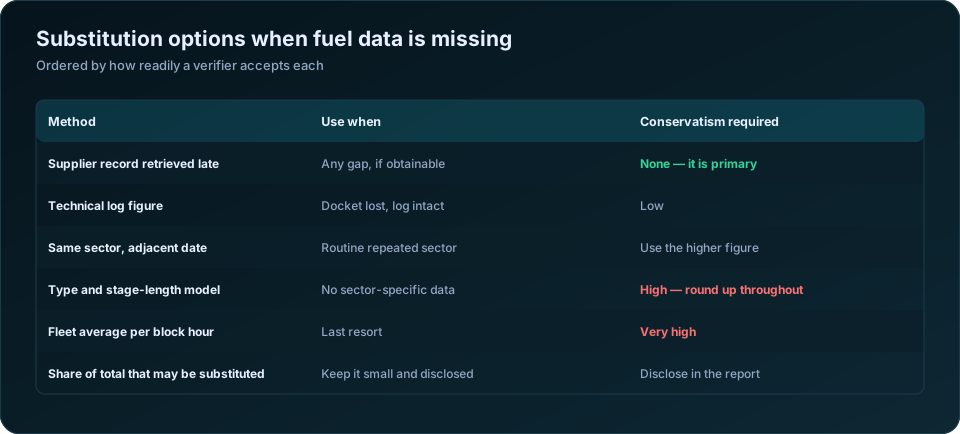
The substitution hierarchy
| Method | Use when | Conservatism required |
|---|---|---|
| Retrieve the supplier record late | Any gap, if obtainable | None — it is primary evidence |
| Technical log figure | Docket lost, log intact | Low |
| Same sector, adjacent date | Routine repeated sector | Use the higher figure |
| Aircraft type and stage-length model | No sector-specific data | High — round up throughout |
| Fleet average per block hour | Last resort | Very high |
The hierarchy is the core of the procedure. It says: exhaust the higher tiers before descending, and increase conservatism as you go.
A common drafting error is to write a procedure that jumps straight to modelling. That is administratively simpler and produces a document a verifier will question, because it does not demonstrate that better evidence was pursued.
What the procedure must contain
| Section | Content |
|---|---|
| Definition | What constitutes a data gap for this operator |
| Detection | How gaps are identified — the exception report, and its frequency |
| Escalation | Who is notified, within what period |
| Retrieval | The sources to be approached, in order, with a time limit for each |
| Substitution hierarchy | The table above, adapted to this operator's data |
| Conservatism rules | Which direction each assumption is biased |
| Documentation | What is recorded for each gap |
| Approval | Who authorises a substituted figure |
| Materiality threshold | Above which the gap is escalated further |
| Reporting | How substituted data is disclosed in the emissions report |
| Review | How the procedure itself is periodically reassessed |
The time limit on retrieval is worth including explicitly. Without one, a gap sits in a pending state for months while someone waits for a supplier reply, and the gap is still open when the report is due. A procedure stating that retrieval is attempted for fifteen working days, after which substitution proceeds, keeps the process moving and is defensible.
The conservatism rules, written down
Conservatism must be specified rather than asserted, because "conservative" is directional and someone has to say which direction.
| Assumption | Conservative direction | Reason |
|---|---|---|
| Fuel quantity | Higher | Overstates emissions |
| Block time | Longer | More burn |
| Load factor | Higher | More burn |
| Density where uncertain | Higher | More mass per litre |
| Route distance | Longer | More burn |
| Auxiliary power usage | Included | More burn |
| Rounding | Upward | Overstates |
Writing these into the procedure removes the argument at verification. The verifier is not assessing whether each individual choice was ideal; they are assessing whether a stated rule was applied consistently, and whether that rule biases against the operator's interest. Both are demonstrable when the rules are written.
Documenting each gap
For every gap closed by substitution, the record should show:
- What was missing — uplift, sector, date, station, quantity affected.
- Why the primary record was unavailable.
- Every source approached, with the date and the outcome.
- Which substitution method was applied, and why that tier.
- The conservatism applied, with the figure before and after.
- Cross-checks performed against independent data.
- The final figure entering the calculation.
- Named approver and date.
This looks heavy for a single missing docket, and in practice it is a short standard form filled in a few minutes. The volume is manageable because a working exception report keeps gaps rare — see when fuel records and flight records do not match.
Disclosure in the emissions report
Substituted data must be visible in the report, not buried. A short section stating the number of gaps, the total quantity substituted, the share of annual fuel it represents, and the methods applied is standard and expected.
| Disclosure element | Example |
|---|---|
| Number of gaps | 41 uplifts across the year |
| Quantity substituted | 380 tonnes of fuel |
| Share of annual total | 0.7% |
| Methods used | Technical log 62%, adjacent-date 24%, model 14% |
| Direction of bias | Conservative throughout |
Disclosing this strengthens rather than weakens the report. A verifier who finds substituted data that was not disclosed treats the omission far more seriously than the substitution itself.
For the plan this procedure sits inside, see CORSIA emissions monitoring plan guide and CORSIA emissions monitoring plan; for the retrieval sequence, missing fuel uplift records. The underlying requirements are in the ICAO CORSIA implementation elements.
Frequently Asked Questions
What is a CORSIA data gap procedure?
A written method in the monitoring plan describing how the operator handles missing data — how gaps are detected, which sources are pursued and in what order, which substitution method applies, how conservatism is enforced, and what is documented for each gap.
Why is a missing data gap procedure a material finding?
Because without it, a verifier cannot establish that gaps were handled consistently across the year. Individually sensible but undocumented decisions are indistinguishable from no method at all when assessed by a third party.
What order should data substitution follow?
Retrieve the supplier record if obtainable, then the technical log figure, then the same sector on an adjacent date, then a type and stage-length model, and only as a last resort a fleet average per block hour — with conservatism increasing at each descending tier.
How is conservatism defined in practice?
By writing down the direction of each assumption: higher fuel quantity, longer block time, higher load factor, higher density where uncertain, longer route, auxiliary power included, rounding upward. Each biases the estimate toward overstating emissions.
Should substituted data be disclosed in the emissions report?
Yes — the number of gaps, total quantity substituted, its share of annual fuel, the methods used and the direction of bias. Verifiers treat undisclosed substitution far more seriously than the substitution itself.
How long should the retrieval attempt last before substituting?
Set an explicit limit in the procedure, commonly around fifteen working days. Without one, gaps sit unresolved while awaiting supplier replies and remain open when the report falls due.
Planning your CORSIA position? DSTechnoverse provides CORSIA carbon credit services for Indian operators and project developers — scope and readiness assessment, monitoring plans, data pipelines, verification support, unit sourcing and second-phase modelling. We are based in Indore, Madhya Pradesh and work across India.
Apply as a CORSIA buyer or seller
Talk to our carbon markets team about your position.