The ICAO CERT Tool: Simplified CORSIA Reporting for Small Emitters
· DSTechnoverse · CORSIA & Carbon Markets
A modelled alternative to full fuel monitoring for operators below the small-emitter threshold. What it needs, what it costs in accuracy, and when using it is a mistake.
The CORSIA CO2 Estimation and Reporting Tool exists because the full monitoring burden is disproportionate for a small operator. An operator flying a handful of international sectors a year should not need the data infrastructure of a scheduled carrier to report a modest emissions figure.
CERT models emissions from aerodrome pairs, aircraft type and number of flights, rather than from measured fuel. For eligible operators it removes most of the fuel data burden. It is also the source of a specific and avoidable planning error.
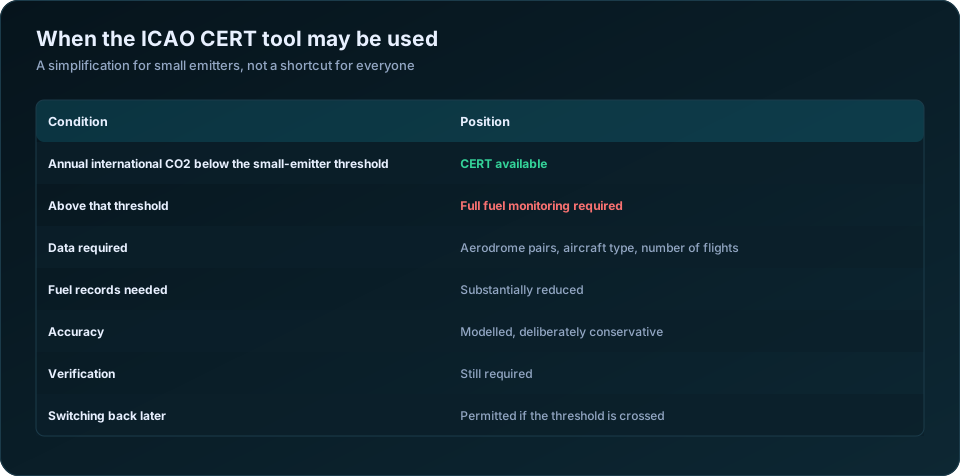
Who may use it
| Condition | Position |
|---|---|
| Annual international CO2 below the small-emitter threshold | CERT available |
| Above that threshold | Full fuel monitoring required |
| Threshold crossed mid-year | Full monitoring applies from that year |
| Falls below again in a later year | CERT may become available again |
| Verification | Still required regardless |
| Monitoring plan | Still required, stating CERT is used |
The small-emitter provision is a defined threshold within CORSIA and sits below the general 10,000 tonne operator threshold. An operator that has a CORSIA obligation at all but produces relatively modest international emissions is the intended user.
What CERT needs
| Input | Detail |
|---|---|
| Aerodrome pairs | ICAO codes for origin and destination of each flight |
| Aircraft type | ICAO type designator |
| Number of flights | Per aerodrome pair, per type |
| Reporting period | The calendar year |
That is substantially the whole list. No uplift dockets, no density certificates, no fuel on board readings, no reconciliation between fuel and flight records. For an operator whose fuel data lives across several handling agents in paper form, the difference in effort is very large.
The data that is required — aerodrome pairs, type and flight count — comes from the flight schedule and operations records, which almost every operator holds reliably.
What it costs in accuracy
CERT is a model, and it is deliberately conservative. It estimates fuel burn from published performance data for the aircraft type over the great circle distance between the pair, with allowances built in.
| Characteristic | Effect |
|---|---|
| Conservative by design | Generally estimates higher than actual |
| No credit for operational efficiency | Efficient flying is not reflected |
| No credit for load factor | Light loads burn less; the model does not know |
| No SAF benefit | Claimed SAF reductions need actual fuel data |
| Simplicity | Very low data burden |
The first row is the trade. An operator using CERT will generally report more CO2 than it produced, and where CORSIA emissions carry an offsetting cost, that overstatement is paid for in units.
For a genuinely small emitter the absolute difference is small and the administrative saving is worth it. For an operator near the top of the eligible range, the overstatement can exceed the cost of running proper fuel monitoring.
When using CERT is a mistake
When you are close to the threshold. An operator near the top of the small-emitter range pays for CERT's conservatism in offsetting units, and may cross the threshold shortly anyway — at which point full monitoring must be built under time pressure.
When you claim SAF. CORSIA eligible fuel reductions require actual fuel quantity data by fuel type. A modelled estimate cannot support a SAF claim, so an operator using SAF and reporting through CERT is discarding the benefit. See SAF and CORSIA offsetting reduction.
When you fly efficiently. Operators with high load factors, efficient routings or newer aircraft than the model assumes are penalised by an estimate that cannot see any of it.
When you are growing. Building fuel monitoring while small and calm is far easier than building it while crossing a threshold — the position described in a business aviation operator crossing the threshold.
Using CERT well
For operators for whom it is genuinely right:
| Practice | Reason |
|---|---|
| State CERT use explicitly in the monitoring plan | It is the declared method |
| Keep accurate flight records | The only inputs, so they must be right |
| Verify aerodrome pairs and type designators | An incorrect code produces an incorrect estimate |
| Record diversions accurately | The aerodrome actually landed at governs |
| Monitor the threshold quarterly | So the transition is planned, not discovered |
| Keep whatever fuel data you do have | It supports a later transition |
The last is worth doing even while using CERT. An operator that has been quietly retaining uplift records has a much easier transition to full monitoring than one starting from nothing, and the retention costs almost nothing.
For method selection generally see choosing a CORSIA fuel use monitoring method; for what the threshold means, CORSIA scope and thresholds. The tool itself and its documentation are published on the ICAO CORSIA site.
Frequently Asked Questions
What is the ICAO CERT tool?
The CORSIA CO2 Estimation and Reporting Tool, which models emissions from aerodrome pairs, aircraft type and flight counts rather than measured fuel. It is available to operators below the small-emitter threshold and substantially reduces the data burden.
Who can use the CERT tool for CORSIA?
Operators whose annual international CO2 falls below the small-emitter threshold. Above it, full fuel use monitoring is required. Verification and a monitoring plan are still required either way.
Is CERT less accurate than fuel monitoring?
Yes, and deliberately conservative — it generally estimates higher emissions than an operator actually produced. Where emissions carry an offsetting cost, that overstatement is paid for in units.
Can I claim SAF benefits while using CERT?
No. CORSIA eligible fuel reductions require actual fuel quantity data by fuel type, which a modelled estimate cannot provide. An operator using SAF and reporting through CERT discards the benefit.
When should a small operator not use CERT?
When close to the threshold, when claiming SAF, when flying more efficiently than the model assumes, or when growing quickly — in which case building fuel monitoring early is easier than building it under threshold pressure.
What data does CERT require?
Aerodrome pairs by ICAO code, aircraft type designator, and the number of flights per pair per type for the reporting year. No fuel dockets, density certificates or fuel on board readings are needed.
Planning your CORSIA position? DSTechnoverse provides CORSIA carbon credit services for Indian operators and project developers — scope and readiness assessment, monitoring plans, data pipelines, verification support, unit sourcing and second-phase modelling. We are based in Indore, Madhya Pradesh and work across India.
Apply as a CORSIA buyer or seller
Talk to our carbon markets team about your position.