Fuel Density Discrepancies in CORSIA Reporting: Where the Tonnes Go Missing
· DSTechnoverse · CORSIA & Carbon Markets
Dockets in litres, invoices in kilograms, a standard density that is not the actual one. Density conversion quietly moves reported emissions by more than most operators expect.
CORSIA emissions are calculated from fuel mass, not fuel volume. Fuel is very often measured and invoiced in volume. The conversion between them is a single multiplication, and it is one of the more common sources of verification findings.
The reason is that density is not a constant. It varies with the fuel batch, with temperature, and with supplier convention — and the standard assumption most operators apply sits at one point in a range that spans several percent.
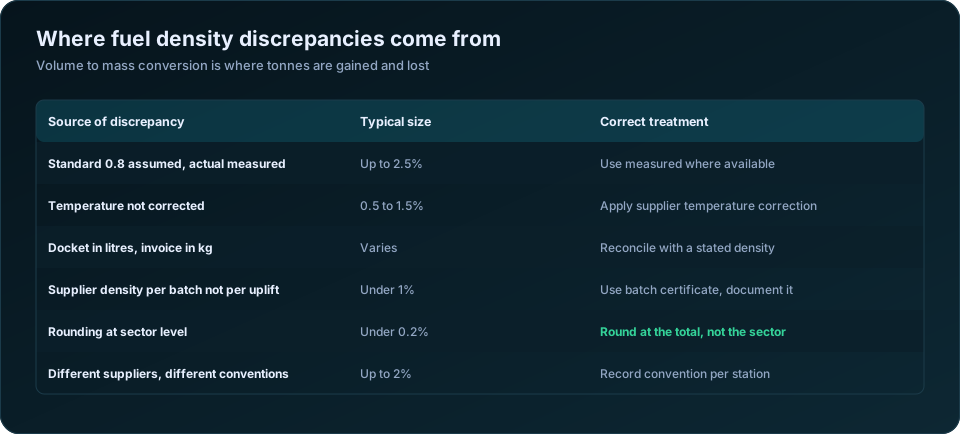
The six sources of discrepancy
| Source | Typical magnitude | Correct treatment |
|---|---|---|
| Standard 0.8 kg/litre assumed where actual is available | Up to 2.5% | Use measured density where the supplier provides it |
| Temperature not corrected | 0.5 to 1.5% | Apply the supplier's temperature correction |
| Docket in litres, invoice in kilograms | Varies | Reconcile the two with a stated density |
| Batch density used rather than per-uplift | Under 1% | Acceptable; document that it is batch-level |
| Rounding applied per sector | Under 0.2% | Round at the total, not at each sector |
| Different suppliers, different conventions | Up to 2% | Record the convention station by station |
Individually these look small. On an annual fuel bill of tens of thousands of tonnes, a systematic 2% error is a material misstatement, and a verifier will treat it as one.
The temperature point is the one operators most often miss. Jet fuel density falls as temperature rises, so a litre uplifted at 42 degrees in a Rajasthan summer carries less mass than a litre at 18 degrees. Suppliers routinely record density at a reference temperature and provide a correction. Applying volume without that correction introduces a seasonal bias into the whole dataset.
The hierarchy of density sources
| Source | Preference | Notes |
|---|---|---|
| Measured density on the uplift docket | Best | Per-delivery, temperature-referenced |
| Supplier batch density certificate | Good | Covers a delivery batch; document the linkage |
| Supplier standard density for the station | Acceptable | Where per-batch is unavailable |
| Regional or contractual assumed density | Weaker | Justify why nothing better exists |
| The generic 0.8 kg/litre default | Last resort | Only where no supplier figure is obtainable |
The governing principle is straightforward and worth internalising: if a measured density is available, a verifier will expect it to be used. Applying the 0.8 default at a station where the supplier issues density certificates per delivery is a finding, and it was the first finding in the verification described in fourteen findings from a first CORSIA verification.
Operators sometimes resist because collecting certificates is administratively tiresome. The answer is to make it part of the standing supplier data request rather than a per-uplift chase.
Reconciling litres against kilograms
Where the docket records volume and the invoice records mass, the two must reconcile. They frequently do not, and the difference is informative.
| Reconciliation result | Interpretation |
|---|---|
| Difference under 0.5% | Rounding and measurement tolerance; acceptable |
| Difference 0.5 to 2% | Density convention mismatch; identify and document |
| Difference above 2% | Investigate — likely a unit or transcription error |
| Systematic difference at one station | Supplier convention differs; record it |
| Difference varies seasonally | Temperature correction is not being applied |
The seasonal pattern is the useful diagnostic. If reconciliation differences at a station track the weather, the cause is almost certainly temperature correction, and the fix is to obtain the supplier's correction table rather than to adjust the figures manually.
What to write in the monitoring plan
Density treatment belongs in the monitoring plan explicitly, station by station. A plan that says "fuel volume is converted to mass using standard density" is too vague to be assessed.
| Element to state | Example |
|---|---|
| Density source, per station | "Supplier density certificate per delivery at stations A, B, C" |
| Fallback where unavailable | "Supplier standard station density at D; 0.8 kg/l at E" |
| Temperature correction | "Applied per supplier correction table where provided" |
| Unit of record | "Dockets in litres at A to D; kilograms at E" |
| Reconciliation frequency | "Monthly, docket volume against invoice mass" |
| Tolerance and escalation | "Differences above 1% investigated before month close" |
Setting the tolerance in the plan is what converts density from an annual verification argument into a routine monthly check. The plan structure is covered in CORSIA emissions monitoring plan guide.
The wider point about small systematic errors
Density is one instance of a general pattern. CORSIA emissions are a product of several factors, and a small consistent bias in any one of them propagates through the entire annual figure.
| Factor | Where bias creeps in |
|---|---|
| Fuel volume | Meter calibration, rounding conventions |
| Density | The subject of this article |
| Emission factor | Using the wrong factor for the fuel type |
| Sector inclusion | Positioning and ferry flights omitted |
| Allocation | Tankered fuel attributed to the wrong sectors |
Random errors cancel across thousands of uplifts. Systematic ones do not — they accumulate in one direction, which is exactly what makes them material. This is why verifiers test conventions and procedures rather than sampling individual records at random.
For the surrounding controls see CORSIA fuel data quality management and why fuel records and flight records fail to match. Fuel specification and density references are published by the International Air Transport Association and in the ICAO CORSIA implementation elements.
Frequently Asked Questions
What fuel density should be used for CORSIA reporting?
Measured density where the supplier provides it, per delivery or per batch. The generic 0.8 kg/litre default should be used only where no supplier figure is obtainable, and applying it where certificates exist is a common verification finding.
Does fuel temperature affect CORSIA emissions calculations?
Yes. Jet fuel density falls as temperature rises, so uncorrected volume converts to the wrong mass — a bias of roughly 0.5 to 1.5% that varies seasonally. Suppliers generally provide a temperature correction that should be applied.
How closely should fuel dockets and invoices reconcile?
Within about 0.5% for rounding and measurement tolerance. Differences of 0.5 to 2% usually indicate a density convention mismatch; above 2% suggests a unit or transcription error requiring investigation.
Why does a 2% density error matter?
Because it is systematic rather than random. Random errors cancel across thousands of uplifts, while a consistent conversion bias accumulates in one direction across the whole year, producing a material misstatement of reported emissions.
What should a monitoring plan say about density?
The density source station by station, the fallback where measurement is unavailable, whether temperature correction is applied, the unit of record at each station, the reconciliation frequency, and the tolerance above which a difference is investigated.
Should rounding be applied per sector or per total?
At the total. Rounding at each sector introduces a small systematic bias that accumulates across thousands of sectors, whereas rounding once at the aggregate does not.
Planning your CORSIA position? DSTechnoverse provides CORSIA carbon credit services for Indian operators and project developers — scope and readiness assessment, monitoring plans, data pipelines, verification support, unit sourcing and second-phase modelling. We are based in Indore, Madhya Pradesh and work across India.
Apply as a CORSIA buyer or seller
Talk to our carbon markets team about your position.