Case Study: Fourteen Findings From a First CORSIA Verification
· DSTechnoverse · CORSIA & Carbon Markets
What a verification body actually raised on a first-cycle emissions report, which findings were material, how each was closed, and how long the whole resolution took.
An operator completing its first CORSIA verification received fourteen findings. The report was ultimately issued without qualification, but the resolution took five weeks and came close to breaching the submission deadline.
The findings are worth working through individually, because they are ordinary. None reflected incompetence or bad faith. Every one is the kind of thing a first-cycle operator does not know to look for, and most would have been caught by an internal dry run.
Material and non-material
The distinction governs everything about how a finding is handled.
| Material | Non-material | |
|---|---|---|
| Definition | Could affect the reported emissions figure or its reliability | Does not affect the figure |
| Must be closed before the report is issued | Yes | Generally yes, but with more flexibility |
| Typical resolution time | Days to weeks | Hours to days |
| Consequence if unresolved | Qualified report or adverse opinion | Noted, may carry to next cycle |
Of the fourteen findings, six were material and eight were not. The six material ones consumed roughly 90% of the resolution effort.
The six material findings
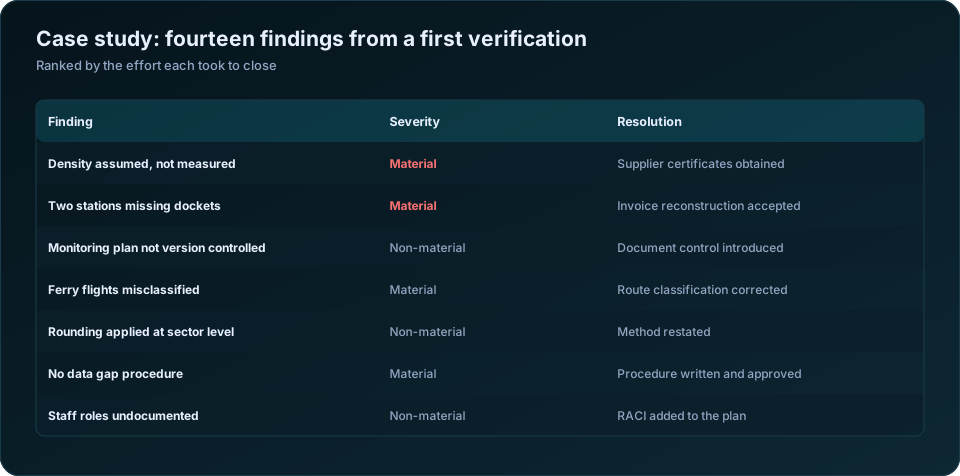
1. Density assumed rather than measured. The operator applied the standard 0.8 kg/litre conversion at all stations. At three stations, suppliers issued density certificates per delivery, which the operator had not collected. Because measured density was available, the verifier required it to be used. Resolution: certificates obtained retrospectively from suppliers, figures recalculated. Six working days.
2. Two stations with missing dockets. Approximately 4% of uplifts had no primary record. Resolution: supplier invoice annexes obtained, cross-checked against technical logs, accepted as primary evidence. Nine working days.
3. Ferry and positioning flights misclassified. Several non-revenue positioning sectors between international points had been excluded on the assumption that only revenue flights counted. They do not — the classification depends on the flight being international between the relevant state pair, not on whether it carried payload. Resolution: sectors reclassified, emissions recalculated upward. Four working days.
4. No documented data gap procedure. The operator had handled gaps case by case without a written method. A verifier cannot assess whether an undocumented approach was applied consistently. Resolution: procedure written, applied retrospectively to every gap, differences reconciled. Seven working days.
5. Monitoring plan not aligned with actual practice. The approved plan described a data flow that had been changed during the year without the plan being updated. Resolution: plan amendment submitted, with a change log. Five working days.
6. Aggregation applied before required checks. Sector data was being summed to monthly totals before the reconciliation checks ran, meaning individual anomalies were invisible. Resolution: reconciliation moved upstream of aggregation, re-run for the full year. Three working days.
The eight non-material findings
| Finding | Resolution |
|---|---|
| Monitoring plan not version controlled | Document control introduced |
| Roles and responsibilities undocumented | RACI matrix added to the plan |
| Rounding applied at sector rather than total level | Method restated, immaterial difference |
| No evidence of management review | Review meeting minuted going forward |
| Training records absent for data staff | Records created and maintained |
| Spreadsheet formulas unprotected | Cell protection applied |
| No backup of the source data | Backup routine documented |
| Supplier contact list out of date | Updated |
None of these changed a single tonne of reported CO2. All of them, however, speak to whether the reported figure can be relied upon, which is exactly what a verifier is assessing. Several would have become material had they persisted.
The pattern behind the findings
Reading the fourteen together, they fall into three groups:
Things that were done but not written down — the data gap procedure, roles, the management review. The operator was handling these; there was simply no evidence a third party could examine.
Things that changed without the documentation following — the monitoring plan misalignment, the outdated supplier list. Practice drifted from the approved description during the year.
Things nobody knew to check — density certificates, positioning flight classification. Genuine knowledge gaps that a dry run against the verifier's checklist, or prior experience, would have surfaced.
The first group is the largest and the cheapest to prevent. A verifier works on evidence, and an undocumented good practice is, from their position, indistinguishable from no practice at all.
What the five weeks cost
| Item | Cost |
|---|---|
| Internal staff time on resolution | 34 working days across three people |
| Additional advisory support | 3,50,000 to 5,00,000 INR |
| Additional verifier time | 1,50,000 to 2,50,000 INR |
| Schedule margin remaining at submission | 4 days |
Four days of margin on a statutory deadline is not a comfortable position, and it was the direct result of scheduling verification too close to the deadline in the first place.
What would have prevented it
An internal dry run against the verification body's published checklist, run six to eight weeks before the real verification. In the engagement described in a regional airline's first cycle, exactly that exercise surfaced fourteen findings — a coincidentally similar number — all of which were closed before the verifier arrived, and the real verification produced none.
The dry run costs around six working days. It is the single highest-return activity available in a first cycle. Practical checklists are in CORSIA emissions report review checklist and CORSIA internal audit preparation; for choosing the verifier, CORSIA verification body selection in India; and for handling findings once raised, CORSIA verification findings resolution. Accredited verification bodies and the underlying requirements are listed by ICAO.
Frequently Asked Questions
What is a material finding in CORSIA verification?
One that could affect the reported emissions figure or the reliability of that figure. Material findings must be closed before an unqualified report can be issued. Non-material findings concern process and documentation without changing the tonnage.
Do positioning and ferry flights count under CORSIA?
Yes, where they are international flights between relevant state pairs. Classification depends on the routing, not on whether the flight carried revenue payload. Excluding non-revenue sectors is a common first-cycle error.
Can you use the standard fuel density assumption?
Only where measured density is not available. If suppliers issue density certificates per delivery, a verifier will generally require those to be used rather than the standard 0.8 kg/litre conversion.
What happens if verification findings are not closed?
The verification body issues a qualified report or an adverse opinion, which the authority treats very differently from an unqualified one. Resolution under deadline pressure is also considerably more expensive than resolution with time in hand.
How long does it take to resolve verification findings?
Material findings typically take three to nine working days each, and they can rarely be worked in parallel because they often depend on the same people and the same data. Five weeks for a set of six material findings is not unusual.
How can first-cycle verification findings be avoided?
Run an internal dry run against the verification body's published checklist six to eight weeks before the real verification, and document every procedure you actually follow — a verifier cannot distinguish an undocumented good practice from no practice at all.
Planning your CORSIA position? DSTechnoverse provides CORSIA carbon credit services for Indian operators and project developers — scope and readiness assessment, monitoring plans, data pipelines, verification support, unit sourcing and second-phase modelling. We are based in Indore, Madhya Pradesh and work across India.
Apply as a CORSIA buyer or seller
Talk to our carbon markets team about your position.