CORSIA costs an operator in four places, and only one of them is the part most people think about. The advisory and verification fees are visible and modest. The offsetting requirement — where it applies — is the number that actually matters, and it is determined largely by decisions taken years earlier.
Where the Cost Sits
| Cost | Character | Order of magnitude |
|---|---|---|
| Emissions units | Variable, price × requirement | Usually the largest, where offsetting applies |
| Internal compliance effort | Recurring annual | Moderate, and often uncosted |
| Verification fee | Recurring annual | Modest, non-negotiable in scope |
| Advisory fees | Front-loaded, declining | Modest if knowledge transfer happens |
| System and data work | One-off, plus maintenance | Moderate in year one |
| Findings remediation | Avoidable | Zero if the data is right |
Two observations that reframe most CORSIA budget conversations.
Poor data quality has a direct financial cost, not just an audit cost. Where data gaps are handled by conservative substitution, reported emissions rise. Where reported emissions rise and an offsetting requirement applies, the number of units to buy rises with them. Sloppy fuel records are, quite literally, a purchase order.
Advisory cost should decline; unit cost should be planned for. Operators frequently negotiate hard on a consulting fee and give no thought to a unit procurement that will dwarf it.
Forecasting the Offsetting Requirement
You cannot manage a cost you have not forecast. The requirement is a function of:
- Emissions on route pairs where both states participate — the route-pair test
- Growth relative to the applicable baseline
- The growth factors in force for the year
- Reductions from CORSIA eligible fuels, where used
None of these is knowable precisely in advance, but all are forecastable to a useful range. Build a simple model that takes your traffic plan, applies the current participating-state list, and produces a low, central and high estimate for the coming two to three years.
Update it whenever the participating-state list changes, because a single significant state joining can move your requirement materially. See CORSIA offsetting requirement calculation for the mechanics.
The value of the forecast is not precision. It is having a number in the budget cycle at all, rather than discovering the requirement after the compliance year has closed and buying units under deadline pressure.
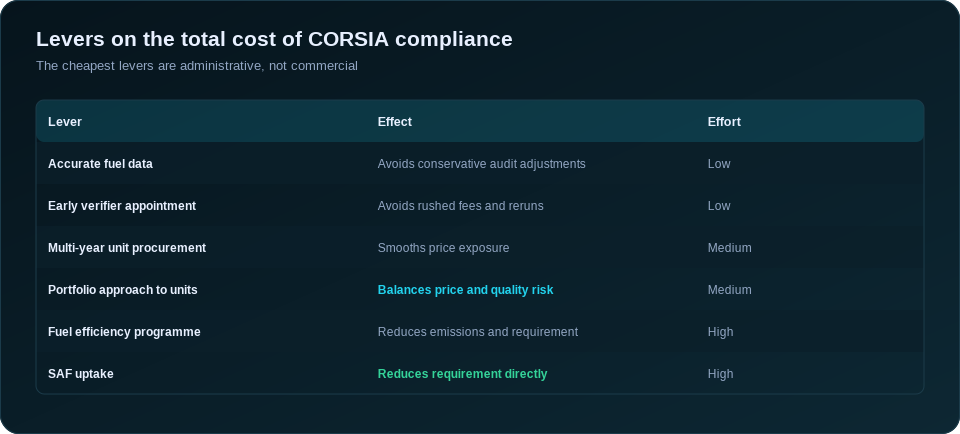
The Levers, Cheapest First
| Lever | Effect | Effort |
|---|---|---|
| Accurate fuel data | Avoids conservative audit adjustments | Low |
| Early verifier appointment | Avoids rushed fees and re-work | Low |
| Multi-year unit procurement | Smooths price exposure | Medium |
| Portfolio approach to units | Balances price and quality risk | Medium |
| Fuel efficiency programme | Reduces emissions and requirement | High |
| SAF uptake | Reduces the requirement directly | High |
The ordering matters. The two cheapest levers are administrative and available immediately; the two most powerful are operational and take years. An operator starting CORSIA planning now should pull the first two this month and begin evaluating the last two over a multi-year horizon.
Unit Procurement Strategy
Where an offsetting requirement applies, unit purchase becomes a commercial exercise with real strategy in it:
Timing. Buying entirely at the cancellation deadline concentrates price risk into a single moment when every other obligated operator is also buying. Staged purchasing across the compliance period spreads it.
Portfolio. Concentrating in one project type or one programme concentrates risk — a programme approval change or a project-level problem affects your whole position. A spread across project types and programmes costs a little more and removes a single point of failure.
Contracting. Forward contracts and offtakes secure supply and price at the cost of flexibility. Spot purchase preserves flexibility at the cost of price certainty. Most operators use both.
Diligence. Every unit must be checked for eligibility — approved programme, vintage window, corresponding adjustment. A cheap unit that fails eligibility has a total cost of the purchase price plus a compliant replacement, which makes price-only procurement the most expensive strategy available. See the CORSIA credit due diligence checklist and how to buy CORSIA carbon credits.
Budgeting Realistically
A workable structure for a board paper:
| Line | Basis |
|---|---|
| Advisory fees | Quoted, declining across three years |
| Verification fee | Quoted, broadly flat |
| Internal effort | Days × loaded cost, honestly estimated |
| System and data work | One-off, plus maintenance |
| Emissions units — central case | Forecast requirement × central price |
| Emissions units — high case | High requirement × high price |
| Contingency | 10-15% in year one |
Presenting a range on the unit line rather than a point estimate is more credible and more useful, because the two variables — requirement and price — move independently and neither is under your control.
Where Operators Overspend
Buying units at the deadline. Concentrated price exposure at the worst possible moment.
Price-only unit selection. Ineligible units cost the purchase price plus the replacement.
Under-investing in data quality. Conservative substitution raises reported emissions and therefore units purchased.
Paying full advisory fees indefinitely. Because knowledge transfer never happened.
Appointing the verifier late. Peak-window premium plus rushed fieldwork plus findings.
Ignoring the SAF interaction. Where eligible fuel is used, the requirement reduces — but only if the certification and chain-of-custody evidence exists to claim it. Using SAF and failing to evidence it means paying for both.
That last one is worth a specific check. See SAF or offsets.
A Worked Cost Shape
Illustrative proportions for an operator in a first compliance cycle where an offsetting requirement applies. The absolute numbers depend entirely on traffic, data readiness and unit prices; the relative shape is what transfers.
| Line | Share of total | Character |
|---|---|---|
| Emissions units | 55-75% | Variable, driven by requirement and price |
| Internal compliance effort | 8-12% | Recurring, frequently uncosted |
| Advisory fees | 6-10% | Front-loaded, should decline |
| Verification fee | 5-8% | Recurring, broadly flat |
| Systems and data work | 4-8% | One-off, plus maintenance |
| Contingency | 5% | Findings, price movement |
Where no offsetting requirement applies for the year, the unit line disappears and the picture inverts entirely — advisory and verification become the dominant costs, and the total is an order of magnitude smaller. This is why the applicability determination is a budgeting document as much as a compliance one: an operator that has not established which route pairs attract an obligation cannot produce a meaningful budget at all.
Who Owns Which Line
Cost control fails when nobody owns the number. A workable allocation:
| Line | Owner | Accountable for |
|---|---|---|
| Emissions units | Finance, with compliance input | Forecast accuracy, procurement strategy |
| Internal effort | Compliance lead | Efficiency of the annual cycle |
| Advisory fees | Compliance lead | Scope discipline, knowledge transfer |
| Verification fee | Compliance lead | Early appointment, clean evidence |
| Systems and data | IT and operations | Capture quality at source |
| Contingency | Finance | Release only against identified issues |
The row that most often has no owner is systems and data — it sits between compliance, operations and IT, and it is the one whose failure drives the largest cost through conservative substitution. Assign it explicitly, to a named person, before the compliance year begins.
The Cost of Deferring
Deferring CORSIA preparation is itself a cost, paid later at a premium. Three specific mechanisms:
Retrospective data reconstruction. Building a monitoring capability after a compliance year has begun means reconstructing months of fuel records from station paperwork. It is slower, more expensive and less complete than capturing the same data as it arises — and the gaps that remain are handled by conservative substitution, which increases the units you must buy.
Emergency advisory rates. Engaging a consultant under deadline pressure removes your negotiating position entirely. Phased pricing, competitive comparison and knowledge transfer clauses all become difficult to insist on when the deadline is eight weeks away.
Verification capacity. Verification bodies fill their deadline windows. An operator appointing late takes what availability remains, usually at a premium and with a compressed fieldwork schedule that leaves no room for findings closure.
None of these appears in a business case for deferring, because they are consequences rather than line items. They are, in aggregate, usually larger than the cost of preparing early.
Frequently Asked Questions
What does CORSIA compliance cost? Advisory, verification, internal effort and system work are modest and predictable. Where an offsetting requirement applies, emissions unit purchase is usually the largest cost by a wide margin.
How do I forecast the offsetting requirement? Model traffic on participating route pairs against the baseline, apply the growth factors in force, and deduct eligible fuel reductions. Produce a range, not a point.
Does data quality affect cost? Directly. Conservative substitution for data gaps raises reported emissions, which raises the units required.
When should we buy emissions units? Staged across the compliance period rather than concentrated at the cancellation deadline, with time allowed for diligence and registry transfer.
Should we concentrate or diversify unit purchases? Diversify across project types and programmes. Concentration creates a single point of failure if a programme or project position changes.
What is the cheapest way to reduce CORSIA cost? Accurate fuel data and early verifier appointment — both low effort, both immediate.
Does SAF reduce the requirement? Yes, where the fuel qualifies and the certification and chain-of-custody evidence supports the claim.
How much contingency should we hold? Ten to fifteen percent in a first cycle, mostly against findings remediation and unit price movement.
Who should own the budget? Finance, with the compliance lead providing the requirement forecast and the procurement input.
Planning your CORSIA position? DSTechnoverse advises Indian operators and project developers on CORSIA compliance strategy — offsetting requirement forecasting, unit procurement due diligence, SAF and efficiency trade-offs, and readiness assessment before the compliance year begins. We are based in Indore, Madhya Pradesh and work with clients across India. See our CORSIA carbon credit services, our carbon credit portal at carboncredit.dstechnoverse.com, or talk to our team.
This article is general information, not legal, financial or regulatory advice. CORSIA rules, participating-state lists and eligibility criteria change — verify the current position with ICAO and the DGCA before acting.