Case Study: A Regional Airline Working Through Its First CORSIA Cycle
· DSTechnoverse · CORSIA & Carbon Markets
Eleven months from "does this apply to us?" to a verified emissions report with no qualifications. Where the time actually went, which two months nearly derailed it, and what the operator would do differently.
A regional operator flying narrow-body aircraft on short international sectors out of two Indian bases came to CORSIA the way most operators do: a letter from the regulator, an internal assumption that it was a fuel-reporting formality, and eleven months later than would have been comfortable.
The engagement is worth describing in detail because nothing about it was unusual. There was no exotic fleet, no disputed regulatory interpretation, no adversarial verifier. It was an ordinary operator doing an ordinary first cycle, and it still took eleven months — for reasons that are entirely predictable and almost entirely avoidable.
The starting position
| Attribute | Detail |
|---|---|
| Fleet | 9 aircraft, all above 5,700 kg MTOM |
| International sectors | 34 state pairs across the schedule |
| Annual international CO2 | Approximately 74,000 tonnes |
| Existing fuel data | Fuel dockets, partly paper, across 5 stations |
| Existing MRV experience | None |
| Staff assigned | One flight operations manager, part time |
The last row is the finding that mattered most. The operator had assigned CORSIA to a capable person who already had a full job, which is the single most common resourcing pattern and the single most reliable cause of an eleven-month timeline.
Month 1: scope, and the first useful surprise
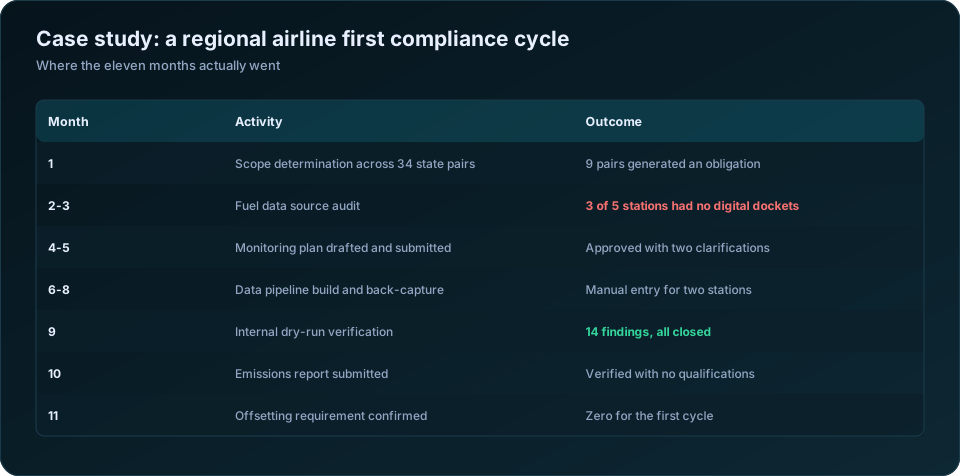
Scope determination took three weeks and produced the first genuinely useful output of the engagement.
Of 34 state pairs in the schedule, only 9 generated an offsetting obligation in the current phase. The rest were either domestic, or between state pairs where at least one state was not participating in the voluntary phase. The operator's internal assumption had been that all international flying was in scope.
This matters commercially. The reporting obligation covers all international flights above the threshold, but the offsetting obligation applies only to flights between participating state pairs. Conflating the two produces a wildly overstated cost estimate — in this case by roughly a factor of three — which had already influenced an internal budget submission.
The route classification exercise is described in CORSIA scope and thresholds, and it should be the first thing any operator does, before any data work.
Months 2 and 3: the fuel data audit, and where it went wrong
This is the phase that determines whether a first cycle takes six months or fourteen, and it is where this engagement lost most of its time.
| Station | Fuel record format | Digital? | Retention |
|---|---|---|---|
| Base 1 | Supplier system export | Yes | 5 years |
| Base 2 | Supplier system export | Yes | 5 years |
| Outstation A | Handling agent paper docket | No | 12 months |
| Outstation B | Handling agent paper docket | No | Unclear |
| Outstation C | Paper, scanned monthly to email | Partially | 24 months |
Three of five stations had no reliable digital fuel record. At two of them, the handling agreement said nothing about fuel data retention at all, so the retention period was whatever the agent's own practice happened to be.
The operator had assumed that because fuel was being purchased and invoiced, the data existed. It did — as an invoice total per month, which is not the same as a per-uplift record linked to a specific aircraft and sector. CORSIA requires the latter.
The remedy was a combination of supplier invoice reconstruction, aircraft technical log cross-referencing, and for one station, manual data entry from scanned paper. The approach is set out in reconstructing missing fuel uplift records.
Months 4 and 5: the monitoring plan
The monitoring plan was drafted, submitted to the authority and approved with two clarifications. The clarifications are instructive:
On the fuel monitoring method. The initial draft proposed Method A for the whole fleet. The authority asked how the method would be applied at stations where uplift records were being reconstructed rather than captured directly. The plan was amended to describe a documented data gap procedure for those stations. See choosing a CORSIA fuel monitoring method.
On density. The draft used the standard 0.8 kg/litre assumption throughout. The authority asked whether supplier density certificates were available. They were, at three stations, and the plan was amended to use measured density where available and the standard assumption elsewhere, with the basis documented per station.
Neither clarification was a rejection. Both were the kind of question a monitoring plan should anticipate, and both would have been avoided by drafting the plan after the data audit rather than in parallel with it.
Months 6 to 8: building the pipeline
The data pipeline work was straightforward at the two digital stations and laborious everywhere else. The operator ended the phase with:
- An automated feed from two supplier systems into a consolidated fuel table.
- A monthly manual entry process for two outstations, with a second-person check.
- A reconciliation routine matching every uplift to a flight record by aircraft registration, date and station.
- An exception report listing uplifts with no matching sector, and sectors with no matching uplift.
That exception report is the most valuable artefact the engagement produced. In the first month it ran, it flagged 6.2% of records. By the third month, after the underlying causes were fixed, it flagged 0.4%. A verifier looking at a system that surfaces and resolves its own exceptions forms a very different view from one looking at a spreadsheet that has never been challenged.
Month 9: the dry run that saved the cycle
Before the real verification, the operator ran an internal dry run against the verifier's published checklist. It produced 14 findings.
All 14 were closed before the verifier arrived. Had they surfaced during the real verification, the operator would have faced a qualified report or a remediation cycle running past the submission deadline — the scenario described in when a first verification produces findings.
The dry run cost about six working days. It is the highest-return activity in a first cycle, and the one most often skipped because by month nine everyone is tired and behind.
Months 10 and 11: submission and outcome
The emissions report was submitted and verified with no qualifications. The offsetting requirement for the cycle was zero, because the sectoral growth factor applied to the baseline produced no obligation for the operator's traffic profile in that year.
That zero deserves comment, because it is often misread. A zero offsetting requirement in one cycle does not mean the compliance machinery was unnecessary. The reporting obligation is independent of the offsetting obligation, and the operator now has an approved plan, a working pipeline and a verified baseline — which is precisely what makes the next cycle a routine exercise rather than another eleven-month project. The calculation itself is covered in CORSIA offsetting requirement calculation.
What the operator would do differently
Asked at the close-out, the operations manager named three things:
Do the data audit first. Before the monitoring plan, before any budget submission, before deciding how much help is needed. Everything else in the timeline depends on what that audit finds.
Fix the handling agreements. A single clause requiring per-uplift fuel data in a defined format, retained for five years, would have removed the entire reconstruction exercise. It costs nothing at contract renewal and is described in coordinating fuel supplier data.
Assign one person properly. Not a full-time hire — the ongoing annual effort is perhaps 15 to 20 working days once the system exists. But the build year needs someone with time actually allocated, not someone doing it between other duties.
The cost, honestly
| Item | Approximate cost (INR) |
|---|---|
| Advisory support across the cycle | 9,00,000 to 14,00,000 |
| Internal staff time, build year | 45 to 60 working days |
| Verification body fee | 4,00,000 to 7,00,000 |
| Data reconstruction effort | 18 working days |
| Offsetting units purchased | Nil this cycle |
For context on what these figures look like across different operator sizes, see CORSIA consultant cost and fees in India and CORSIA compliance cost management. The ICAO CORSIA implementation elements set out the underlying requirements.
Frequently Asked Questions
How long does a first CORSIA compliance cycle take?
Eight to fourteen months for an operator starting with no MRV system, dominated by the fuel data audit and pipeline build rather than by the monitoring plan or the reporting itself. Operators with clean digital fuel data at every station can complete it considerably faster.
Do all international flights create an offsetting obligation?
No. All international flights above the threshold create a reporting obligation, but only flights between participating state pairs create an offsetting obligation. Conflating the two produces cost estimates that can be several times too high.
What is the most common problem in a first CORSIA cycle?
Fuel data that exists as monthly invoice totals rather than as per-uplift records linked to a specific aircraft and sector. Operators assume the data exists because fuel is being purchased and invoiced, which is true but not in the form CORSIA requires.
Is an internal dry run before verification worth the effort?
It is the highest-return activity in a first cycle. Six working days against the verifier's published checklist typically surfaces a dozen or more findings that would otherwise appear during the real verification, when the deadline leaves no room to resolve them.
Does a zero offsetting requirement mean CORSIA did not apply?
No. The reporting obligation is independent of the offsetting obligation. A zero requirement in one cycle simply reflects how the growth factor applied to that year's traffic, and the approved plan and verified data remain necessary for every subsequent cycle.
How much staff time does CORSIA need after the first year?
Roughly 15 to 20 working days annually once the monitoring plan is approved and the data pipeline works. The build year is the expensive one; the steady state is a manageable annual cycle.
Planning your CORSIA position? DSTechnoverse provides CORSIA carbon credit services for Indian operators and project developers — scope and readiness assessment, monitoring plans, data pipelines, verification support, unit sourcing and second-phase modelling. We are based in Indore, Madhya Pradesh and work across India.
Apply as a CORSIA buyer or seller
Talk to our carbon markets team about your position.