Changing a CORSIA Monitoring Plan: Which Amendments Need Approval
· DSTechnoverse · CORSIA & Carbon Markets
Plans drift out of alignment with practice, and that misalignment is a standard verification finding. Which changes are material, when the amendment must be approved, and how to keep the plan current.
An approved monitoring plan describes how an operator captures, processes and reports its emissions data. Operations change — new stations, new aircraft, replaced systems, changed suppliers — and unless the plan changes with them, it describes something the operator no longer does.
A plan that does not match practice is a verification finding, and in a first cycle it is one of the more common material ones. The remedy is a change management routine that takes minutes rather than an annual reconciliation exercise that takes days.
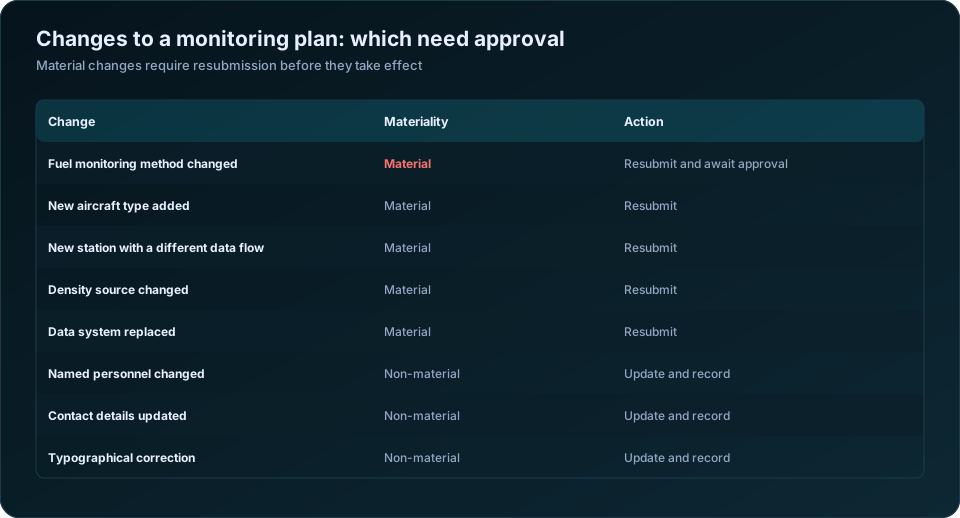
Material and non-material changes
| Change | Materiality | Action |
|---|---|---|
| Fuel monitoring method changed | Material | Resubmit and await approval |
| New aircraft type introduced | Material | Resubmit |
| New station with a different data flow | Material | Resubmit |
| Density source changed | Material | Resubmit |
| Data system replaced | Material | Resubmit |
| Fuel supplier changed at a station | Material if the data flow changes | Assess, then resubmit if needed |
| Data gap procedure amended | Material | Resubmit |
| Named personnel changed | Non-material | Update the plan and record it |
| Contact details updated | Non-material | Update and record |
| Typographical correction | Non-material | Update and record |
| Organisational structure changed | Non-material unless roles change | Assess |
The general test: does the change affect how emissions data is generated, captured, processed or checked? If yes, it is material. If it only affects who to telephone, it is not.
The supplier change row deserves a second look. Swapping fuel supplier at a station is not automatically material — if the new supplier provides the same per-uplift records in the same format, nothing about the data flow has changed. If the new supplier issues monthly totals where the old one issued per-uplift detail, the data flow has changed fundamentally and the plan must reflect it.
Timing, and the trap in it
A material change generally requires the amended plan to be approved before the change takes effect, not after.
This creates a practical difficulty. An operator opening a new station next month cannot always wait for an approval cycle. The workable approach:
| Situation | Practice |
|---|---|
| Change is planned and foreseeable | Submit the amendment ahead of the effective date |
| Change is forced and immediate | Notify the authority promptly, submit the amendment, document the interim |
| Change is under consideration | Do not submit until decided |
| Approval is pending at year end | Document the position in the emissions report |
The forced-change case is the realistic one, and the defensible response is documentation. An operator that opened a station on short notice, notified the authority within days, submitted an amendment, and documented exactly how data was captured in the interim is in a very different position from one that simply operated for eight months outside its approved plan.
The change log
The single most useful artefact is a change log maintained alongside the plan.
| Column | Content |
|---|---|
| Date identified | When the change arose |
| Description | What changed |
| Materiality assessment | Material or not, and why |
| Action taken | Amendment submitted, or plan updated |
| Approval date | Where applicable |
| Effective date | When the change took effect operationally |
| Version | The plan version incorporating it |
A verifier presented with a change log showing eleven assessed changes, three of them material and all three submitted, forms a very different view from one presented with a plan last touched two years ago at an operator that has since changed three stations and a data system.
The log also answers the question a verifier will ask about any discrepancy between plan and practice: was this noticed and handled, or was it not noticed at all?
Version control
| Practice | Reason |
|---|---|
| Version number on every page | Ambiguity about which version applies is itself a finding |
| Date of issue and approval date shown | They differ, and both matter |
| Superseded versions retained | A prior year is verified against the version then in force |
| One controlled copy | Multiple uncontrolled copies diverge |
| Distribution list | Who holds it, and who was notified of the change |
Retaining superseded versions is essential and often missed. Verification of a prior reporting year assesses practice against the plan as it stood in that year, not the current one. An operator that overwrote its plan each time cannot demonstrate what was approved when.
An annual reconciliation
Even with a change log, an annual walkthrough is worth the half day. Take the plan section by section and confirm each description still matches reality:
- Fleet list against the current fleet.
- Station list against current operations.
- Fuel suppliers against current contracts.
- Data systems against what is actually in use.
- Named roles against current staff.
- Data flow diagrams against the actual flow.
- Data gap procedure against how gaps were actually handled.
Point seven is the one that most often reveals drift. Procedures written in year one and applied loosely in year three are exactly the misalignment that produces a material finding — see writing a CORSIA data gap procedure.
For the plan itself see CORSIA emissions monitoring plan guide; for what verification looks for, fourteen findings from a first CORSIA verification and CORSIA internal audit preparation. Amendment requirements are set out in the ICAO CORSIA implementation elements.
Frequently Asked Questions
What counts as a material change to a CORSIA monitoring plan?
Anything affecting how emissions data is generated, captured, processed or checked — a changed fuel monitoring method, a new aircraft type, a new station with a different data flow, a changed density source, a replaced data system, or an amended data gap procedure.
Does a monitoring plan amendment need approval before the change takes effect?
Generally yes for material changes. Where a change is forced and immediate, notify the authority promptly, submit the amendment, and document exactly how data was captured in the interim period.
Is changing fuel supplier a material change?
Only if the data flow changes. A new supplier providing the same per-uplift records in the same format changes nothing material; one issuing monthly totals where the old supplier issued per-uplift detail changes the data flow fundamentally.
Why should superseded plan versions be retained?
Because verification of a prior year assesses practice against the plan as it stood in that year, not the current version. An operator that overwrote its plan cannot demonstrate what was approved when.
What is a monitoring plan change log?
A record of every change identified, its materiality assessment and reasoning, the action taken, approval and effective dates, and the plan version incorporating it. It demonstrates that changes were noticed and handled rather than missed.
How often should the monitoring plan be reviewed?
Continuously through a change log, plus an annual walkthrough confirming that the fleet, stations, suppliers, systems, roles, data flows and gap procedure described still match reality. The annual review typically takes half a day.
Planning your CORSIA position? DSTechnoverse provides CORSIA carbon credit services for Indian operators and project developers — scope and readiness assessment, monitoring plans, data pipelines, verification support, unit sourcing and second-phase modelling. We are based in Indore, Madhya Pradesh and work across India.
Apply as a CORSIA buyer or seller
Talk to our carbon markets team about your position.