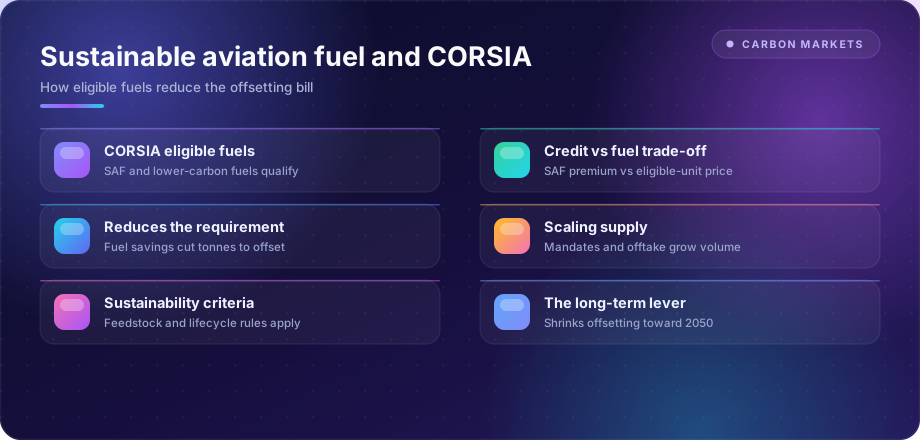
Quick answer: CORSIA sustainable aviation fuels are aviation fuels that meet ICAO's sustainability criteria, are certified by an approved Sustainability Certification Scheme (such as ISCC or RSB) and are backed by batch-level documentation. Known formally as CORSIA Eligible Fuels (CEF), they include sustainable aviation fuel (SAF) and lower carbon aviation fuel (LCAF). An aircraft operator that claims CEF subtracts the resulting emissions reduction, calculated from the fuel's life cycle emissions value against an 89 gCO2e/MJ jet fuel baseline, from its offsetting requirement, so it needs fewer CORSIA Eligible Emissions Units.
CORSIA sustainable aviation fuels are the one part of the ICAO scheme that cuts an airline's own emissions rather than compensating for them elsewhere. Under the Carbon Offsetting and Reduction Scheme for International Aviation, an operator can meet its obligation in two ways: by buying and cancelling CORSIA Eligible Emissions Units, or by using CORSIA Eligible Fuels and claiming the emissions reduction they deliver. The second route is less familiar, more document-heavy and, for many operators, poorly understood. A fuel that is sustainable in every ordinary sense can still produce no CORSIA claim at all if the paperwork is wrong.
This guide explains how sustainable aviation fuel works within CORSIA in practical terms: what makes a fuel eligible, how the emissions reduction formula uses default life cycle values or actual values, how a claim flows through to the offsetting requirement (with an illustrative worked example), which certification schemes matter, what an operator must hold before making emissions reductions claims, and what the picture looks like for SAF in India.
If you need the background first, start with what CORSIA is and how it works. For a short reference on the definitions, see the knowledge-base entry on CORSIA Eligible Fuels.
What Are CORSIA Sustainable Aviation Fuels?
ICAO uses the umbrella term CORSIA Eligible Fuel (CEF) for any aviation fuel that an operator can use to reduce its offsetting requirement. There are two categories:
| Category | What it is | Typical source | Size of reduction |
|---|---|---|---|
| Sustainable Aviation Fuel (SAF) | Renewable or waste-derived drop-in aviation fuel | Used cooking oil, animal fats, agricultural and forestry residues, municipal solid waste, ethanol or other alcohols, renewable hydrogen and captured carbon (power-to-liquid) | Usually large, often well over half of the fossil baseline |
| Lower Carbon Aviation Fuel (LCAF) | Fossil-based jet fuel produced with a lower life cycle carbon intensity than the baseline | Crude production and refining with reduced flaring, venting or methane leakage, or with carbon capture | Usually modest, just above the 10% minimum |
Both have to be technically certified as jet fuel (SAF is blended with conventional Jet A or Jet A-1 under ASTM D7566 or equivalent specifications, then treated as ordinary jet fuel once blended). Both have to meet the CORSIA sustainability criteria and be certified by an approved scheme. The difference is that SAF changes the carbon source of the fuel, while LCAF reduces the emissions of producing conventional fuel.
Three conditions must all hold before any reduction can be claimed:
- The fuel meets the CORSIA sustainability criteria applicable to the batch's production date.
- The fuel is certified by an ICAO-approved Sustainability Certification Scheme (SCS), with an economic operator (producer) holding a valid certificate.
- The batch is documented from production through to purchase by the operator, so that the claim can be verified and not double counted.
The rest of this article unpacks how each condition works in practice and how the numbers are calculated.
How Sustainable Aviation Fuel Fits Into CORSIA
To see why SAF matters to an airline's compliance budget, it helps to recall how CORSIA builds the obligation. The scheme runs in phases: a pilot phase from 2021 to 2023, a first phase from 2024 to 2026 (both voluntary for States), and a second phase from 2027 to 2035 in which participation broadens to most States meeting the scheme's activity thresholds. The phases and timeline entry covers the detail.
From 2024 the baseline is 85% of 2019 international aviation CO2 emissions. Each year, an operator's offsetting requirement is its CO2 emissions on international routes subject to offsetting, multiplied by a growth factor that reflects how far sector emissions exceed that baseline. Operators emitting more than 10,000 tonnes of CO2 a year on international flights must monitor and report their emissions in any case, whether or not their routes attract offsetting. The baseline and growth factors reference and our article on how the offsetting requirement is calculated walk through the arithmetic.
CORSIA Eligible Fuels enter at the end of this calculation:
Final offsetting requirement = Sum of annual offsetting requirements for the compliance period − Sum of emissions reductions from CEF claimed in the same period
Two points follow from this structure.
- Monitored emissions do not change. A tonne of SAF burned in an engine is reported like any other jet fuel and converted to CO2 using the standard conversion factor (3.16 tonnes of CO2 per tonne of Jet A or Jet A-1). The benefit is not hidden in the emissions report; it appears as a separate emissions reduction claim.
- The claim reduces units, not emissions totals. The reduction comes off the number of CORSIA Eligible Emissions Units the operator must cancel. This is why sustainable aviation fuel CORSIA claims are a compliance matter, not just a sustainability-report matter.
Because only a percentage of emissions turns into an offsetting obligation while SAF cuts close to the whole life cycle footprint of its own volume, a small SAF share can remove a large share of the obligation. The knowledge-base page on SAF and the CORSIA offsetting reduction explains that leverage effect briefly; below we focus on the formula and its inputs.
The Emissions Reduction Formula for CORSIA Eligible Fuels
ICAO's Standards and Recommended Practices (Annex 16, Volume IV) set out how the emissions reduction from CEF is calculated. In simplified form:
ER = FCF × Σ [ MS × (1 − LS ÷ LC) ]
| Term | Meaning | Typical value or source |
|---|---|---|
| ER | Emissions reduction claimed for the year, in tonnes of CO2 | Result of the calculation |
| FCF | Fuel conversion factor for the fuel type | 3.16 t CO2 per tonne for Jet A or Jet A-1; 3.10 for AvGas |
| MS | Mass of the neat CEF claimed, in tonnes, for each batch | From purchase and batch documentation |
| LS | Life cycle emissions value of the CEF batch, in gCO2e/MJ | ICAO default life cycle value or certified actual value |
| LC | Baseline life cycle emissions value for the fossil fuel | 89 gCO2e/MJ for jet fuel; 95 gCO2e/MJ for AvGas |
The term (1 − LS ÷ LC) is simply the percentage life cycle saving. A batch with LS of 20 gCO2e/MJ saves about 78% against the 89 gCO2e/MJ baseline, so each tonne of that neat SAF reduces the offsetting requirement by about 3.16 × 0.78, or roughly 2.45 tonnes of CO2.
A few practical consequences:
- The mass is the neat fuel, not the blend. If a supplier delivers a 30% SAF blend, only the SAF fraction counts. A tonne of blended fuel at 30% contains 0.3 tonnes of SAF.
- The 10% threshold sets a ceiling on LS. A CEF must achieve at least a 10% life cycle saving, so LS cannot exceed about 80.1 gCO2e/MJ for jet fuel.
- Each batch is calculated separately. Batches with different feedstocks, pathways or certified values are summed, not averaged.
For how the 3.16 factor and other fuel-type factors are applied in routine monitoring, see CORSIA emission factors and fuel types.
Default Life Cycle Values and Actual Values
The LS term is where most of the technical work sits. ICAO allows two ways of establishing it.
Default Life Cycle Values
ICAO publishes a document of CORSIA default life cycle emissions values for combinations of conversion process and feedstock. Each default value has two parts:
- Core LCA value: emissions from feedstock cultivation or collection, transport, conversion, fuel transport and combustion, expressed per MJ.
- Induced land use change (ILUC) value: an addition for crop-based feedstocks, reflecting emissions caused when demand for fuel feedstock displaces other land uses. For wastes, residues and by-products, ILUC is generally zero.
The life cycle value used in the formula is the core LCA value plus the ILUC value, minus any eligible emissions credits (for example, from improved agricultural practices or landfill emissions avoided) where the ICAO methodology permits.
Pathways covered by default values include, among others:
| Conversion pathway | Common feedstocks | Typical position on life cycle values |
|---|---|---|
| HEFA (hydroprocessed esters and fatty acids) | Used cooking oil, tallow, other wastes and vegetable oils | Waste oils give low values; crop oils carry ILUC and can be much higher |
| Fischer-Tropsch (FT) | Agricultural and forestry residues, municipal solid waste | Residues usually very low; MSW depends on the non-biogenic share |
| Alcohol-to-jet (ATJ) | Ethanol or isobutanol from sugarcane, corn, residues | Varies widely with feedstock and ILUC |
| Synthesised iso-paraffins (SIP) | Sugars | Depends on sugar source and ILUC |
| Co-processing | Lipids co-processed in petroleum refineries | Applies to the renewable share only |
We avoid quoting exact default values: ICAO revises the document as pathways are added, so always read the current version.
Actual Life Cycle Values
A producer can instead calculate an actual life cycle value for its specific plant and supply chain using the ICAO methodology, with the value certified by an approved SCS. Producers choose this when their process is cleaner than the default assumes, for example through renewable process energy or very short feedstock logistics, or when no default exists for their pathway.
LCAF always relies on actual values, because the saving depends on the specific crude production and refining chain. Actual values take more effort to establish and audit, but they can make a material difference to the size of an emissions reductions claim.
Worked Example: How a CEF Claim Reduces Offsetting Requirements
The following example is illustrative only. The airline, volumes, growth factor and life cycle values are chosen to show the mechanics and are not real data, real ICAO default values or a forecast.
Scenario. An airline operates international routes that are subject to offsetting. In one year of a compliance period its CO2 emissions on those routes are 600,000 tonnes. For the example we assume a sector growth factor of 0.10, so its annual offsetting requirement before any fuel claim is 60,000 tonnes.
During the year the carrier purchases 1,500 tonnes of blended fuel at a 40% SAF ratio from an ISCC CORSIA certified supply chain. The SAF is HEFA from used cooking oil, with an illustrative certified life cycle value of 20 gCO2e/MJ.
Step-By-Step Calculation
- Find the neat SAF mass. 1,500 t × 40% = 600 t of neat SAF.
- Find the life cycle saving. 1 − (20 ÷ 89) = 1 − 0.2247 = 0.7753, or about 77.5%.
- Apply the fuel conversion factor. 3.16 × 600 t = 1,896 t CO2 (what the neat SAF would represent if it were fossil jet fuel).
- Calculate the emissions reduction. 1,896 × 0.7753 = about 1,470 t CO2.
- Subtract from the offsetting requirement. 60,000 − 1,470 = 58,530 t.
| Line | Value (illustrative) |
|---|---|
| CO2 emissions on offsetting routes | 600,000 t |
| Growth factor (assumed) | 0.10 |
| Offsetting requirement before CEF | 60,000 t |
| Neat SAF claimed | 600 t |
| Emissions reduction claimed | about 1,470 t |
| Offsetting requirement after CEF | about 58,530 t |
The carrier still reports 600,000 tonnes of CO2 in its emissions report, because SAF is combusted like any jet fuel. What changes is the number of units it must cancel: about 1,470 fewer.
How the Life Cycle Value Changes the Answer
The same 600 tonnes of neat fuel produces very different results depending on LS. Again, these LS values are illustrative points across the permitted range, not ICAO defaults for specific pathways.
| Illustrative LS (gCO2e/MJ) | Life cycle saving | Reduction per tonne of neat CEF | Reduction for 600 t |
|---|---|---|---|
| 10 | 88.8% | about 2.80 t | about 1,683 t |
| 20 | 77.5% | about 2.45 t | about 1,470 t |
| 40 | 55.1% | about 1.74 t | about 1,044 t |
| 60 | 32.6% | about 1.03 t | about 618 t |
| 80 | 10.1% | about 0.32 t | about 192 t |
Two lessons stand out. First, a tonne of low-carbon waste-based SAF can be worth around eight to nine times as much in CORSIA terms as a fuel that only just clears the 10% threshold. Second, buying on volume alone is a mistake. A contract for SAF should specify the certified life cycle value or at least the pathway and feedstock, because that number decides how many units the fuel replaces.
Turning the Result Into a Cost Comparison
Operators often want a cost per tonne of CO2 avoided to compare with eligible unit prices. Without quoting market prices, the logic is:
Cost per tonne avoided = SAF price premium per tonne of neat fuel ÷ reduction per tonne of neat fuel
At 2.45 tonnes of reduction per tonne of neat SAF, the premium is spread across 2.45 tonnes of avoided units. At 1.03 tonnes per tonne, the same premium buys far less. Market sources report that SAF premiums and eligible unit prices both move with supply, policy and the availability of authorised credits, so this comparison has to be re-run with current quotes. Our guide on SAF or offsets as two routes to a CORSIA obligation discusses the strategy side, and carbon pricing and its impact on airlines covers the wider cost picture.
Sustainability Certification Schemes for CORSIA Eligible Fuels
No CEF claim exists without certification by an ICAO-approved Sustainability Certification Scheme (SCS). ICAO publishes and updates a document listing approved schemes. The two best known are:
- ISCC CORSIA (with ISCC CORSIA PLUS for the expanded criteria), operated by International Sustainability and Carbon Certification.
- RSB CORSIA, operated by the Roundtable on Sustainable Biomaterials.
Other schemes have sought or obtained approval over time, so operators and producers should check the current ICAO list rather than assume.
The SCS does several things at once. It audits producers and other economic operators in the supply chain against the CORSIA sustainability criteria; it certifies the life cycle value used (default or actual); it governs chain of custody, typically under a mass-balance approach; and it issues the documentation, such as sustainability declarations or proofs of sustainability, that travel with each batch.
The sustainability criteria themselves have widened. In the pilot phase the criteria focused on greenhouse gas reduction (at least 10% against the baseline) and carbon stock (no feedstock from land converted from primary forest, wetlands or peatland after 1 January 2008). For fuel produced from the first phase onward, ICAO expanded the criteria to cover themes including water, soil, air, conservation, waste and chemicals, human and labour rights, land use and water use rights, local and social development, and food security. The certification scope must match the batch's production date.
This article does not walk through the certification process itself. For the audit steps, roles of collecting points and processing units, and what an Indian supplier must prepare, read our ISCC CORSIA certification guide. If you are unsure whether you need ISCC CORSIA or the voluntary-market ISCC PLUS standard, see ISCC CORSIA versus ISCC PLUS.
What an Aircraft Operator Needs to Make a CEF Claim
From the operator's side, a CEF claim is a documentation exercise that sits on top of normal monitoring, reporting and verification. A practical sequence looks like this:
- Confirm the scope. Check that the operator is subject to offsetting on at least some routes in the relevant year; without an offsetting requirement, a CEF claim has nothing to reduce.
- Contract for certified fuel. Purchase agreements should require SCS certification under a CORSIA scheme, the pathway and feedstock, the life cycle value basis (default or actual) and delivery of batch documentation.
- Collect batch records. For each batch, obtain the identification, production date, neat mass, blend ratio where blended, life cycle value, SCS certificate details and the sustainability declaration.
- Hold purchase evidence. Invoices and delivery records must link the batch to the operator. The operator needs to show it bought the fuel and that it entered the aviation fuel supply.
- Guard against double claiming. Obtain supplier confirmation that the same batch has not been claimed under another scheme or sold to another party for the same purpose, and record any other scheme where the batch is also reported.
- Include the claim in the annual emissions report. CEF claims are reported alongside monitored emissions, with the batch information set out in the reporting template.
- Support verification. The independent verification body checks the claim against the evidence. Missing or inconsistent documents mean the reduction may be disallowed.
- Carry the reduction into the compliance period total. The verified reductions are subtracted when the State calculates the final offsetting requirement for the compliance period.
The fuel side of monitoring connects closely with this process. Our articles on coordinating data with fuel suppliers and CORSIA fuel data quality management cover the data controls that keep both emissions and CEF claims clean.
Documentation Checklist
| Document | Who provides it | Why it matters |
|---|---|---|
| SCS certificate of the producer | Producer or trader | Shows the fuel comes from a certified source |
| Sustainability declaration or proof of sustainability per batch | Last certified economic operator | Carries LS, feedstock, pathway and production date |
| Certificate of analysis or quality certificate | Producer or blender | Confirms the fuel meets the jet fuel specification |
| Blending records | Blender | Supports the neat SAF mass in a blended delivery |
| Purchase invoices and delivery records | Supplier and operator | Link the batch to the operator |
| Double-claiming declaration | Supplier | Supports the claim's uniqueness |
Double Claiming and Other Common Pitfalls
Most failed claims are not about the fuel; they are about the evidence. The recurring problems are:
- Uncertified fuel. Genuinely low-carbon fuel bought outside a CORSIA certified chain produces a real environmental benefit and no CORSIA reduction.
- Wrong certification scope. A supply chain certified under a voluntary-market or road-transport standard is not automatically certified for CORSIA.
- Blend and neat mass confusion. Claiming the full blended volume as SAF overstates the reduction many times over.
- Life cycle value mismatch. Using a default value from an older version of the ICAO document, or a value that does not match the certified pathway.
- Double claiming. The same batch claimed by two airlines, or by an airline under CORSIA and also used for another scheme's credit in a way the rules do not allow. Supplier declarations and registry or scheme records are the defence.
- Timing errors. Claiming a batch in a year other than the one in which it was purchased and reported, or with documents dated outside the reporting window.
- Claims to customers. Telling passengers or corporate buyers they have "bought SAF" for fuel already in the airline's CORSIA claim risks the same benefit being claimed twice. See offsetting corporate business travel.
SAF Versus Eligible Emissions Units: Why Both Matter
Sustainable aviation fuel is not a cheap compliance option today. Production capacity is limited, feedstocks such as waste oils are contested by other sectors, and processing costs are high, so SAF trades at a premium to fossil jet fuel. CORSIA Eligible Emissions Units, by contrast, are a direct compliance instrument whose supply for the first phase depends on projects obtaining host-country Letters of Authorization and corresponding adjustments, and on ICAO Council approval of crediting programmes following Technical Advisory Body (TAB) recommendations.
| Lever | What it does | Main constraints |
|---|---|---|
| CORSIA Eligible Emissions Units | Compensate emissions through cancelled units from approved programmes | Supply of authorised units, corresponding adjustments, vintage and eligibility rules |
| CORSIA Eligible Fuels (SAF, LCAF) | Reduce the operator's own life cycle emissions and its offsetting requirement | Fuel availability, price premium, certification and documentation |
Most operators will use both: SAF where supply and price allow, eligible units for the remainder. The balance shifts as unit supply, SAF production and policy incentives change. For the unit side, see how airlines use carbon credits under CORSIA and CORSIA Eligible Emissions Units explained. For the long-term direction, the future of CORSIA explains why in-sector measures such as SAF are expected to take a growing share.
Sustainable Aviation Fuel in India: The CORSIA Context
India is relevant to CORSIA sustainable aviation fuels from two directions: as a home to airlines with growing international networks, and as a potential producer and feedstock supplier.
Policy Direction
India's government has announced indicative SAF blending targets for international flights, starting from 2027 at low percentage levels and rising in later years. The 2027 start aligns with the beginning of CORSIA's second phase, when broader State participation is expected. Exact percentages and any change to them should be checked against the latest announcements from the Ministry of Petroleum and Natural Gas and the Ministry of Civil Aviation, since indicative targets can be revised before they become binding.
Indicative blending targets and CORSIA claims are separate things. A blending target concerns the fuel supplied into the national market; a CORSIA claim concerns an operator's own purchases, certified and documented to ICAO's rules. Fuel supplied to meet a national blending policy only reduces an airline's CORSIA requirement if it also meets the CORSIA certification and documentation conditions, and the claim is not duplicated.
For how CORSIA applies to Indian operators more broadly, see the knowledge-base entry on CORSIA in India, our guide to CORSIA compliance for Indian airlines, and second phase readiness for 2027.
Feedstock and Production Opportunities
India has several features that make SAF India discussions practical rather than theoretical:
- Waste oils and fats. Used cooking oil collection from restaurants, food processors and households is a potential HEFA feedstock, provided collection is traceable and certified.
- Agricultural residues. Large volumes of crop residue, some of which is currently burned in fields, could supply FT or other advanced pathways if logistics can be solved.
- Ethanol. India's established ethanol blending programme for road fuel creates a base for alcohol-to-jet pathways, subject to life cycle values and ILUC for crop-based ethanol.
- Refinery co-processing. Existing refineries can co-process renewable lipids, which offers a lower-capital entry route for the renewable share.
What Indian Producers and Suppliers Should Prepare
For a producer or trader in India planning to sell into CORSIA markets, the practical checklist is:
- Choose the scheme and scope that buyers will accept (ISCC CORSIA, RSB CORSIA or another approved SCS), covering every site in the chain.
- Decide between default and actual life cycle values. Default values are faster; actual values may be worthwhile if your process energy and logistics are clean.
- Build traceability from collection onwards. Waste and residue feedstocks need records at the point of origin, not only at the plant gate.
- Prepare batch documentation in the format airline buyers and their verifiers expect, including clear neat-mass and blend data.
- Set up double-claiming controls, including a register of which batches have been sold, to whom and for which claims.
- Plan for the expanded sustainability themes, such as labour rights and food security, which auditors will examine for fuel produced in the first phase and beyond.
How DSTechnoverse Helps
DSTechnoverse supports aircraft operators and suppliers on the data side of CORSIA sustainable aviation fuels. For operators, we review SAF purchase and batch documents, reconcile neat SAF mass with invoices and monitoring data, calculate CEF emissions reduction claims and show their effect on offsetting requirement estimates alongside unit sourcing. For Indian producers and traders, we help organise traceability and batch records ahead of SCS audits. We are not a verification body and do not verify emissions reports or certify fuels. See our CORSIA carbon credit services and data analytics pages, or contact us to discuss your fuel data.
Frequently Asked Questions
What are CORSIA Eligible Fuels? CORSIA Eligible Fuels (CEF) are aviation fuels that meet ICAO's sustainability criteria, are certified by an approved Sustainability Certification Scheme and are documented at batch level. They come in two types: sustainable aviation fuel made from renewable or waste sources, and lower carbon aviation fuel, which is fossil-based but produced with lower life cycle emissions. Operators can claim the resulting reduction against their offsetting requirement.
How does sustainable aviation fuel reduce a CORSIA offsetting requirement? The operator calculates an emissions reduction for each certified batch using the fuel conversion factor, the neat fuel mass and the fuel's life cycle value compared with the 89 gCO2e/MJ jet fuel baseline. The total reduction for the compliance period is subtracted from the sum of annual offsetting requirements, so fewer CORSIA Eligible Emissions Units need to be cancelled.
What is the difference between SAF and LCAF? Sustainable aviation fuel is made from renewable or waste feedstocks such as used cooking oil, residues or captured carbon, and usually cuts life cycle emissions substantially. Lower carbon aviation fuel is conventional fossil jet fuel produced with lower upstream emissions, for example through reduced flaring or carbon capture at the refinery. Both must achieve at least a 10% saving to qualify under CORSIA.
What are default life cycle values? Default life cycle values are emissions intensities published by ICAO for specific combinations of conversion pathway and feedstock, such as HEFA from used cooking oil. Each combines a core LCA value with an induced land use change value. Producers can use them without calculating their own figure, or calculate a certified actual value using the ICAO methodology if their process performs better.
Which certification schemes are approved for CORSIA? ICAO maintains a list of approved Sustainability Certification Schemes. ISCC (through ISCC CORSIA and ISCC CORSIA PLUS) and RSB (through RSB CORSIA) are the best known. The list changes as schemes apply and are reviewed, so producers and airlines should check the current ICAO document before relying on a certificate for an emissions reductions claim.
Does the SAF have to be burned in the claiming airline's own aircraft? The operator must show that it purchased the batch and that the fuel entered the aviation fuel supply, supported by documents that verifiers accept. Practices around how closely the fuel must be traced to the operator's own uplift have been the subject of ongoing discussion, so operators should follow the current ICAO guidance and their State's requirements rather than assume a particular approach.
Can an airline count the full blended fuel volume? No. Only the neat CEF counts in the emissions reduction formula. If a delivery is a 30% blend, only 30% of its mass is sustainable aviation fuel. Claiming the blended volume overstates the reduction substantially and will be picked up at verification, so blending records and blend ratios are part of the core evidence.
Has India set SAF blending targets? India has announced indicative SAF blending targets for international flights, beginning in 2027 at low percentages and rising later. These are national policy signals, not CORSIA requirements. Fuel supplied under them only reduces an airline's CORSIA offsetting requirement if it is certified by an approved scheme, documented at batch level and not claimed twice.
Is SAF cheaper than buying CORSIA eligible credits? Usually not on a cost-per-tonne basis today, because SAF carries a substantial price premium over fossil jet fuel. The comparison depends on the life cycle value of the fuel, current SAF and unit prices, and any incentives. Low-carbon waste-based SAF delivers more reduction per tonne, which narrows the gap. Most operators use a mix of both.
Can DSTechnoverse certify SAF or verify a CEF claim? No. Certification is done by auditors under approved Sustainability Certification Schemes, and verification of emissions reports, including CEF claims, is done by accredited verification bodies. DSTechnoverse supports the data and documentation work before those steps: batch reconciliation, reduction calculations, offsetting estimates and readiness for audits.
For the full picture of the carbon credit side of compliance, start with the complete CORSIA carbon credits guide.
Apply as a carbon credit buyer or seller
Navigating carbon credits and climate claims? DSTechnoverse works on the data and integrity side of carbon — project screening, registry and eligibility verification, MRV and monitoring-data analysis, reconciliation and defensible reporting. See our CORSIA carbon credit services and data analytics. We are based in Indore, Madhya Pradesh and work across India and internationally.
Apply as a carbon credit buyer or seller
Talk to our team, or start with the complete carbon credits guide.