Missing a CORSIA Deadline: The Remediation Path
· DSTechnoverse · CORSIA & Carbon Markets
Late emissions reports, unverified submissions and unmet offsetting obligations all have a route back. Voluntary disclosure produces a materially different outcome from being found.
Deadlines get missed. A verifier withdraws, a data problem surfaces in the final week, a key person leaves, an obligation is discovered retrospectively. The question is not whether this happens but what an operator does in the following fortnight, because that largely determines the outcome.
The single most consequential decision is whether to disclose or wait.
Disclosure versus discovery
| Voluntary disclosure | Found by the authority | |
|---|---|---|
| Framing | An operator managing a problem | An operator that concealed one |
| Remediation timetable | Usually negotiable | Usually imposed |
| Scope of review | The specific failure | Often widened to other areas |
| Regulatory relationship | Preserved | Damaged, and it persists |
| Enforcement posture | Proportionate | Less so |
The asymmetry is large and it is the reason the standing advice is to disclose early, before the position is fully resolved, rather than to wait until a complete remediation package can be presented. An authority told in week two that a report will be six weeks late, with a plan attached, is in a very different position from one that discovers the omission in month four.
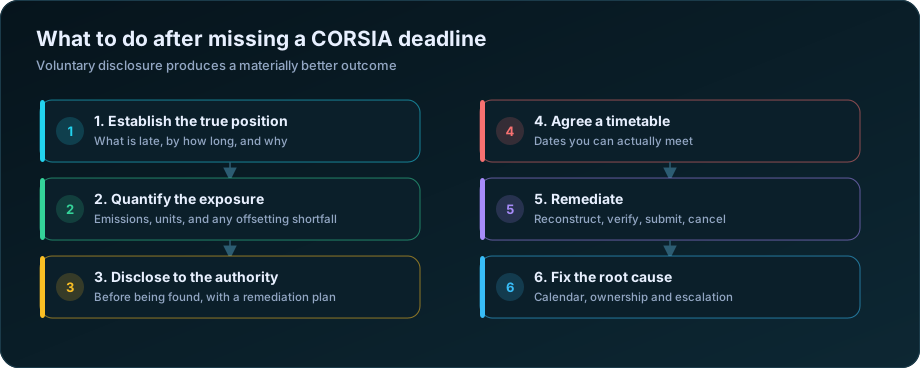
The six steps
1. Establish the true position. Before contacting anyone, know precisely what is late, by how long, and why. A partial or shifting account of the problem is worse than a delayed one. This usually takes two to three days and should not take longer.
2. Quantify the exposure. What is the emissions figure, what is the offsetting requirement, and is there a shortfall in units held? An operator that can state its numbers is in a stronger position than one presenting an unquantified problem.
3. Disclose, with a plan. In writing, to the authority, stating what was missed, why, what has been done, what remains, and the dates by which each step will complete. The plan matters more than the apology.
4. Agree a timetable you can actually meet. The most common second failure is committing to a recovery date to appear responsive and then missing that too. A longer date that holds is better than a shorter one that does not.
5. Remediate. Reconstruct data, complete verification, submit the report, acquire and cancel units as applicable.
6. Fix the root cause. And say what it was in the disclosure. An authority assessing whether this recurs looks at whether the cause was addressed.
The four failure modes and what each requires
| What was missed | Remediation |
|---|---|
| Monitoring plan not submitted | Submit; expect questions on how data was captured without an approved plan |
| Emissions report late | Complete verification and submit; disclose the delay in the covering letter |
| Report submitted unverified | Verification cannot be retrofitted quickly — book the VVB immediately |
| Offsetting units not cancelled by the deadline | Acquire and cancel; the obligation does not lapse |
The unverified submission is the most difficult, because verification body availability becomes the binding constraint and cannot be compressed. An operator in this position should contact verifiers before contacting the authority, so the disclosure can name a realistic verification date. See CORSIA verification body selection in India.
The unmet offsetting obligation is the most expensive, because units must be bought on the spot market against a known deadline — the weakest possible negotiating position. It is also the one with the least ambiguity: the obligation persists, and it must be met.
What the disclosure letter should contain
| Element | Purpose |
|---|---|
| What was missed, precisely | Which submission, which period, which deadline |
| The date it was identified | Demonstrates the response was prompt |
| Why it happened | Factually, without excessive explanation |
| Current status | What has already been completed |
| Remediation plan with dates | Step by step |
| Root cause and the control added | Shows it will not recur |
| Named contact | Someone who can answer questions |
Keep it factual. A letter that reads as a defence rather than a disclosure invites scrutiny of the defence. State what happened, what is being done, and by when.
Preventing the second occurrence
Most late submissions trace to one of four causes, each with a cheap control:
| Cause | Control |
|---|---|
| No compliance calendar | A calendar with owners and internal dates ahead of statutory ones |
| Task marked complete on initiation | Close tasks on verification of the outcome, not on instruction |
| Verifier booked too late | Book the VVB slot at the start of the reporting year |
| Single point of failure in staffing | A named deputy for every compliance task |
The internal deadline buffer is the highest-value item. Setting internal dates four to six weeks ahead of statutory ones means a slippage consumes buffer rather than causing a breach. Operators that run to the statutory date have no absorption capacity for the ordinary problems that occur every year.
For the calendar itself see CORSIA reporting deadlines and calendar and CORSIA compliance periods and deadlines; for regulator engagement, CORSIA DGCA interaction guide. Requirements and timelines are published in the ICAO CORSIA implementation elements.
Frequently Asked Questions
What happens if a CORSIA emissions report is submitted late?
The report must still be completed and verified. Voluntary disclosure with a remediation plan generally produces a negotiated timetable and a proportionate response, whereas discovery by the authority tends to widen the review and harden the enforcement posture.
Should we disclose a missed CORSIA deadline before we have fixed it?
Yes. Disclosing in week two with a plan attached is materially better than presenting a complete package in month four. Authorities distinguish sharply between an operator managing a problem and one that concealed it.
Can an offsetting obligation be missed and forgotten?
No. The obligation persists and must be met by acquiring and cancelling eligible units. Doing so late means buying on the spot market against a known deadline, which is the weakest possible negotiating position.
What if the report was submitted but not verified?
Verification cannot be retrofitted quickly, since verification body availability is the binding constraint. Contact verifiers before contacting the authority so the disclosure can name a realistic verification date rather than an aspirational one.
What should a disclosure letter say?
What was missed and when it was identified, why it happened stated factually, what has already been completed, a remediation plan with dates, the root cause and the control added to prevent recurrence, and a named contact who can answer questions.
How can late submission be prevented?
Set internal deadlines four to six weeks ahead of statutory ones, close compliance tasks on verification of the outcome rather than on instruction, book the verification slot at the start of the reporting year, and name a deputy for every compliance task.
Planning your CORSIA position? DSTechnoverse provides CORSIA carbon credit services for Indian operators and project developers — scope and readiness assessment, monitoring plans, data pipelines, verification support, unit sourcing and second-phase modelling. We are based in Indore, Madhya Pradesh and work across India.
Apply as a CORSIA buyer or seller
Talk to our carbon markets team about your position.