Missing Fuel Uplift Records: What a CORSIA Verifier Will and Will Not Accept
· DSTechnoverse · CORSIA & Carbon Markets
A practical hierarchy of evidence for fuel records that no longer exist, the order in which to pursue each source, and the documentation a verifier needs to accept a reconstruction.
Fuel records go missing for prosaic reasons. A handling agent's retention period expired. A station was served by a supplier that has since changed systems. Dockets were paper, kept in a drawer, and the drawer was cleared. None of this is exotic, and all of it is recoverable if approached in the right order.
The mistake operators make is starting with the sources they control rather than the sources a verifier will accept.
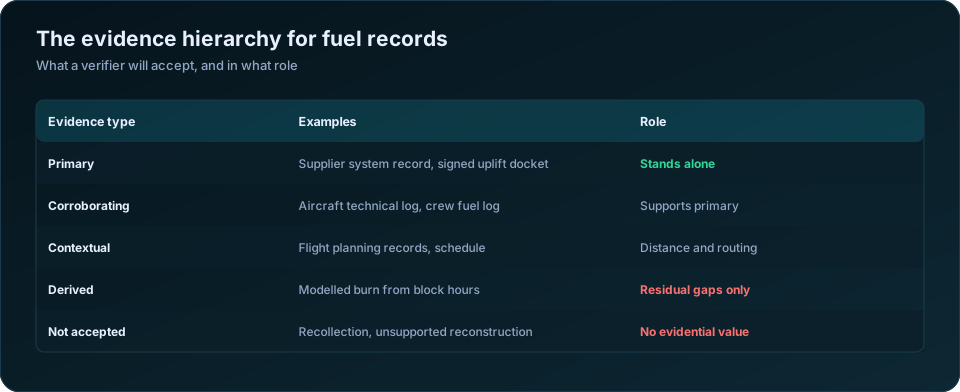
The hierarchy that governs everything
| Tier | What qualifies | Standing with a verifier |
|---|---|---|
| Primary | A contemporaneous record created by the party that measured or supplied the fuel | Stands on its own |
| Corroborating | A contemporaneous record created by another party, consistent with primary | Supports, does not replace |
| Contextual | Records establishing that the flight occurred and its routing | Distance and existence only |
| Derived | A figure calculated after the fact from other data | Residual gaps only, if conservative |
| Not accepted | Recollection, unsupported estimates, round numbers | No evidential value |
Everything else in this article follows from that table. An operator that spends three weeks compiling crew fuel logs has produced corroborating evidence, which is useful and does not close a gap by itself.
The order to work in
1. Ask the fuel supplier for the detailed annex. This is the highest-yield action and the most frequently skipped. Suppliers routinely hold per-uplift records in their own systems even where the operator receives only a monthly invoice total. The data exists; nobody requested it. One email per supplier commonly recovers the large majority of a gap.
2. Ask the handling agent. Where the agent physically supervised the uplift, they may hold a copy of the docket even if the operator's copy is gone. Retention varies, but the agent's own commercial records often outlast the operator's.
3. Check the aircraft technical log. Fuel on board figures recorded by the crew are contemporaneous and independent. This is corroborating rather than primary, but it is strong corroboration and can validate a supplier figure recovered in step one.
4. Check the flight planning and dispatch system. Planned uplift, planned burn and actual routing. Contextual for fuel purposes, and it establishes that the sector occurred and its distance, which matters for the emissions calculation.
5. Check accounting records beyond the invoice. Purchase orders, delivery acknowledgements, payment references. These sometimes carry quantity detail the summary invoice omits.
6. Only then, model the residual. With a documented, conservative method.
The sequence matters because each step reduces the volume that needs modelling, and modelled volume is the part a verifier scrutinises hardest.
What a verifier needs to accept a reconstruction
Reconstruction is not inherently a problem. An undocumented reconstruction is. For each recovered record, the file should show:
| Element | Detail |
|---|---|
| The gap | Which uplift, which sector, which date, which station |
| Why the primary record is unavailable | Retention expired, supplier system change, agent ceased |
| What was attempted | Every source approached, with dates and outcomes |
| What was recovered, and from where | The substitute record and its origin |
| The tier of that evidence | Primary, corroborating or derived |
| Cross-checks performed | Consistency against independent sources |
| The figure used, and its basis | The number entering the emissions calculation |
| Who approved it | Named, dated |
The "what was attempted" row carries more weight than operators expect. A verifier assessing whether a derived figure is acceptable is partly assessing whether better evidence could reasonably have been obtained. A documented record of six sources approached and five exhausted supports a modelled residual far better than a modelled figure with no trail behind it.
When modelling is the only option
Where a genuine residual remains, the estimate must be conservative — biased toward overstating emissions rather than understating them.
| Modelling input | Conservative choice |
|---|---|
| Aircraft type burn rate | The higher end of the published range |
| Block time | Actual if available; otherwise scheduled, if longer |
| Payload assumption | The higher load factor |
| Taxi and APU allowance | Include rather than omit |
| Route distance | Actual routing if known, else great circle plus an allowance |
| Rounding | Upward |
This produces a reported figure slightly above the true one, which feels wrong to operators reporting emissions they did not produce. The trade is deliberate: a modest overstatement is accepted, while a figure a verifier believes may be understated results in a qualified report. The cost asymmetry is heavily in favour of conservatism.
Keep the modelled share small and disclose it. A reconstruction covering a low single-digit percentage of total fuel, fully documented, is routinely accepted. A reconstruction covering a quarter of the year invites a different conversation entirely.
Preventing recurrence
Every reconstruction exercise should end with four changes, none of which costs anything meaningful:
| Control | Effect |
|---|---|
| Fuel data clause in every handling agreement | Per-uplift records, defined format, five-year retention |
| Standing monthly supplier data request | The annex arrives automatically, not on request |
| Station opening checklist | Fuel data arrangement confirmed before the first flight |
| Monthly exception report | Gaps surfaced within 30 days, not two years |
The monthly exception report is the one that changes the risk permanently. A gap found in the month it occurs is a phone call to the station. The same gap found two years later is the exercise described above — see rebuilding two years of fuel data for a cargo operator for what that costs.
For the formal procedure that must sit in the monitoring plan, see CORSIA data gap procedures; for the systems side, CORSIA data systems and automation and CORSIA fuel data quality management. MRV requirements are set out in the ICAO CORSIA implementation elements.
Frequently Asked Questions
What happens if fuel uplift records are missing for CORSIA?
They must be reconstructed from other sources, following a documented procedure. Supplier system records and handling agent copies are primary evidence; technical logs corroborate; modelled figures are accepted only for a residual share and only where conservative.
Do fuel suppliers keep records the operator does not have?
Frequently. Many suppliers hold per-uplift detail in their own systems while issuing the operator only a monthly invoice total. Requesting the detailed annex is the single highest-yield step in any reconstruction and is routinely overlooked.
Will a verifier accept crew fuel logs as evidence?
As corroborating evidence, yes. As the sole source for a gap, generally not — a crew log is a record made by the operator's own staff rather than by the party that supplied or measured the fuel, so it supports primary evidence rather than replacing it.
How much modelled fuel data will a verifier accept?
There is no fixed percentage, but a low single-digit share of total fuel, fully documented and conservatively estimated, is routinely accepted. Larger shares attract proportionately more scrutiny and may lead to a qualified opinion.
What documentation does a reconstruction need?
For each gap: what is missing, why the primary record is unavailable, every source approached with dates and outcomes, what was recovered and from where, the evidence tier, cross-checks performed, the figure used and its basis, and a named approver.
How can missing fuel records be prevented?
A data clause in every handling agreement requiring per-uplift records with five-year retention, a standing monthly supplier data request, a fuel data check on the station opening checklist, and a monthly exception report reviewed within thirty days.
Planning your CORSIA position? DSTechnoverse provides CORSIA carbon credit services for Indian operators and project developers — scope and readiness assessment, monitoring plans, data pipelines, verification support, unit sourcing and second-phase modelling. We are based in Indore, Madhya Pradesh and work across India.
Apply as a CORSIA buyer or seller
Talk to our carbon markets team about your position.