Case Study: Rebuilding Two Years of Fuel Data for a Cargo Operator
· DSTechnoverse · CORSIA & Carbon Markets
A freight operator discovered mid-engagement that its outstation fuel records had never been retained. What each reconstruction source was actually worth to the verifier, and what the exercise cost.
A dedicated freight operator running six aircraft on regional international routes reached the data audit stage of its CORSIA preparation and found something the finance team had not flagged: fuel purchased at four of its nine outstations had never been recorded at uplift level. It had been invoiced monthly, paid, and reconciled to a cost centre. Nothing linked a quantity of fuel to an aircraft and a sector.
Two years of data needed reconstructing before an emissions report could be verified. This is what that took.
Why cargo operators are particularly exposed
The pattern is more common in freight than in scheduled passenger operations, for structural reasons worth naming:
| Factor | Effect on fuel data |
|---|---|
| More outstations, less frequently served | No permanent company presence to enforce process |
| Heavier reliance on handling agents | Data practice follows the agent, not the operator |
| Charter and ad-hoc sectors | Fall outside routine scheduled processes |
| Tankering decisions | Fuel uplifted at one station burned across several sectors |
| Night operations | Paperwork completed under time pressure |
| Aircraft changes at short notice | Registration on the docket may not match the sector flown |
The tankering point deserves emphasis. A cargo operator uplifting a large quantity at a station with favourable fuel pricing, then flying three sectors on it, has a fuel record that does not map one-to-one to a sector. CORSIA accommodates this through the fuel allocation methods, but only if the monitoring plan describes how allocation is done — see choosing a CORSIA fuel monitoring method.
What each reconstruction source was worth
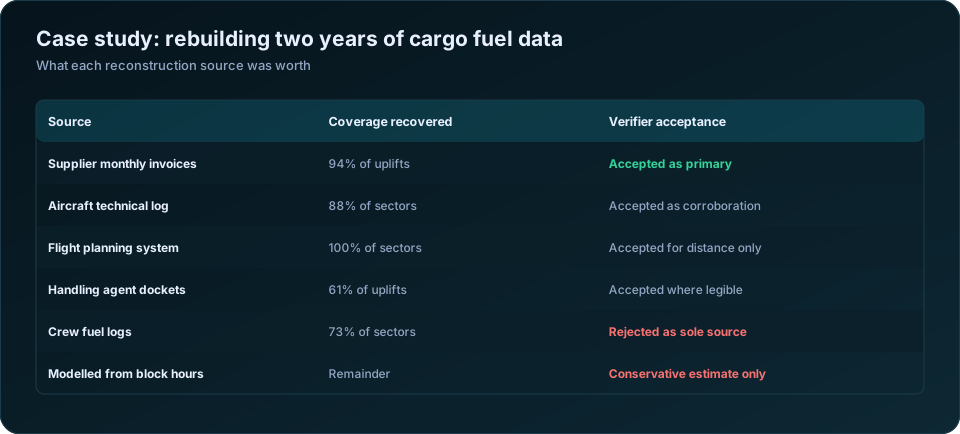
Six sources were available. They were not equally useful, and the verifier's treatment of each was the decisive factor.
| Source | Coverage recovered | Verifier treatment |
|---|---|---|
| Supplier monthly invoices with uplift annexes | 94% of uplifts | Accepted as primary evidence |
| Aircraft technical log fuel entries | 88% of sectors | Accepted as corroboration |
| Flight planning system records | 100% of sectors | Accepted for distance and routing only |
| Handling agent dockets, where retained | 61% of uplifts | Accepted where legible and signed |
| Crew fuel logs | 73% of sectors | Rejected as a sole source |
| Modelled from block hours and aircraft type | Residual gaps | Accepted only as a conservative estimate |
The critical discovery was that supplier invoices, which the operator had assumed were useless because they showed monthly totals, carried per-uplift annexes in the supplier's own system. Those annexes had never been requested. One email to each supplier recovered the large majority of the missing data.
That is the general lesson: before treating data as lost, ask every party in the chain what they hold. Fuel suppliers, handling agents, lessors and flight planning providers all retain records the operator has never asked for.
The hierarchy of evidence
The verifier applied a consistent principle, and understanding it in advance would have saved several weeks of work on sources that were never going to be accepted alone.
Primary evidence is a contemporaneous record created by the party that measured or supplied the fuel — a supplier system record or a signed docket. It stands on its own.
Corroborating evidence is a contemporaneous record created by someone else that is consistent with the primary evidence — the technical log, the crew log. It supports but does not replace primary evidence.
Derived evidence is calculated after the fact from other data — modelled burn from block hours. It is accepted only where primary and corroborating evidence are unavailable, only for a limited share of the total, and only where the method is conservative.
The operator had initially invested effort in compiling crew fuel logs, which are corroborating rather than primary. That work was not wasted, but it did not close the gap on its own.
The conservatism requirement
For the residual gaps closed by modelling, the verifier required that the estimate be demonstrably conservative — meaning it should, if anything, overstate emissions rather than understate them.
| Modelling choice | Conservative direction |
|---|---|
| Aircraft type burn rate | Use the higher figure in the range |
| Block time | Use scheduled where actual is missing, if longer |
| Payload assumption | Use the higher load factor |
| Taxi and APU allowance | Include rather than omit |
| Rounding | Round up |
This felt uncomfortable to the operator, since it meant reporting a higher emissions figure than the true value. But the alternative — an estimate the verifier considers potentially understated — results in a qualified report, which carries considerably more cost than a slightly inflated tonnage. The principle is discussed further in CORSIA data gap procedures.
What the exercise cost
| Item | Effort or cost |
|---|---|
| Supplier data requests and follow-up | 6 working days |
| Technical log extraction and digitisation | 22 working days |
| Docket scanning and manual entry | 31 working days |
| Reconciliation and exception resolution | 18 working days |
| Modelling for residual gaps | 5 working days |
| Advisory support | 6,00,000 to 9,00,000 INR |
| Schedule impact | Approximately 4 months |
Eighty-two working days of internal effort, plus advisory cost, plus a four-month delay to the compliance timeline. Against that, the contract clause that would have prevented it entirely costs nothing.
The fix, applied going forward
The operator made four changes, and none was expensive:
A data clause in every handling agreement. Per-uplift fuel records in a defined format, provided monthly, retained five years. Added at renewal, at no cost.
A standing supplier data request. Monthly uplift annexes delivered automatically rather than on request.
A station opening checklist. Any new station requires the fuel data arrangement to be confirmed before the first flight operates.
A monthly exception report. Uplifts without a matching sector, and sectors without a matching uplift, reviewed within thirty days rather than discovered two years later.
The fourth is the one that changes the risk profile permanently. A gap found in the month it occurs is a phone call. The same gap found two years later is the exercise described above. For the systems side, see CORSIA data systems and automation and CORSIA fuel data quality management. The ICAO CORSIA MRV requirements define what the records must ultimately support.
Frequently Asked Questions
Can missing CORSIA fuel data be reconstructed?
Usually yes, from supplier invoice annexes, aircraft technical logs, handling agent dockets and flight planning records. What matters is the hierarchy: contemporaneous records from the party that supplied or measured the fuel are primary; records created by others corroborate; modelled figures are accepted only for residual gaps and only if conservative.
Do fuel suppliers keep per-uplift records?
Frequently yes, in their own systems, even where the operator receives only a monthly invoice total. Many operators never request the detailed annex. Asking each supplier what they hold is the cheapest first step in any reconstruction exercise.
Will a verifier accept estimated fuel data?
For a limited residual share, where primary and corroborating evidence are genuinely unavailable, and only where the estimation method is demonstrably conservative — meaning it is more likely to overstate emissions than understate them.
Why are cargo operators more exposed to fuel data gaps?
More outstations served less frequently, heavier reliance on handling agents, ad-hoc and charter sectors outside routine processes, tankering that breaks the one-to-one link between uplift and sector, and short-notice aircraft changes that leave registration mismatches on dockets.
What does conservative estimation mean in practice?
Choosing the assumption that raises rather than lowers reported emissions at every point — the higher burn rate in a range, the longer block time, the higher load factor, rounding up. It produces a slightly overstated figure, which is far cheaper than a qualified verification report.
How can fuel data gaps be prevented?
A clause in every handling agreement requiring per-uplift records in a defined format with five-year retention, a standing monthly data request to suppliers, a station opening checklist covering the fuel data arrangement, and a monthly exception report reviewed within thirty days.
Planning your CORSIA position? DSTechnoverse provides CORSIA carbon credit services for Indian operators and project developers — scope and readiness assessment, monitoring plans, data pipelines, verification support, unit sourcing and second-phase modelling. We are based in Indore, Madhya Pradesh and work across India.
Apply as a CORSIA buyer or seller
Talk to our carbon markets team about your position.