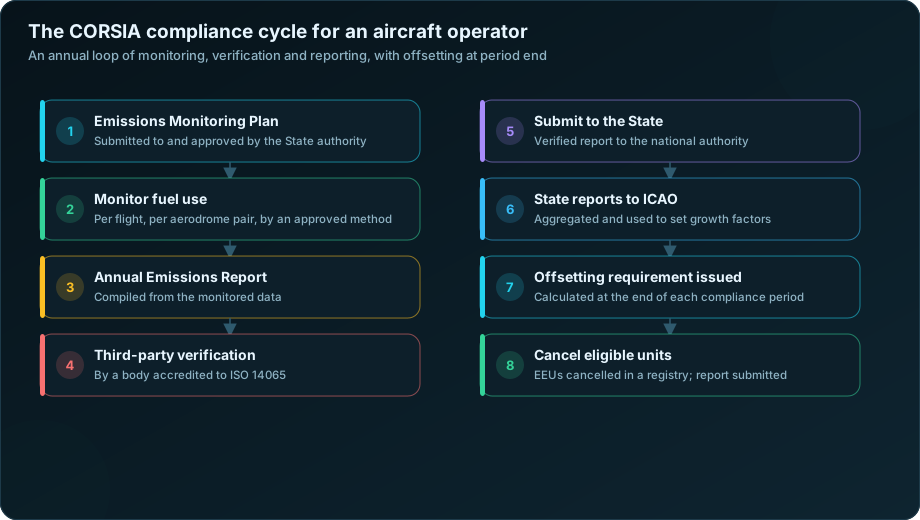
Quick answer: CORSIA compliance means an aircraft operator monitors the CO2 from its international flights under an approved Emissions Monitoring Plan, submits a verified Emissions Report to its national authority each year (typically by 30 April), and, where it flies between participating States, cancels CORSIA Eligible Emissions Units equal to its offsetting requirement after each three-year compliance period. The work runs in a fixed sequence: scope, plan, data, report, verification, calculation, sourcing, cancellation and record keeping.
CORSIA compliance is a sequence, and the sequence matters. ICAO's Carbon Offsetting and Reduction Scheme for International Aviation sets one set of Standards and Recommended Practices in Annex 16, Volume IV, but operators meet them through their own national authority, on a calendar that repeats every year and settles every three years. Steps taken out of order, most commonly thinking about credit purchasing before the emissions data is sound, produce work that has to be redone.
This guide is for aircraft operators anywhere. It sets out the CORSIA compliance requirements, the annual cycle with its standard ICAO dates, how the offsetting obligation is calculated under Resolution A41-22, a ten-step roadmap with the failure point at each stage, and a compliance checklist you can work through.
CORSIA Compliance Requirements at a Glance
CORSIA places two broad obligations on operators. The first, monitoring, reporting and verification (often shortened to CORSIA MRV), applies to every operator above the scope threshold, on all its international flights, whether or not those flights attract offsets. The second, offsetting, applies only to emissions on routes between States that participate in the scheme for that year.
| Obligation | Who it applies to | What it involves | Frequency |
|---|---|---|---|
| Emissions Monitoring Plan | Operators in scope | A plan, approved by the national authority, describing how fuel and CO2 will be monitored | Once, then updated when things change |
| Monitoring | Operators in scope | Fuel use and CO2 recorded for every international flight | Continuous |
| Emissions Report | Operators in scope | Annual report of CO2 from international flights, by State pair | Every year |
| Verification | Operators in scope | Independent check of the report by an accredited verification body | Every year |
| Offsetting | Operators with emissions on covered State pairs | Cancel CORSIA Eligible Emissions Units equal to the offsetting requirement | Per three-year compliance period |
| Cancellation reporting | Operators with an offsetting requirement | Verified Emissions Unit Cancellation Report to the authority | Per compliance period |
| Record keeping | Operators in scope | Retain data, plans, reports and unit records | Ongoing |
CORSIA covers operators of aeroplanes with a maximum certificated take-off mass above 5,700 kg that emit more than 10,000 tonnes of CO2 a year on international flights. Humanitarian, medical and firefighting flights are excluded, as are State aircraft such as military and customs flights. Helicopters are outside the scheme. The detail of where each line falls is covered in CORSIA scope and thresholds and, for edge cases, flights excluded from CORSIA.
The Phases That Frame the Obligations
| Phase | Years | Participation | What it means for operators |
|---|---|---|---|
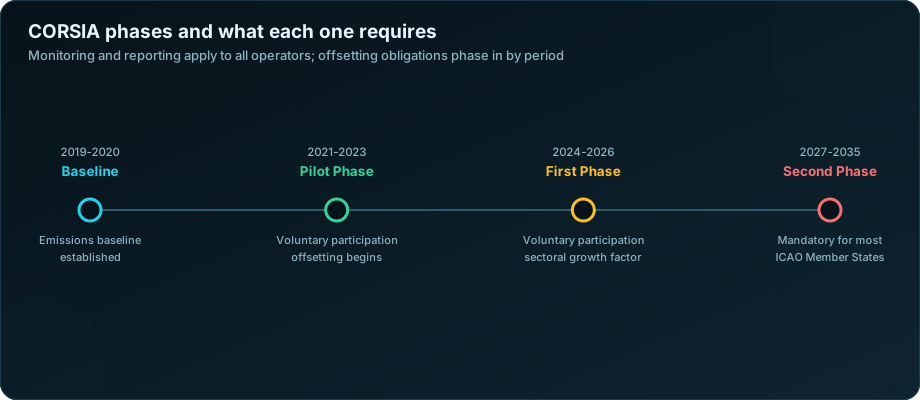
| Pilot phase | 2021-2023 | Voluntary States | Offsetting applied on covered routes; the 2021 sector growth factor was zero |
| First phase | 2024-2026 | Voluntary States | Baseline set at 85% of 2019 emissions; obligations become material |
| Second phase | 2027-2035 | Mandatory for States above defined activity thresholds, with exemptions for some States | Route coverage widens; individual growth factor carries weight from 2033 |
Monitoring and reporting have applied since 1 January 2019, and they never take a year off. Offsetting is the part that switches on and off by route, depending on which States participate. For what changes at each transition, see CORSIA phases explained.
Who Enforces CORSIA Obligations for Airlines
CORSIA is an ICAO framework, but ICAO does not regulate airlines directly. Each State implements Annex 16, Volume IV in its own law, and the obligations reach an operator through the authority of the State it is attributed to. Attribution normally follows the air operator certificate; where there is no certificate, it follows the place of registration or other criteria set out in the Annex.
National implementation differs in format, if not in substance: portals, templates, penalties and sometimes deadlines are set nationally. Examples:
- United Arab Emirates: the General Civil Aviation Authority (GCAA) is the authority for UAE-attributed operators. Operators across the Gulf deal with their own national authorities, which have issued their own CORSIA regulations.
- United States: the Federal Aviation Administration (FAA) is the relevant aviation authority for US operators, working within the US government's approach to implementing CORSIA.
- India: the Directorate General of Civil Aviation (DGCA) administers CORSIA for Indian operators through its civil aviation requirements.
The working rule: the ICAO timeline is the default, and your authority's published requirements are what your calendar should carry. The roles of States, verifiers and ICAO are described in CORSIA national authorities and enforcement. Indian operators should read CORSIA compliance for Indian airlines, and operators in the Gulf and North America can see how we support them on our CORSIA services for the UAE and Middle East and CORSIA services for the United States pages.
CORSIA MRV: Why Monitoring Comes First
Most of an operator's CORSIA effort happens before any unit is bought: proving, to a verifier's satisfaction, exactly how much CO2 it emitted. An offsetting obligation is only as trustworthy as the data behind it.
The CORSIA MRV cycle has four connected stages:
- The Emissions Monitoring Plan. Approved by the authority, it fixes which flights are covered, which fuel use monitoring method applies, how data gaps are filled, and the systems and controls that keep data reliable. It is a commitment made in advance, so the operator cannot choose a convenient method after seeing the results.
- Monitoring fuel use. Emissions are derived from fuel burned, converted to CO2 with fixed factors (3.16 tonnes of CO2 per tonne of Jet-A or Jet-A1, and 3.10 for Jet-B and aviation gasoline). ICAO defines five fuel use monitoring methods: Method A, Method B, block-off/block-on, fuel uplift, and block hour allocation. Operators with lower emissions may use ICAO's CORSIA CO2 Estimation and Reporting Tool (CERT), and operators above 500,000 tonnes a year must use a fuel use method for flights subject to offsetting.
- The Emissions Report. After the year closes, the operator compiles total CO2 from international flights, aggregated by State pair and supported by evidence.
- Verification. An accredited verification body, independent of the operator and of anyone who advised on the report, checks the data for completeness and material misstatement and issues an opinion. Only verified reports count.
The mechanics have their own pages: CORSIA MRV explained for the full cycle, choosing a fuel use monitoring method for the methods, and the ICAO CERT tool for smaller emitters.
The CORSIA Annual Cycle and Compliance Calendar
The CORSIA annual cycle is predictable, which is its saving grace. Annex 16, Volume IV, Appendix 1 sets a standard timeline. The table below shows the dates as ICAO sets them; national authorities can and do set earlier internal deadlines, so treat each date as typical and confirm against your own authority's requirements.
| When (typically) | Who | What happens |
|---|---|---|
| Before monitoring starts | Operator and authority | Emissions Monitoring Plan submitted and approved; new entrants have a set window after falling into scope |
| 1 January to 31 December | Operator | Monitoring year: fuel use and CO2 recorded for every international flight |
| January to April of the following year | Operator and verifier | Emissions Report compiled and verified |
| 30 April | Operator | Verified Emissions Report submitted to the national authority |
| 30 April | Verification body | Verification report submitted to the authority, with the operator's permission |
| May to July | Authority | Order of magnitude check on the report; data aggregated |
| 31 July | Authority | State reports the operators' CO2 data to ICAO |
| Later the same year | ICAO | Sector growth factor for the year published |
| 30 November | Authority | Authority calculates each operator's offsetting requirement for the year and notifies it |
| 31 January after the period ends | Operator | CORSIA Eligible Emissions Units cancelled for the whole compliance period |
| 30 April after the period ends | Operator | Verified Emissions Unit Cancellation Report submitted to the authority |
For the first phase, that means emissions for 2024, 2025 and 2026 are each reported by 30 April of the following year, the offsetting requirements accumulate, and units for the full 2024-2026 period are cancelled by 31 January 2028. Because the requirement for 2026 is notified late, the Annex allows cancellation for that final year within 60 days of the authority's notification if that falls later. The cancellation report for the period is due by 30 April 2028.
Verifier capacity is tight in March and April, and the gap between knowing the final obligation and having to cancel units is short for the whole sector at once. For a month-by-month working calendar, with internal milestones counted back from the deadline, see the CORSIA compliance calendar. We do not repeat that planning detail here.
How the CORSIA Offsetting Obligation Is Calculated
The CORSIA offsetting obligation for a year is the operator's covered emissions multiplied by a growth factor, less any reduction claimed for CORSIA Eligible Fuels. The authority performs the official calculation, but operators should model it themselves to budget ahead.
The structure, as set out in Assembly Resolution A41-22, is:
- Covered emissions: the operator's CO2 on international flights between participating State pairs for that year.
- Sector growth factor (SGF): the growth of covered sector emissions above the baseline, expressed as a share of that year's covered sector emissions. From 2024 the baseline is 85% of 2019 emissions.
- Individual growth factor: the same calculation using the operator's own emissions against its own baseline.
- Weighting: 100% sectoral and 0% individual from 2024 to 2032; 85% sectoral and 15% individual from 2033 to 2035.
- CORSIA Eligible Fuels reduction: the lifecycle saving from qualifying sustainable or lower carbon aviation fuel, claimed with certification and chain of custody.
In formula terms: offsetting requirement = covered emissions x [(sectoral weight x SGF) + (individual weight x individual growth factor)] minus the eligible fuels reduction.
The baseline, the 2020 reset and the weighting schedule are explained in CORSIA baseline and growth factors. The step-by-step forecasting method is in how to calculate CORSIA offsetting requirements. The example below shows how the A41-22 factors work in each part of the second phase.
Worked Example: An Offsetting Obligation Under A41-22
All figures in this example are illustrative. They are chosen to show the mechanics, not to predict actual ICAO growth factors or any operator's position.
Part A: A First-Phase Year (Fully Sectoral)
An operator reports 820,000 tonnes of CO2 on all flights in a year. Filtering to the emissions that create an obligation:
| Step | Tonnes CO2 | Note |
|---|---|---|
| Total emissions, all flights | 820,000 | Starting point |
| Less domestic flights | -340,000 | Outside CORSIA |
| International emissions (reported) | 480,000 | Monitored, reported and verified |
| Less flights to or from non-participating States | -130,000 | Reported but no offsetting |
| Covered emissions | 350,000 | Base for the obligation |
Suppose, for illustration, that covered sector emissions in the year are 640 million tonnes and the sector baseline (85% of 2019 covered sector emissions) is 560 million tonnes. The sector growth factor is:
(640 - 560) / 640 = 12.5%
With a fully sectoral weighting, the gross requirement is 350,000 x 12.5% = 43,750 tonnes. If the operator holds a valid claim for 1,250 tonnes of lifecycle savings from certified eligible fuel, the net requirement for the year is 42,500 tonnes.
Part B: A Year Between 2033 and 2035 (Blended Factors)
Move forward to an illustrative year in the last part of the second phase. The operator has grown faster than the sector:
| Input | Illustrative value |
|---|---|
| Operator's covered emissions in the year | 420,000 t |
| Operator's 2019 emissions on the same covered basis | 300,000 t |
| Operator's individual baseline (85% of 2019) | 255,000 t |
| Individual growth factor: (420,000 - 255,000) / 420,000 | 39.3% |
| Sector growth factor for the year | 18.0% |
| Weighting | 85% sectoral, 15% individual |
The blended factor is (0.85 x 18.0%) + (0.15 x 39.3%) = 15.3% + 5.9% = 21.2%.
The requirement is 420,000 x 21.2% = about 89,000 tonnes. Had the factor stayed fully sectoral at 18.0%, it would have been 75,600 tonnes. The difference, roughly 13,400 tonnes, is the cost of growing faster than the sector.
What the Example Shows
- The covered-emissions filter does most of the work. Total emissions of 820,000 tonnes became a base of 350,000.
- Route coverage moves the number. If the 130,000 tonnes on non-participating routes come into scope as second-phase participation widens, covered emissions rise to 480,000 and, at the same 12.5% factor, the requirement rises to 60,000 tonnes before fuel claims.
- Growth decisions have a CORSIA cost from 2033. Fleet and network plans made now will land in the blended-factor years, so the cost is worth surfacing when those decisions are taken.
- Obligations accumulate. Each year adds to the period total, cancelled once after the period closes, with no carry-forward of surplus.
Which flights fall on covered State pairs is a detailed question in its own right; see state pairs and route classification.
The CORSIA Compliance Roadmap: Ten Steps
The roadmap below is the order in which the work should be done. Each step lists what to do, the failure point we see most often, and the output that shows the step is complete.
Step 1: Establish Scope and Threshold
What to do: Determine whether you are in scope, and for which flights. Check aircraft mass, international emissions against the 10,000 tonne threshold, exempt flight types and the participating status of each State on your network.
Failure point: Operating structure ambiguity. Wet leases, code shares, franchise arrangements and multiple air operator certificates within a group all raise the question of which legal entity is the operator for CORSIA purposes. Getting this wrong means reporting under the wrong entity, which is not a trivial correction. See CORSIA reporting for wet leases and damp leases.
Output: A documented determination of in-scope entity, in-scope flights, and current route coverage. First-time entrants: see new entrants and threshold crossings.
Step 2: Build the Emissions Monitoring Plan
What to do: Develop the plan, covering method, data sources, systems, responsibilities, data gap procedures and controls, and submit it to your national authority.
Failure point: Choosing a method your systems cannot actually support. The method is selected on paper, the plan is approved, and then a year later at verification it emerges that the required data was never captured at the necessary granularity. By then the reporting year is closed and the gap cannot be filled retrospectively.
How to avoid it: Test a sample month of real data against the method before choosing. The plan section by section is covered in the CORSIA Emissions Monitoring Plan guide.
Output: An approved monitoring plan and a tested data process.
Step 3: Get the Data Pipeline Working
What to do: Establish the annual process for collecting, reconciling and quality-checking fuel and flight data.
Failure point: Sources disagree. Fuel uplift dockets, flight operations records, aircraft systems and finance records rarely produce identical numbers. Reconciling them is the bulk of the annual effort.
How to avoid it: Treat it as a data engineering task: define the authoritative source for each field, build the reconciliation logic once, and document the discrepancy rules, because a verifier will ask why each was resolved as it was. See CORSIA data systems and automation.
Output: A repeatable pipeline producing a defensible dataset with an audit trail.
Step 4: Prepare the Annual Emissions Report
What to do: Assemble the report for the preceding calendar year in the format your authority requires, with CO2 aggregated by State pair.
Failure point: Late assembly. Operators who begin in the reporting window rather than maintaining data through the year find gaps at exactly the point where there is no time to resolve them.
Output: A complete report, with supporting evidence organised and accessible.
Step 5: Verification
What to do: Engage an accredited verification body to verify the report against Annex 16, Volume IV.
Failure point: Two, actually. First, verifier availability: accredited bodies are limited and demand is concentrated in the same window, so engage early. Second, independence: the body verifying your report cannot have advised on it, so if a consultant wrote your monitoring plan, they cannot verify.
How to smooth it: Anticipate what the verifier will test (sampling of fuel records, reconciliation logic, treatment of exceptions, completeness of flight lists) and have that evidence ready rather than assembling it under time pressure. The verification process and how to choose a body are covered in CORSIA verification and choosing a verification body, and resolving findings in CORSIA verification findings.
Output: A verified emissions report and a resolved findings log, submitted by the deadline.
Step 6: Calculate the Offsetting Requirement
What to do: Model the requirement each year from your covered emissions, an estimated growth factor range and any realistic eligible fuels claim. Reconcile it to the authority's notification when it arrives.
Failure point: Waiting for the authority's number. Operators who do not model in advance discover the size of the obligation too late to spread purchasing. Estimate annually with low, central and high cases and refine when factors are confirmed.
Output: A documented requirement figure with the calculation reproducible.
Step 7: Open and Test Registry Accounts
What to do: Establish accounts in the registries where your intended supply sits.
Failure point: Assuming this is quick. Account opening involves know-your-customer processes and can take weeks. Operators who leave it until they have agreed a purchase find the transfer blocked by their own onboarding.
Output: Live, tested accounts with more than one authorised representative, ahead of need.
Step 8: Source Units
What to do: Identify and secure CORSIA Eligible Emissions Units. Only units from programmes the ICAO Council has approved, on the recommendation of its Technical Advisory Body (TAB), qualify, and only within the approved eligibility dates. For the first phase, units must also carry a Letter of Authorization from the host country and a corresponding adjustment, so the reduction is not also counted towards the host country's own climate target.
Failure point: Buying against a description rather than evidence. "CORSIA-ready" and "eligible pending authorisation" describe units that are not eligible. See the CORSIA credit due diligence checklist for what to verify.
Strategic point: Deferring purchase to the end of the period means competing with the whole sector for thin supply. Progressive acquisition reduces that exposure.
Output: Contracted supply with a complete documentation package.
Step 9: Cancel and Report
What to do: Cancel the units in the registry against the right compliance period and submit the verified Emissions Unit Cancellation Report to your authority.
Failure point: Confusing purchase with compliance. Holding units discharges nothing. Cancellation is the act that counts, and it must be reported. Cancellation errors are generally irreversible, so the operational detail in the CORSIA cancellation runbook is worth following closely.
Output: Cancellation records and an accepted report.
Step 10: Maintain the Evidence
What to do: Retain the complete package: monitoring plan versions, data, reconciliation logic, reports, verification statements, unit documentation, authorisations, transfer and cancellation records.
Failure point: Staff turnover and system migration. Three years later nobody can reconstruct why a figure was what it was.
Output: A durable, indexed record, held centrally rather than in one person's inbox.
Reducing the Obligation: CORSIA Eligible Fuels
The only way within CORSIA to reduce the offsetting requirement directly is to use CORSIA Eligible Fuels: sustainable aviation fuel or lower carbon aviation fuel that meets ICAO's sustainability criteria, certified under an approved Sustainability Certification Scheme, with the chain of custody documented from production to the aircraft.
The reduction reflects the lifecycle emissions saving against conventional jet fuel, not the fuel volume, and the verifier checks the documentation; qualifying fuel burned without the paperwork earns no CORSIA claim. For most operators today, eligible fuel reduces the obligation at the margin rather than replacing offsetting. The detail is in CORSIA sustainable aviation fuels.
What CORSIA Compliance Actually Costs
First-time budgets tend to treat CORSIA as a credit purchase with some paperwork attached. The proportions are usually different.
| Cost line | Nature | Common mistake |
|---|---|---|
| Unit purchase | Variable, market-exposed; largest once obligations become material | Leaving it to the end of the period |
| Data work | Largest hidden line; heavy in year one, ongoing after | Under-resourcing it and paying at verification |
| Verification | Fixed annual cost that rises if findings require re-work | Booking the verifier late |
| Internal time | Flight operations, fuel, finance and sustainability all contribute | Nobody owns the coordination |
| Advisory | Usually the smallest line, and the one most likely to reduce the others | Buying recurring support before the assessment and build |
We do not quote unit prices: market sources report a range that depends on vintage, project type, programme and whether units carry the authorisation and corresponding adjustment that first-phase eligibility needs. The failure pattern worth naming is an operator that saves on data work, then absorbs a larger cost at verification or in a rushed end-of-period purchase. See managing the cost of CORSIA compliance.
Where Operators Get Caught Out
The recurring failures are mundane: monitoring plans that no longer match practice, fuel data with unexplained gaps, verifiers booked too late, misallocated leases, ineligible units and no model of the second phase. Late submission has consequences set nationally; the recovery route is in missing a CORSIA deadline. Operators that also fly into Europe face the EU ETS alongside CORSIA; see operating under CORSIA and the EU ETS at the same time.
The CORSIA Compliance Checklist
Use this CORSIA compliance checklist before the monitoring year and again at year end.
Scope and governance
- In-scope legal entity identified and attribution to a State confirmed
- International emissions tested against the 10,000 tonne threshold
- Aircraft above 5,700 kg and exempt flight types identified
- Participating status of every State on the network checked for the year
Monitoring and data
- Emissions Monitoring Plan approved and current
- Monitoring method tested against real data
- Data gap procedure documented
- Reconciliation rules written down and repeatable
- Monthly completeness and anomaly checks evidenced
Reporting and verification
- Verification body appointed early, independence confirmed
- Evidence pack ready before fieldwork
- Time allowed for findings
- Verified Emissions Report submitted by the authority's deadline (typically 30 April)
Offsetting
- Offsetting requirement modelled annually, with low, central and high cases
- Eligible fuels claims supported by certification and chain of custody
- Registry accounts open and tested ahead of need
- Units checked for programme approval, eligibility dates, Letter of Authorization and corresponding adjustment
- Units acquired progressively rather than all at the deadline
- Cancellation completed against the right period and reported
Records and forward planning
- Evidence package durable and indexed
- Second-phase impact modelled on the actual network
If you want a deeper diagnostic before the compliance year begins, our CORSIA readiness assessment checklist goes into more detail on each area.
Planning Ahead: 2027 and 2033
Second-phase participation becomes mandatory from 2027 for States above defined activity thresholds, with exemptions for least developed countries, small island developing States and landlocked developing countries unless they volunteer. For operators with significant traffic to States not currently participating, the increase can be large, so model it on your actual network rather than applying a generic uplift.
From 2033, the individual growth factor carries 15% weight under Resolution A41-22, so operators growing faster than the sector carry proportionally more. Fleet and network plans therefore have a CORSIA cost attached that is worth surfacing in those decisions rather than discovering afterwards.
How DSTechnoverse Helps
DSTechnoverse supports aircraft operators with the parts of CORSIA compliance that sit before and after verification. Through our CORSIA carbon credit services we help with Emissions Monitoring Plan and MRV support, data reconciliation, offsetting requirement estimates, CORSIA eligibility checks, sourcing and due diligence of CORSIA Eligible Emissions Units, registry cancellation support and eligible fuel claims. We work with operators internationally, including through our UAE and Middle East and United States services. We are not a verification body and do not verify emissions reports, which keeps your verifier's independence intact. Contact us to discuss your position.
Frequently Asked Questions
What are the main CORSIA compliance requirements for an airline? An operator in scope must have an approved Emissions Monitoring Plan, monitor CO2 on all international flights, and submit a verified Emissions Report to its national authority every year. Where it flies between participating States, it must also cancel CORSIA Eligible Emissions Units to meet its offsetting requirement for each compliance period and file a verified cancellation report.
What does CORSIA MRV mean? MRV stands for monitoring, reporting and verification. It is the process by which an operator measures fuel use and CO2 under its approved plan, compiles an annual Emissions Report, and has that report checked by an accredited, independent verification body. It applies to all international flights of an in-scope operator, whether or not those flights attract offsets.
When is the CORSIA Emissions Report due? Under the standard ICAO timeline in Annex 16, Volume IV, the verified Emissions Report for a calendar year is submitted to the national authority by 30 April of the following year. Some authorities set earlier internal dates or specific submission formats, so confirm your own authority's published requirements.
How is the CORSIA offsetting obligation calculated? The authority multiplies the operator's emissions on covered State pairs by a growth factor, then deducts any reduction claimed for CORSIA Eligible Fuels. Under Resolution A41-22 the factor is fully sectoral until 2032, then 85% sectoral and 15% individual for 2033 to 2035. The baseline is 85% of 2019 emissions.
When must CORSIA units be cancelled? Units are cancelled once per three-year compliance period. For the first phase (2024-2026), the standard deadline is 31 January 2028, or within 60 days of the authority's notification for 2026 if that is later. The verified Emissions Unit Cancellation Report follows, typically by 30 April 2028.
What if we are just below the 10,000 tonne threshold? The Annex 16, Volume IV requirements apply above 10,000 tonnes of CO2 a year on international flights, but you need reliable data to show you are below it. Keep monitoring international emissions, document the position each year, and plan for the year you cross the line, because obligations start then.
Can we change our monitoring method later? Yes, but significant changes to the Emissions Monitoring Plan need approval from your authority and are disruptive mid-year. Choosing a method your data can actually support from the start is much cheaper than changing it after a difficult verification.
Do national authorities apply CORSIA differently? The substance comes from ICAO Annex 16, Volume IV, but each State implements it through its own law. Submission formats, portals, internal deadlines and penalties are set nationally, by bodies such as the UAE GCAA, the US FAA or India's DGCA. Always work from your own authority's requirements.
Who is legally responsible for CORSIA compliance? The aircraft operator. A consultant can help prepare the plan, data and calculations, and a verification body checks the report, but accountability for accurate reporting, meeting deadlines and cancelling enough eligible units rests with the operator.
What if we cannot find eligible supply? Raise it early with your advisers and, where needed, your authority. Supply of first-phase units depends on host-country authorisations, which is why late purchasing is a poor strategy. Acquiring progressively through the period and checking documentation early reduces the risk.
Ready to act on CORSIA? DSTechnoverse provides specialist CORSIA carbon credit services for aircraft operators, project developers and traders — eligibility screening, offsetting requirement calculation, unit sourcing and due diligence, corresponding adjustment support and registry execution. We are based in Indore, Madhya Pradesh and work with clients across India and internationally.
Apply as a CORSIA buyer or seller
Talk to our carbon markets team about your specific position.
Sources and Further Reading
Official and primary sources for the standards, rules and data discussed on this page.
- ICAO: CORSIA: the scheme home page with official documents and participating States.
- ICAO: CORSIA Eligible Emissions Units: the current approved programmes and unit eligibility conditions.
- IATA: CORSIA: airline industry guidance and fact sheets on CORSIA.
- Science Based Targets initiative (SBTi): corporate net-zero standards and the role of credits for residual emissions.