Flights Excluded From CORSIA: Humanitarian, Medical, State and Small Aircraft
· DSTechnoverse · CORSIA & Carbon Markets
Exemptions exist for specific flight purposes and aircraft categories. Each must be documented rather than assumed, and undocumented exclusions are among the easier findings for a verifier to make.
CORSIA excludes certain flights and certain aircraft. Operators sometimes treat an exemption as a category they can apply from general knowledge, and a verifier treats it as a claim requiring evidence.
The distinction matters because an excluded flight reduces reported emissions, and any reduction in a reported figure is exactly what verification exists to test.
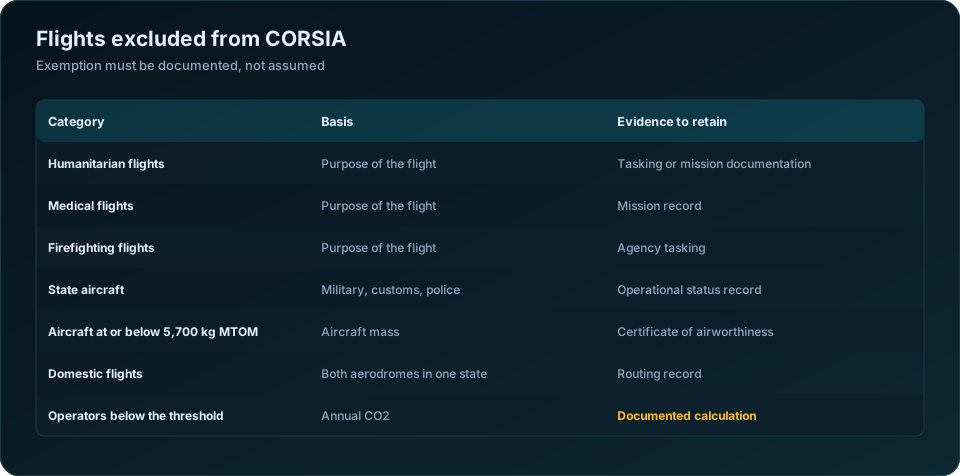
The exclusion categories
| Category | Basis | Evidence to retain |
|---|---|---|
| Humanitarian flights | Purpose of the flight | Tasking documentation, mission record |
| Medical flights | Purpose of the flight | Mission record, requesting authority |
| Firefighting flights | Purpose of the flight | Agency tasking documentation |
| State aircraft | Military, customs, police service | Operational status record |
| Aircraft at or below 5,700 kg MTOM | Aircraft mass | Certificate of airworthiness |
| Domestic flights | Both aerodromes within one state | Routing record |
| Operators below the threshold | Annual international CO2 | Documented calculation |
The first four are purpose or status based; the fifth is a property of the aircraft; the last two are structural. They behave differently in practice, and the purpose-based ones require the most careful handling.
Purpose-based exemptions and their evidence
A humanitarian, medical or firefighting flight is exempt because of what it was doing, and the operator must be able to demonstrate that after the fact — sometimes years later.
| Evidence element | Detail |
|---|---|
| Who tasked the flight | The requesting agency or authority |
| The nature of the mission | Relief, evacuation, organ transport, fire suppression |
| Date and routing | Matching the flight record |
| Any reference number | Mission or tasking reference |
| Contemporaneous record | Created at the time, not reconstructed |
The last row is decisive. A flight logged as an ordinary charter and reclassified as humanitarian during the reporting exercise, with no contemporaneous evidence, is a weak claim. A flight recorded at the time as operating under an agency tasking, with the reference captured in the operations record, is a strong one.
The practical control is to capture the exemption claim at the point of operation. A field in the flight record for exemption category and tasking reference, completed by operations staff on the day, costs nothing and produces contemporaneous evidence automatically.
Mixed missions
The awkward cases are flights that are partly exempt in character.
| Situation | Treatment |
|---|---|
| Relief cargo carried on a commercial sector | Commercial flight; not exempt |
| Positioning sector to collect relief cargo | Assess against the purpose test and document the reasoning |
| Medical evacuation returning empty | Both sectors relate to the mission; document |
| Firefighting aircraft repositioning between bases | Assess and document |
| Charter flight for a government department | Not automatically a state aircraft flight |
The last row is a common misconception. A commercial operator flying government officials under an ordinary charter contract is operating a commercial flight, not a state aircraft flight. The state aircraft exclusion concerns aircraft used in military, customs or police service, not any flight with a government customer.
Where a mixed case is genuinely arguable, document the reasoning at the time and apply it consistently. A verifier will accept a defensible position applied consistently far more readily than a series of individual judgements.
The aircraft mass exclusion
Aircraft at or below 5,700 kg maximum take-off mass are outside CORSIA entirely — their emissions are not reported and do not count towards the operator's threshold.
| Situation | Effect |
|---|---|
| Fleet entirely at or below 5,700 kg | No CORSIA obligation |
| Mixed fleet across the line | Only aircraft above the mass are in scope |
| Aircraft in scope, flight domestic | Out of scope for that flight |
| MTOM changed by modification | Reassess from the effective date |
| MTOM near the boundary | Confirm from the certificate, not from a type table |
The final row matters for aircraft types produced in several mass variants. Some business jets and turboprops exist in configurations both above and below the threshold, so the type designator does not settle the question. The certificate of airworthiness for the individual aircraft does, and that is the document to retain.
For the wider fleet and threshold interaction, see aircraft mass and other CORSIA exclusions.
Documenting exemptions in the reporting pack
| Element | Content |
|---|---|
| Exemption categories claimed | Which apply to this operator |
| Number of flights excluded | By category |
| Basis for each category | Purpose, mass, or routing |
| Evidence retained | What, and where held |
| Treatment of borderline cases | The reasoning applied |
| Approval | Who authorised each exclusion |
Disclosing excluded flights in the emissions report is better practice than omitting them silently. A verifier who discovers unreported flights that turn out to have been legitimately excluded still has to establish that, and a short disclosure saves the exercise.
For the classification of what remains in scope, see state pairs and route classification and CORSIA scope and thresholds. Exclusion definitions are set out in the ICAO CORSIA implementation elements.
Frequently Asked Questions
Which flights are exempt from CORSIA?
Humanitarian, medical and firefighting flights, state aircraft used in military, customs or police service, aircraft at or below 5,700 kg maximum take-off mass, domestic flights, and flights by operators below the annual emissions threshold.
What evidence is needed for a humanitarian flight exemption?
Contemporaneous documentation showing who tasked the flight, the nature of the mission, the date and routing matching the flight record, and any mission reference number. Reclassifying a flight during the reporting exercise without contemporaneous evidence is a weak claim.
Is a charter flight for a government department a state aircraft flight?
No. The state aircraft exclusion concerns aircraft used in military, customs or police service. A commercial operator carrying government officials under an ordinary charter contract is operating a commercial flight.
Are aircraft below 5,700 kg included in the CORSIA threshold calculation?
No. Aircraft at or below 5,700 kg maximum take-off mass are outside CORSIA entirely, so their emissions neither require reporting nor count towards the operator's threshold.
How should exemption claims be recorded?
At the point of operation, through a field in the flight record for exemption category and tasking reference completed by operations staff on the day. This produces contemporaneous evidence automatically and costs nothing.
Should excluded flights be mentioned in the emissions report?
Yes. Disclosing the categories claimed, the number of flights excluded and the evidence retained is better practice than silent omission, and it saves a verifier the exercise of establishing why flights are missing.
Planning your CORSIA position? DSTechnoverse provides CORSIA carbon credit services for Indian operators and project developers — scope and readiness assessment, monitoring plans, data pipelines, verification support, unit sourcing and second-phase modelling. We are based in Indore, Madhya Pradesh and work across India.
Apply as a CORSIA buyer or seller
Talk to our carbon markets team about your position.