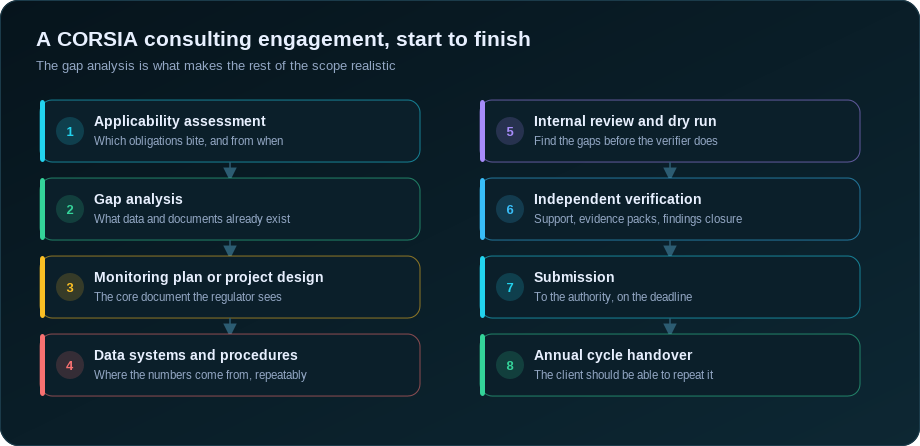
Most CORSIA problems are visible months before they become expensive. This is a structured self-assessment you can run in a day, before the compliance year starts, to find them while they are still cheap to fix.
Score each item: 2 if it is fully in place with evidence, 1 if partial, 0 if absent.
Section 1: Scope and Applicability
| # | Item | Score |
|---|---|---|
| 1.1 | A written applicability determination exists and is signed off | |
| 1.2 | Every legal entity and AOC in scope is identified | |
| 1.3 | The aircraft mass criterion has been applied to the current fleet | |
| 1.4 | International versus domestic classification is documented and systematised | |
| 1.5 | Exempt flight categories are identified and evidenced | |
| 1.6 | Route pairs attracting an offsetting requirement are identified for the year | |
| 1.7 | Someone tracks changes to the participating-state list | |
| 1.8 | Wet-leased and dry-leased aircraft responsibility is documented |
Item 1.8 is the one most often scored optimistically. If you cannot point to the clause or correspondence establishing responsibility, it is a 0.
Section 2: Monitoring Plan
| # | Item | Score |
|---|---|---|
| 2.1 | A monitoring plan exists and has been accepted by the authority | |
| 2.2 | The accepted version is identifiable and controlled | |
| 2.3 | The fleet list in the plan matches the current fleet | |
| 2.4 | The fuel monitoring method is stated and applied consistently | |
| 2.5 | The data flow section names systems and owners | |
| 2.6 | A data gap procedure exists, is conservative and pre-defined | |
| 2.7 | Control procedures state who checks what, how often | |
| 2.8 | A change control process routes operational changes into the plan |
Section 3: Data and Systems
| # | Item | Score |
|---|---|---|
| 3.1 | Fuel data is captured per flight, for every international sector | |
| 3.2 | Source documents are retained and retrievable within a day | |
| 3.3 | Outstation data arrives to a standard and a deadline | |
| 3.4 | A monthly completeness check runs and is evidenced | |
| 3.5 | Anomaly and duplicate checks run monthly | |
| 3.6 | Reported fuel is reconciled against fuel purchase records monthly | |
| 3.7 | A gap log records every gap, substitution and approval | |
| 3.8 | Unit and density conversions are documented and consistent |
Section 3 predicts your verification result more than any other. If items 3.2 and 3.6 score 0, expect a difficult first cycle regardless of how good the plan document is. See CORSIA fuel data quality management.
Section 4: Verification Readiness
| # | Item | Score |
|---|---|---|
| 4.1 | A verification body is identified and appointed | |
| 4.2 | Their accreditation and acceptability have been checked | |
| 4.3 | Independence from your consultant and internal team is confirmed | |
| 4.4 | An evidence pack structure exists and is populated through the year | |
| 4.5 | A worked example traces one flight from source to report | |
| 4.6 | An internal dry run is scheduled before fieldwork | |
| 4.7 | Prior-year findings are closed with evidence, not cosmetically |
Section 5: Offsetting (Where Applicable)
| # | Item | Score |
|---|---|---|
| 5.1 | The offsetting requirement is forecast with a low, central and high case | |
| 5.2 | Budget approval covers the high case | |
| 5.3 | A registry account is open and active | |
| 5.4 | A unit due diligence process exists, covering CA status | |
| 5.5 | Procurement is staged rather than concentrated at the deadline | |
| 5.6 | Any SAF claim has certification and chain-of-custody evidence | |
| 5.7 | Cancellation timing is calendared with transfer time allowed |
Item 5.3 catches operators every year. Registry account setup takes longer than expected and cannot be compressed under deadline pressure.
Section 6: Governance and Continuity
| # | Item | Score |
|---|---|---|
| 6.1 | A named compliance lead owns the cycle | |
| 6.2 | A named deputy exists and has seen a verification | |
| 6.3 | The accountable manager is engaged and understands what they sign | |
| 6.4 | A compliance calendar is held centrally, not in one inbox | |
| 6.5 | Written procedures exist for the annual cycle | |
| 6.6 | Someone monitors regulatory change and reports it | |
| 6.7 | Record retention meets the prescribed period and is retrievable |
Scoring and What to Do
Maximum score is 92. Interpret by section rather than in total, because a strong overall score can hide a section that fails.
| Section score | Position |
|---|---|
| 80% or above | In control; refine and maintain |
| 60-79% | Workable, with identified gaps to close before the year starts |
| 40-59% | Material risk in the coming cycle; prioritise the zeros |
| Below 40% | A first-cycle build, not a refinement; get support |
Fix in this order: every 0 in Section 3, then every 0 in Section 2, then Section 1, then Section 4, then 5 and 6.
That ordering is deliberate. Data (Section 3) takes longest to fix because it depends on behaviour at stations and on systems you may not control. A monitoring plan can be written in weeks; a year of clean fuel data cannot be created retrospectively at all.
Running It Well
- Score honestly. A 1 that should be a 0 costs you at verification, not in this exercise.
- Require evidence for every 2. If nobody can produce it in the room, it is a 1.
- Involve the data owners, not just the compliance lead. They know what actually happens at stations.
- Re-run it mid-year. The June check is the one that leaves time to act.
- Keep the completed sheets. The trend across years is itself evidence of a maturing control environment, and verifiers notice.
For what to do with the gaps, see CORSIA compliance for Indian airlines and, if the score suggests external help, CORSIA carbon credit consultant in India.
Turning the Score Into a Plan
A score is only useful if it produces a sequence of actions with owners and dates. Convert every 0 and 1 into a row:
| Gap | Owner | Fix | Lead time | By when |
|---|---|---|---|---|
| Outstation records not retrievable | Ops / ground handling | Scan-on-receipt; requirement into the handling agreement | 1-3 months | Before year start |
| No monthly reconciliation | Compliance / finance | Define the routine, schedule it, evidence it | 2-4 weeks | Immediately |
| Data gap procedure absent | Compliance lead | Write it, approve it, add to the plan | 2-4 weeks | Before year start |
| Plan does not match fleet | Compliance lead | Update and resubmit | 4-8 weeks | Before year start |
| Registry account not open | Finance / commercial | Begin the application | Unpredictable | Start now |
| No deputy compliance lead | Accountable manager | Appoint and include in verification | 1 month | Before verification |
Two sequencing rules make the difference between a plan that works and a list that does not.
Start the items with unpredictable lead times immediately, even if they score better than others. Registry account opening and authority interactions do not compress under pressure, and starting them early costs nothing.
Fix the data items before the document items. A monitoring plan can be written in weeks. A year of clean fuel data cannot be created retrospectively at all — so anything that changes what happens at a station or in a system belongs at the front of the plan, ahead of anything that only changes what a document says.
Review the plan monthly until every row is closed, and re-run the full assessment at mid-year against the new position.
Using the Assessment With a Consultant
If you engage external support, this completed assessment is the most useful document you can hand them. It shortens their gap analysis, focuses their proposal on your actual weaknesses, and gives you a basis for comparing quotes — because every firm is pricing against the same stated position rather than their own assumption about it.
It also protects you. A consultant who quotes against a disclosed weak position and later raises a variation for "unexpected data remediation" has a much harder argument to make. Disclose the low scores honestly for exactly that reason: hiding them produces a lower quote and a higher final invoice.
And re-run it after the first cycle. The delta between the two scores is the clearest evidence available of whether the engagement built lasting capability or simply produced a report.
Frequently Asked Questions
What is a CORSIA readiness assessment? A structured self-assessment across scope, monitoring plan, data, verification readiness, offsetting and governance, scored to show where the gaps are.
When should we run it? Before the compliance year begins, and again mid-year while there is still time to act.
Which section matters most? Data and systems. It predicts the verification result more than any other and takes the longest to fix.
What score is acceptable? Above 80% by section indicates control. Below 40% indicates a first-cycle build rather than a refinement.
Who should take part? The compliance lead, data owners for fuel and flight records, a finance contact and the accountable manager.
What if we score badly? Fix the zeros in data first, then the monitoring plan. Both are achievable before a compliance year starts if you begin early enough.
Can a consultant run this for us? Yes — it is essentially a gap analysis, and it is the right first paid engagement with any adviser.
How long does it take? A day internally, including the discussion the scoring provokes, which is often more valuable than the score.
Should we keep the results? Yes. The year-on-year trend is evidence of a maturing control environment.
Planning your CORSIA position? DSTechnoverse advises Indian operators and project developers on CORSIA compliance strategy — offsetting requirement forecasting, unit procurement due diligence, SAF and efficiency trade-offs, and readiness assessment before the compliance year begins. We are based in Indore, Madhya Pradesh and work with clients across India. See our CORSIA carbon credit services, our carbon credit portal at carboncredit.dstechnoverse.com, or talk to our team.
This article is general information, not legal, financial or regulatory advice. CORSIA rules, participating-state lists and eligibility criteria change — verify the current position with ICAO and the DGCA before acting.
Sources and Further Reading
Official and primary sources for the standards, rules and data discussed on this page.
- ICAO: CORSIA: the scheme home page with official documents and participating States.
- IATA: CORSIA: airline industry guidance and fact sheets on CORSIA.
- Bureau of Energy Efficiency (BEE): the administrator of India’s Carbon Credit Trading Scheme.
- Verra (Verified Carbon Standard): the largest voluntary carbon crediting programme and registry.