State Pairs and Route Classification: Which Flights Actually Create a CORSIA Obligation
· DSTechnoverse · CORSIA & Carbon Markets
Reporting covers all international flights. Offsetting covers only flights between participating state pairs. Conflating the two is the most expensive scoping error an operator makes.
An operator reviewing its network for CORSIA usually asks one question — which of our flights are international — and stops there. That answers the reporting question and not the offsetting one, and the difference between them is frequently a factor of two or three in cost.
Getting this right is the highest-value hour available at the start of a CORSIA programme, because every budget figure downstream depends on it.
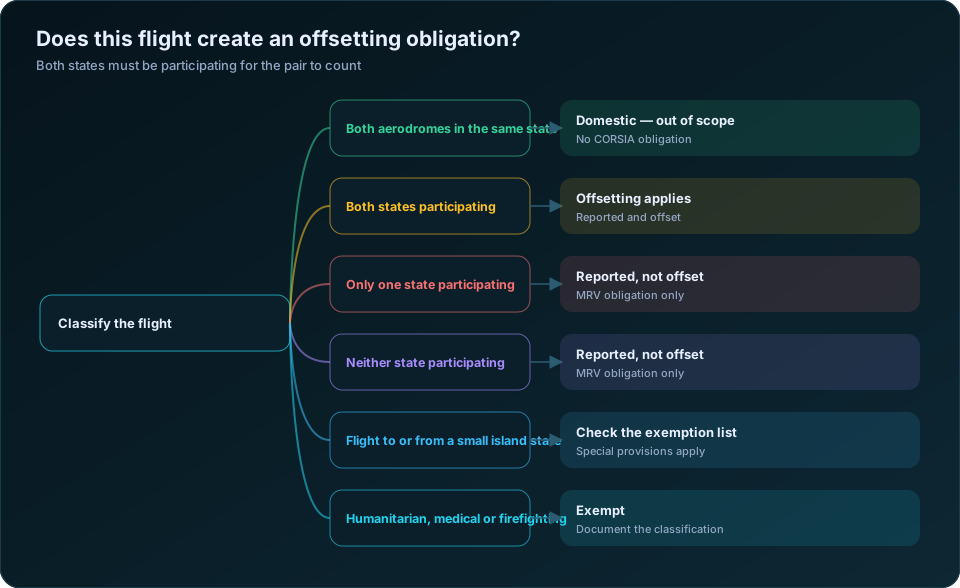
Two obligations, two scopes
| Reporting (MRV) | Offsetting | |
|---|---|---|
| Applies to | All international flights by an operator above the threshold | Flights between participating state pairs |
| Domestic flights | Out of scope | Out of scope |
| One participating state only | Reported | Not offset |
| Neither state participating | Reported | Not offset |
| Both states participating | Reported | Offset |
| Effect of the distinction | Data burden | Cost |
The reporting scope is broad and generates work. The offsetting scope is narrower and generates expenditure. An operator that models its offsetting cost across its entire international network will produce a number substantially higher than its actual obligation.
In the case described in a regional airline's first CORSIA cycle, 9 of 34 state pairs generated an offsetting obligation, and the operator's internal budget submission had assumed all 34.
Building the classification table
The exercise is mechanical once the inputs are assembled.
| Step | Detail |
|---|---|
| 1. List every aerodrome pair flown | From the schedule and ad-hoc records |
| 2. Map each aerodrome to its state | By ICAO code, using published aerodrome data |
| 3. Remove pairs where both aerodromes are in one state | Domestic, out of scope |
| 4. Identify the state pair for each remaining route | Origin state and destination state |
| 5. Check each state against the participating list | As published for the relevant period |
| 6. Classify | Both participating, one, or neither |
| 7. Record the classification and its date | The list changes over time |
Step seven matters more than it appears. Participation is not static — states join, and the list applicable to one compliance period is not necessarily the list applicable to the next. A classification table without a date is a table nobody can audit.
The classification should be rebuilt at the start of each reporting year and any change documented, since a state joining changes the offsetting scope for every route touching it.
Where classification goes wrong
| Error | Effect |
|---|---|
| Classifying by airline nationality rather than aerodrome location | Wrong from the start |
| Ignoring the direction of travel | Both directions of a pair share the classification |
| Using the marketing carrier's network | Attribution follows the operating carrier |
| Classifying by scheduled route, ignoring diversions | The aerodrome actually used governs |
| Treating technical stops as through-flights | Each sector is separately classified |
| Missing ad-hoc and charter sectors | They count like any other |
| Using a stale participation list | Scope shifts as states join |
The technical stop case catches operators out regularly. A flight from India to Europe with a fuel stop in the Gulf is two sectors, each with its own aerodrome pair and its own classification. Treating it as one long-haul sector between the origin and final destination misclassifies both.
Diversions follow the same principle: the aerodrome actually landed at determines the pair, not the one on the flight plan. This matters for both classification and distance, covered in how flight distance is established for CORSIA.
Building it into the data pipeline
Classification should be a derived field on every flight record, calculated automatically rather than applied manually to a route list.
| Field | Source |
|---|---|
| Origin aerodrome | Flight record |
| Destination aerodrome | Flight record, actual not planned |
| Origin state | Lookup from aerodrome reference data |
| Destination state | Lookup from aerodrome reference data |
| Origin state participating | Lookup from the participation table, by year |
| Destination state participating | Lookup from the participation table, by year |
| Classification | Derived: domestic, reported only, or offset |
Building it this way means diversions, ad-hoc sectors and new routes are classified correctly without anyone remembering to update a list. It also means the classification for a prior year can be reproduced from the participation table as it stood then, which is what verification requires. The architecture is discussed in sector-level data in CORSIA.
Planning implications
Because offsetting scope is route-specific, network decisions carry CORSIA consequences that are worth modelling in advance.
| Decision | CORSIA effect |
|---|---|
| Adding a route between two participating states | Adds offsetting obligation |
| Adding a route where only one state participates | Adds reporting only |
| Shifting capacity between routes | May change offsetting exposure without changing total emissions |
| A state joining the scheme | Existing routes touching it move into offsetting scope |
| Second phase, broader participation | A step change in exposure |
The fourth row is the one operators cannot control and must monitor. A state joining moves every route touching it into offsetting scope, and the operator's cost rises without any change in its own operations. Modelling that sensitivity — how much offsetting cost would arise if each significant non-participating state on the network joined — is a straightforward exercise and is rarely done.
For the phase structure see CORSIA phases and timeline and CORSIA second phase readiness for India 2027. The participating state list is published on the ICAO CORSIA states page.
Frequently Asked Questions
Do all international flights create a CORSIA offsetting obligation?
No. All international flights by an operator above the threshold must be reported, but only flights between two participating states create an offsetting obligation. Conflating the two can overstate cost estimates by a factor of two or three.
How is a state pair determined for CORSIA?
By the location of the origin and destination aerodromes, not by the operator's nationality or the marketing carrier's identity. Both directions of a route share the same classification.
How are technical stops classified?
As separate sectors. A flight with a fuel stop is two aerodrome pairs, each classified independently. Treating it as one through-flight between origin and final destination misclassifies both sectors.
What happens if a flight diverts?
The aerodrome actually landed at determines the state pair and the distance, not the aerodrome on the flight plan. Diversions should be captured automatically in the flight record rather than corrected manually.
Does the participating state list change?
Yes, as states join the scheme. A classification table therefore needs a date, must be rebuilt at the start of each reporting year, and must be reproducible as it stood in any prior year for verification.
How should route classification be implemented?
As a derived field calculated automatically on every flight record from aerodrome reference data and a dated participation table — not as a manually maintained route list, which will not survive diversions, ad-hoc sectors or new routes.
Planning your CORSIA position? DSTechnoverse provides CORSIA carbon credit services for Indian operators and project developers — scope and readiness assessment, monitoring plans, data pipelines, verification support, unit sourcing and second-phase modelling. We are based in Indore, Madhya Pradesh and work across India.
Apply as a CORSIA buyer or seller
Talk to our carbon markets team about your position.