New Entrants and Threshold Crossings: When CORSIA Starts Applying to You
· DSTechnoverse · CORSIA & Carbon Markets
A new operator starting international flights, and an existing one growing past the threshold, face different first-year positions. What triggers the obligation, and the quarterly monitor that prevents a surprise.
Two operators can arrive at a CORSIA obligation by different routes. One is newly established and begins international operations that exceed the threshold. The other has been flying for years and grows past it. The obligation is the same; the practical position in year one is not.
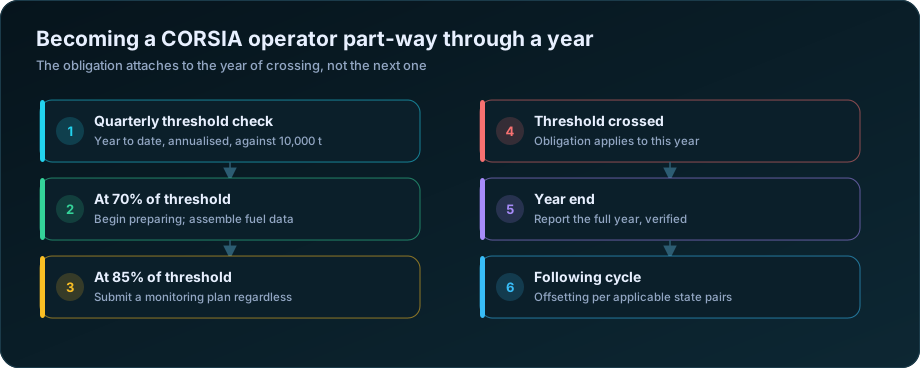
The trigger, and the year it attaches to
The obligation attaches to the year in which the threshold is exceeded, not the following one. This single point causes more difficulty than any other aspect of entry.
| Assumption | Reality |
|---|---|
| We crossed this year, so we start reporting next year | Reporting is required for the year of crossing |
| We can build systems and then start | Systems must cover the year already in progress |
| We will submit a monitoring plan for next year | The plan is needed for the current year |
| We will start collecting fuel data now | Data is needed from the start of the crossing year |
An operator that identifies a crossing in November is required to report the full year that began in January, using data it may not have been capturing. That is the position described in a business aviation operator crossing the threshold, and it turns an administrative task into a reconstruction exercise.
The new operator's position
A newly established operator has one substantial advantage: it can build the data capture correctly from the first flight.
| Advantage | Detail |
|---|---|
| No legacy data problem | Nothing to reconstruct |
| Contracts not yet signed | Fuel data clauses can be included from the start |
| Systems being selected anyway | CORSIA requirements can shape the choice |
| Processes being written anyway | Data capture built in rather than retrofitted |
| Staff being trained anyway | One training programme, not two |
The mistake new operators make is deferring CORSIA until the threshold is in sight. By then the handling agreements are signed without data clauses, the operations system has been chosen without reference to fuel record export, and the processes are established.
Building the capture from day one costs almost nothing. Retrofitting it costs the reconstruction exercise described in missing fuel uplift records.
| Action for a new operator | Timing |
|---|---|
| Include fuel data clauses in every handling agreement | At contract signature |
| Specify per-uplift export when selecting the operations system | At procurement |
| Capture the uplift docket at the point of uplift | From the first flight |
| Record aerodrome pairs and block times per sector | From the first flight |
| Run a threshold projection quarterly | From the first quarter |
The quarterly threshold monitor
For both new and established operators, the control is the same and takes about two hours a quarter.
| Metric | Purpose |
|---|---|
| Year-to-date international CO2 | The actual position |
| Annualised projection at current run rate | Where the year lands |
| Percentage of threshold on the projection | The trigger indicator |
| Fleet changes in the quarter | The leading indicator |
| Route changes in the quarter | The other leading indicator |
With two trigger levels attached:
At 70% of threshold on the projection — begin preparing. Assemble fuel data, assess data sources by station, scope the monitoring plan.
At 85% — submit a monitoring plan regardless of whether the threshold is ultimately crossed.
The asymmetry justifies triggering early. Preparing and not crossing wastes a monitoring plan that sits unused. Crossing without preparing means retrospective reconstruction, late disclosure and a compressed verification against a fixed deadline.
Note that the metric is driven by the operated fleet, not the owned one. An operator growing by taking aircraft on lease or under management contracts can cross without buying anything — see who reports CORSIA emissions for a leased aircraft.
Year one for a crossing operator
| Task | Note |
|---|---|
| Confirm the crossing with a defensible calculation | Do not assume; a scope review may change the answer |
| Classify routes by state pair | Reporting scope and offsetting scope differ |
| Submit the monitoring plan | Retrospectively, if the year has advanced |
| Reconstruct data from the start of the year | Where capture was not in place |
| Engage a verification body | Availability is the binding constraint |
| Open a registry account | Two to three months for a clean application |
| Assess the offsetting requirement | May be nil in the first cycle |
The registry account is the item most often started too late. It sits on the critical path to meeting any offsetting obligation and takes months even when the application is clean — see why CORSIA registry account applications get rejected.
The scope review in the first row is worth doing properly rather than assuming the crossing. It frequently changes the answer in the operator's favour, because sectors counted as generating an obligation may fall between state pairs where only one state participates.
After crossing
Falling below the threshold in a later year does not automatically end the obligation. Continuing reporting requirements generally apply, and the position should be checked against the current rules rather than assumed. The safe planning assumption is that crossing the threshold is a one-way door.
For the initial build see CORSIA for new airlines in India and CORSIA first year compliance in India. Threshold definitions are in CORSIA scope and thresholds and the ICAO CORSIA implementation elements.
Frequently Asked Questions
When does a CORSIA obligation start for a new operator?
In the year the threshold is exceeded, not the following year. An operator identifying a crossing late in the year is required to report the full year already in progress, using data it may not have been capturing.
What should a new airline do about CORSIA before it has an obligation?
Build the data capture from the first flight — fuel data clauses in every handling agreement, per-uplift export specified when selecting the operations system, uplift dockets captured at the point of uplift, and a quarterly threshold projection. It costs almost nothing and removes any later reconstruction.
How should an operator monitor its CORSIA threshold position?
Quarterly: year-to-date international CO2, an annualised projection, the percentage of threshold on that projection, and any fleet or route changes. Begin preparing at 70% and submit a monitoring plan at 85%.
Does the threshold follow the owned fleet or the operated fleet?
The operated fleet. An operator growing by taking aircraft on lease or under management contracts can cross the threshold without acquiring anything, which is a common way crossings go unnoticed.
What should be done first after crossing the threshold?
Confirm the crossing with a defensible calculation and a route classification review, which frequently changes the answer favourably. Then submit the monitoring plan, engage a verification body and open a registry account, since the last two have the longest lead times.
If we fall below the threshold later, does the obligation end?
Not automatically. Continuing reporting requirements generally apply and the position should be checked against the current rules. The safe planning assumption is that crossing is a one-way door.
Planning your CORSIA position? DSTechnoverse provides CORSIA carbon credit services for Indian operators and project developers — scope and readiness assessment, monitoring plans, data pipelines, verification support, unit sourcing and second-phase modelling. We are based in Indore, Madhya Pradesh and work across India.
Apply as a CORSIA buyer or seller
Talk to our carbon markets team about your position.