
Once you know what to ask, you have to decide how to collect the answers. The three main modes — CATI (phone), CAPI (tablet), and paper — each shape your survey's cost, quality, reach, and speed. Choosing well matters.
CAPI — Computer-Assisted Personal Interviewing
Enumerators conduct face-to-face interviews on tablets or smartphones running survey software.
Strengths:
- Built-in quality control — skip logic, validation, mandatory fields
- GPS and timestamps — verify interviews really happened
- Faster data — no separate data-entry step
- Audio audits — recorded snippets to check field quality
- Multimedia — show images or capture photos
Limitations:
- Device and software costs
- Needs enumerator training on the tool
- Battery/charging logistics in remote areas
CAPI is now the default for serious household and socio-economic surveys.
CATI — Computer-Assisted Telephone Interviewing
Interviews conducted by phone, with responses entered into software.
Strengths:
- Fast and low-cost — no travel
- Wide geographic reach quickly
- Good for short surveys and follow-ups
Limitations:
- Coverage bias — excludes those without phones
- Hard to build rapport or ask long/sensitive questions
- Not suited to observation-based data
Paper (PAPI) — Pen-and-Paper Interviewing
The traditional method: printed questionnaires filled in by hand.
Strengths:
- No technology required — works anywhere
- Low upfront cost
- Familiar and simple
Limitations:
- Separate data entry — slow and error-prone
- No automatic validation — skip-logic errors slip through
- Harder to verify field quality
- Bulky logistics for large surveys
Choosing a mode
| Priority | Best fit |
|---|---|
| Data quality & verification | CAPI |
| Speed & low cost, phone coverage good | CATI |
| No tech, very remote, small survey | Paper |
Mixed-mode surveys
Many projects combine modes — for instance, CAPI for the main household survey and CATI for follow-ups. Mixed modes broaden reach but require care to keep responses comparable across modes.
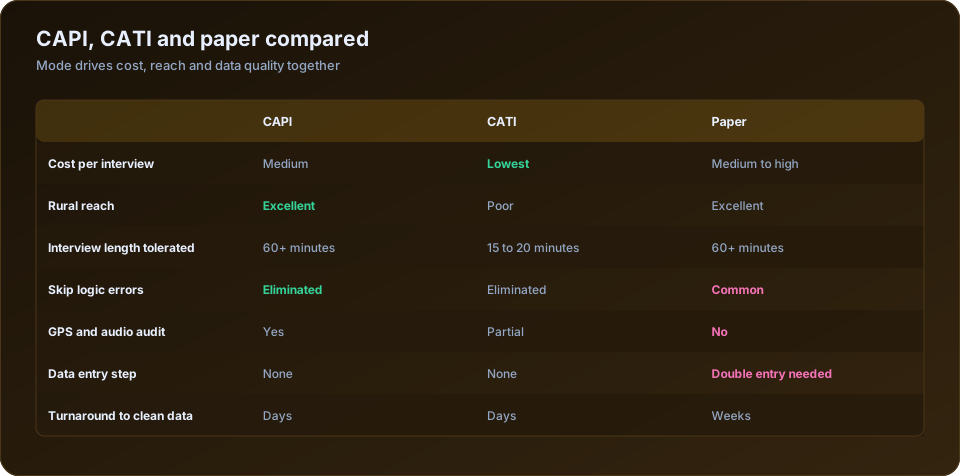
The comparison in full
| CAPI (tablet, in person) | CATI (telephone) | Paper (PAPI) | |
|---|---|---|---|
| Cost per completed interview | Medium | Lowest | Medium to high |
| Rural reach | Excellent | Poor | Excellent |
| Interview length tolerated | 60 minutes or more | 15 to 20 minutes | 60 minutes or more |
| Skip logic errors | Eliminated by the software | Eliminated | Common |
| Range and consistency checks | At the point of entry | At the point of entry | Only after data entry |
| GPS verification | Yes | No | No |
| Audio audit | Yes | Yes, if recorded | No |
| Data entry step | None | None | Double entry required |
| Time from field to clean data | Days | Days | Three to six weeks |
| Photographs and documents | Yes | No | No |
| Works without connectivity | Yes, syncs later | No | Yes |
| Upfront cost | Devices and programming | Call centre setup | Printing only |
| Sensitive questions | Moderate disclosure | Higher disclosure | Moderate |
Two rows drive most decisions. Rural reach rules out CATI for most Indian household surveys covering the general population — telephone frames systematically miss the poorest households, women in households where a man holds the phone, and areas with weak coverage. Time from field to clean data is why paper has largely disappeared from professional survey work: the data entry step adds weeks and introduces a fresh source of error.
When each mode is actually correct
CAPI is the default for household surveys, baselines, EIA studies and impact evaluations. It handles long instruments, verifies location, allows photographs of documents, and eliminates skip-logic error. The upfront cost of devices and programming is recovered on any study above a few hundred interviews.
CATI is correct for short follow-ups with respondents you have already met, business and institutional surveys where the phone frame is complete, rapid monitoring rounds, and any situation where physical access is impossible. It is excellent for a 12-minute check-in with households already enrolled at baseline, and unsuitable as the primary mode for a general-population rural survey.
Paper survives in three genuine cases: areas where devices create security or acceptability concerns, very small studies where programming costs exceed the entry savings, and as a backup when devices fail mid-fieldwork. Every CAPI study should carry printed backup forms for exactly this reason.
What changes when the mode changes
Mode is not a neutral delivery mechanism. The same question asked three ways produces different answers, and the differences are systematic.
| Effect | What happens |
|---|---|
| Social desirability | Respondents report more approved behaviour face to face than by phone |
| Satisficing | Telephone respondents choose earlier options in long lists more often |
| Acquiescence | Agreement bias is stronger by telephone |
| Recall quality | Face to face allows probing and the use of visual aids |
| Non-response | Telephone refusal rates are substantially higher |
| Item non-response | Higher by phone for income and other sensitive items |
| Household composition | Harder to enumerate accurately by telephone |
The practical implication for panel studies is serious. If your baseline was face-to-face and your endline is by telephone, some of the change you measure is mode effect rather than programme effect — and it can easily be larger than the effect you are looking for. If circumstances force a mode change, run a subsample in both modes to estimate the difference, and report it. See baseline vs endline survey.
Choosing a CAPI platform
| Platform | Best suited to |
|---|---|
| KoBoToolbox | Free, humanitarian and NGO use, quick deployment |
| ODK / ODK Central | Free and self-hosted, full control over data |
| SurveyCTO | Commercial, strong quality-control features and audit trails |
| Survey Solutions | Complex household rosters and multi-stage designs |
| CommCare | Programmes combining data collection with case management |
The features that matter for quality are similar across the serious platforms: GPS capture, timestamps on each question, audio auditing, offline operation with later sync, constraint and relevance logic, and an exportable audit trail. Confirm all six before committing, particularly the audit trail — it is what lets you detect an interview that was completed in four minutes.
Mixed-mode designs
Combining modes is often the sensible answer, and the standard pattern is CAPI for the main round and CATI for follow-ups. Collect a mobile number at baseline, and subsequent light-touch rounds become dramatically cheaper.
Two rules make mixed mode work. Keep the same mode for any indicator you intend to compare across rounds. And record the mode as a variable in the dataset, so it can be included as a control and any mode effect can be examined rather than assumed away.
For the field procedures that sit around the mode choice see how to conduct a socio-economic survey step by step and data quality control in large-scale surveys. Our socio-economic and baseline survey service runs CAPI fieldwork with GPS, audio audits and daily monitoring. KoBoToolbox is free to try and the fastest way to see how CAPI programming works in practice.
The takeaway
There is no universally "best" mode — only the best fit for your questions, population, budget, and timeline. For most household and socio-economic surveys, CAPI's built-in quality control makes it the strong default; CATI and paper still earn their place where reach, cost, or conditions demand.
Frequently Asked Questions
What is the difference between CAPI, CATI and PAPI?
CAPI is computer-assisted personal interviewing, conducted face to face on a tablet. CATI is computer-assisted telephone interviewing. PAPI is pen-and-paper interviewing, which requires a separate data entry stage. CAPI is the standard for household surveys; CATI suits short follow-ups.
Which survey mode is best for rural India?
CAPI. Telephone frames systematically miss the poorest households, women in households where a man controls the phone, and areas with weak network coverage. CAPI also handles the longer questionnaires that household surveys require.
Is CATI cheaper than face-to-face surveys?
Per completed interview, considerably. But it is unsuitable as the primary mode for general-population rural surveys because of coverage gaps, higher refusal rates and a 15 to 20 minute practical limit on interview length.
Do people answer differently on the phone than in person?
Yes. Telephone respondents show more acquiescence, choose earlier options in long lists more often, and have higher item non-response on sensitive questions such as income. Face-to-face interviews elicit more socially approved answers on some topics.
Can I switch from paper to CAPI mid-project?
You can, but not for indicators being compared across rounds — the mode change itself shifts responses. If a switch is unavoidable, run a subsample in both modes to estimate the difference and report it alongside your results.
What CAPI software should I use for a household survey?
KoBoToolbox and ODK are free and widely used; SurveyCTO and Survey Solutions offer stronger quality-control features for complex designs. Whichever you choose, confirm it supports GPS capture, question timestamps, audio audits, offline operation and an exportable audit trail.
How DSTechnoverse Runs Your Survey
DSTechnoverse is a full-service socio-economic and baseline survey agency based in Indore. We do not just advise — we run the whole study end to end and hand you evidence you can defend:
- Design — objectives, indicators, and sampling (random, stratified, cluster, or multi-stage), with a piloted questionnaire translated into local languages.
- Field data collection — trained enumerators using CAPI (tablet) tools such as KoBoToolbox, ODK, and SurveyCTO-style apps, with GPS stamping, audio audits, and built-in skip-logic validation.
- Quality control — back-checks, spot-checks, and daily high-frequency data monitoring so problems are caught in the field, not after.
- Analysis — SPSS, R, Python, and Excel for indicators, cross-tabulations, and impact estimates, including baseline–endline difference-in-differences.
- A detailed report — cleaned datasets, indicator tables, charts, GIS maps, and clear interpretation, with interactive Power BI / Tableau dashboards on request.
Our survey experience in Indore includes Smart City citizen-feedback surveys, Startup India & MSME surveys, Swachh Survekshan (Swachh Bharat) cleanliness surveys, and skill-development impact evaluations — delivered for government, municipal, corporate, and NGO clients.
Planning a socio-economic, baseline, endline, or willingness-to-pay survey? Talk to our survey team for a scope and quote.