
A large survey can involve dozens of enumerators and thousands of interviews across a wide area. That scale creates enormous room for error — and, occasionally, fraud. Quality control is the system that keeps the data honest. Here is what good QC looks like.
Quality control happens at every stage
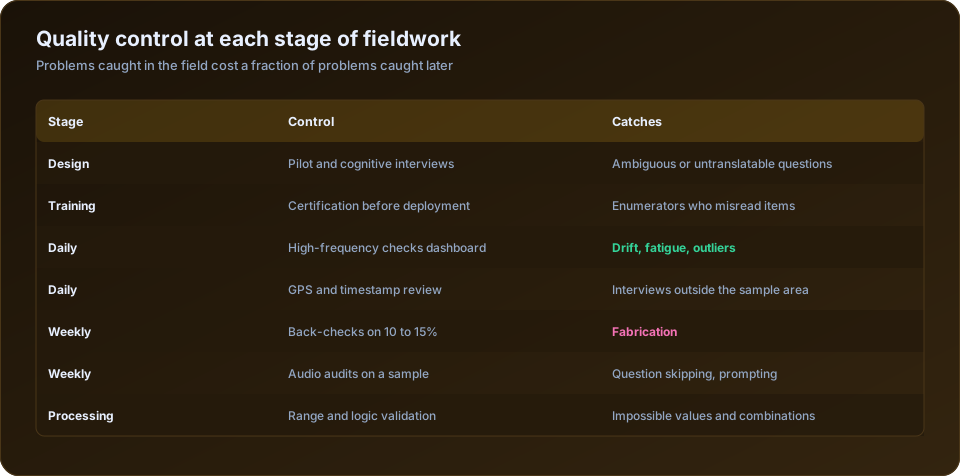
QC is not a single check at the end — it runs from design through analysis.
During survey design
- Pilot testing to catch flawed questions and logic early
- Built-in validation in CAPI tools — range checks, mandatory fields, skip logic
- Clear protocols for edge cases
During fieldwork — the critical phase
This is where most quality is won or lost.
Back-checks (re-interviews)
Supervisors re-interview a sample of each enumerator's respondents to confirm the interview happened and key answers match. Back-checks are the single most powerful anti-fraud tool.
Spot-checks and accompaniment
Supervisors observe live interviews to catch technique problems and coach on the spot.
GPS and timestamp verification
CAPI records where and when each interview happened. Interviews with impossible locations, suspicious durations, or clustered timestamps get flagged.
Audio audits
Short recorded snippets let reviewers verify interviews were conducted properly.
High-frequency checks
Data is reviewed daily as it comes in — monitoring response rates, outliers, straight-lining, and enumerator-level patterns — so problems are caught within days, not after fieldwork ends.
During data processing
- Range and logic checks for impossible or inconsistent values
- Duplicate detection
- Consistency checks across related questions
- Transparent handling of missing data and outliers
Enumerator-level monitoring
Comparing enumerators reveals a lot: one whose interviews are unusually fast, unusually uniform, or statistically odd deserves a closer look. Dashboards that track each enumerator's metrics make outliers visible.
Documentation
Every QC action — back-check results, flags raised, corrections made — should be documented. This is what lets you demonstrate data quality to clients, regulators, and funders.
The economics of catching problems early
Every quality control decision is really a decision about when you would rather find out.
| Caught at | Cost to fix |
|---|---|
| Pilot stage | Rewrite a question — hours |
| Day 2 of fieldwork | Retrain one enumerator — one conversation |
| Day 20 of fieldwork | Re-survey that enumerator's completed interviews |
| During cleaning | Drop the variable, or the affected cases |
| After the report is submitted | Correction, and a credibility problem |
This is the entire argument for daily monitoring. The same defect costs a conversation on day two and a re-survey on day twenty, and the difference is only how quickly someone looked at the data.
The daily dashboard
Data syncing from CAPI devices should be reviewed every evening against a fixed set of indicators. Six checks catch the overwhelming majority of field problems.
| Check | Flag when | What it usually means |
|---|---|---|
| Interviews per enumerator per day | More than 1.5× the team median | Shortened interviews or fabrication |
| Median interview duration | Below 60% of the team median | Sections being skipped |
| Duration of specific modules | Near zero for a long module | Module skipped through rapid clicking |
| GPS point vs assigned village | Outside the boundary | Interview conducted elsewhere |
| Don't-know and refusal rate | Well above the team rate | Enumerator not probing, or fabricating |
| Distribution of key outcomes | Differs systematically from peers | Different interpretation, or invention |
The module-duration check is the most useful and the least commonly implemented. An enumerator can produce a plausible total interview time while clicking through the income module in eleven seconds. Timestamps at question level are what make this visible, which is why an exportable audit trail should be a requirement when selecting a CAPI platform — see CATI vs CAPI vs paper surveys.
Back-checks: the protocol that matters
Back-checking means independently re-interviewing a subset of households on a short subset of questions, and comparing. It is the only direct test of whether an interview happened as recorded.
| Element | Standard practice |
|---|---|
| Coverage | 10 to 15% of completed interviews |
| Who does it | A supervisor or a dedicated back-check team, never the original enumerator |
| Timing | Within 3 to 7 days of the original interview |
| Length | 8 to 12 questions, 10 minutes |
| Question selection | Stable facts, not opinions or fluctuating values |
| Sampling | Random, plus targeted at anyone the dashboard flagged |
Choose back-check questions that should not change and cannot be misremembered: household size, roof material, toilet presence, electricity connection, whether anyone in the household attends school. Do not back-check attitudes, last month's expenditure, or anything a respondent might reasonably answer differently on a second occasion — a discrepancy there proves nothing.
| Discrepancy rate | Interpretation | Action |
|---|---|---|
| Under 5% | Normal measurement variation | No action |
| 5 to 10% | Comprehension problem | Retrain that enumerator; review their interviews |
| 10 to 20% | Serious quality failure | Suspend and re-survey a sample of their work |
| Above 20%, or household denies the interview | Probable fabrication | Remove from the team; re-survey all their interviews |
The rule that must be written before fieldwork: what happens when fabrication is confirmed. Deciding in the moment, with a deadline approaching, produces the wrong decision. The rule should be that all interviews by that enumerator are re-surveyed, and it should be in the agency contract.
Audio audits
Recording a portion of each interview, with respondent consent, is the closest thing to sitting in the room. A sample of 5 to 10% of interviews, reviewed for a few minutes each, reveals things no numeric check can:
- Whether questions were read as written or improvised.
- Whether the enumerator led the respondent toward an answer.
- Whether the household roster was properly enumerated or assumed.
- Whether other family members answered on the respondent's behalf.
- Whether consent was properly obtained.
Reviewers do not need to listen to whole interviews. Spot-checking two or three minutes from a randomly chosen module across many interviews is more informative than listening to a few in full. Consent for recording must be explicit and the option to decline genuinely available.
Processing-stage validation
After fieldwork, before analysis, the dataset needs its own checks. These are distinct from cleaning judgement calls — they are mechanical rules that either pass or fail.
| Validation | Example |
|---|---|
| Range checks | Age between 0 and 110; household size between 1 and 30 |
| Logical consistency | Age 14 cannot have 20 years of work experience |
| Skip pattern integrity | Answered a question that should have been skipped |
| Duplicate detection | Same household identifier recorded twice |
| Cross-module consistency | Roster count matches the reported household size |
| Completeness by module | No module with an unexplained spike in missing values |
| Outlier flagging | Values far outside the distribution, for investigation not deletion |
Every rule that fails, and every resulting change, belongs in a cleaning log. The standard to hold is that someone should be able to delete the clean dataset and rebuild it exactly by running the documented steps against the raw file. What that involves is covered in how to clean survey data before analysis.
What the report should disclose
A methods section that states quality control was performed says nothing. State the numbers: back-check percentage and discrepancy rate, number of interviews rejected and why, response rate with non-contacts and refusals separated, audio audits conducted, and any enumerator removed with the treatment of their data.
Disclosure of a problem found and fixed builds more confidence than silence. A report saying two enumerators were removed and their 180 interviews re-surveyed is a report from a study that was actually monitored.
For the training that prevents these problems see training enumerators for a quality field survey, and for the bias types quality control is defending against, how to reduce bias in field surveys. Our socio-economic and baseline survey service runs daily high-frequency checks and 12% back-checks as standard. SurveyCTO's data quality guidance documents high-frequency check design in practical detail.
The takeaway
In large surveys, quality does not happen by accident — it is engineered through layered checks at design, fieldwork, and processing. Back-checks, GPS, high-frequency monitoring, and enumerator-level analysis together turn a sprawling field operation into data you can genuinely stand behind.
Frequently Asked Questions
What is a back-check in survey research?
An independent re-interview of a sample of households on a short set of stable questions, conducted by a supervisor rather than the original enumerator, to verify that interviews took place as recorded. Standard coverage is 10 to 15% of completed interviews.
What percentage of interviews should be back-checked?
Ten to fifteen percent, split between random selection and targeted checks on enumerators flagged by daily monitoring. Higher rates early in fieldwork, when problems are cheapest to correct, are a sensible allocation.
How do you detect fabricated survey data?
Through interview duration far below the team median, module-level timestamps showing sections completed impossibly fast, GPS points outside the assigned area, unusually low don't-know rates, outcome distributions differing systematically from other enumerators, and back-checks where households deny the interview occurred.
What are high-frequency checks?
Automated daily reviews of incoming data covering interviews per enumerator, interview and module durations, GPS locations, missingness rates and outcome distributions by enumerator. They catch problems while the team is still in the field and the fix is still cheap.
What should happen if an enumerator is found fabricating data?
They should be removed from the team and all of their interviews re-surveyed. The rule must be written into the contract before fieldwork begins, because deciding under deadline pressure reliably produces a weaker decision.
Are audio recordings of interviews ethical?
Yes, with explicit consent and a genuine option to decline, secure storage, and deletion after a stated period. Audio audits are among the most effective quality tools available, revealing improvised wording and leading questions that no numeric check can detect.
How DSTechnoverse Runs Your Survey
DSTechnoverse is a full-service socio-economic and baseline survey agency based in Indore. We do not just advise — we run the whole study end to end and hand you evidence you can defend:
- Design — objectives, indicators, and sampling (random, stratified, cluster, or multi-stage), with a piloted questionnaire translated into local languages.
- Field data collection — trained enumerators using CAPI (tablet) tools such as KoBoToolbox, ODK, and SurveyCTO-style apps, with GPS stamping, audio audits, and built-in skip-logic validation.
- Quality control — back-checks, spot-checks, and daily high-frequency data monitoring so problems are caught in the field, not after.
- Analysis — SPSS, R, Python, and Excel for indicators, cross-tabulations, and impact estimates, including baseline–endline difference-in-differences.
- A detailed report — cleaned datasets, indicator tables, charts, GIS maps, and clear interpretation, with interactive Power BI / Tableau dashboards on request.
Our survey experience in Indore includes Smart City citizen-feedback surveys, Startup India & MSME surveys, Swachh Survekshan (Swachh Bharat) cleanliness surveys, and skill-development impact evaluations — delivered for government, municipal, corporate, and NGO clients.
Planning a socio-economic, baseline, endline, or willingness-to-pay survey? Talk to our survey team for a scope and quote.
Sources and Further Reading
Official and primary sources for the standards, rules and data discussed on this page.
- World Bank DIME Wiki: field survey, data quality and impact evaluation guidance.
- Ministry of Statistics and Programme Implementation (MoSPI): official Indian surveys, sampling frames and NSS reports.
- American Statistical Association: statement on p-values (2016): six principles for interpreting p-values correctly.
- NIST/SEMATECH e-Handbook of Statistical Methods: a free reference on statistical methods and tests.