
Commissioning a large household survey is a leap of faith: you are trusting an agency to send teams into the field and bring back data you will base real decisions on. Choose well and the data is gold; choose badly and it is worthless. Here is how to pick a household survey agency you can rely on.
1. Field reach and local presence
Household surveys live or die on the ground. Ask:
- Do they have enumerator networks in your target regions?
- Do their fieldworkers speak the local languages?
- Can they reach remote or hard-to-access areas?
An agency without genuine local presence will struggle where it matters most.
2. Sampling expertise
Representative data comes from sound sampling. A credible agency can explain:
- How they will select households (random, stratified, cluster, etc.)
- How they will handle non-response and replacements
- How they ensure the sample represents your target population
Vague answers here are a warning sign.
3. Quality-control systems
Field data is easy to fake or fumble. Look for:
- Back-checks and spot-checks during fieldwork
- GPS stamping and audio audits on digital surveys
- Supervisor structures in the field
- Logic and consistency checks on incoming data
4. Data collection technology
Modern agencies use CAPI (tablet-based) tools that enforce skip logic, validate answers, and timestamp interviews — reducing errors and fraud versus paper.
5. Experience with your kind of study
Baseline/endline, socio-economic, willingness-to-pay, KAP — each has its own demands. An agency that has done your type of survey before will anticipate the pitfalls.
6. Transparent reporting
You want more than a dataset. Expect:
- A clear methodology note
- Fieldwork documentation (response rates, challenges)
- Clean, labelled data and analysis
- Willingness to explain and defend their choices
Red flags
- Prices that seem too good to be true (fieldwork is expensive)
- No clear sampling plan
- No quality-control detail
- Reluctance to share methodology
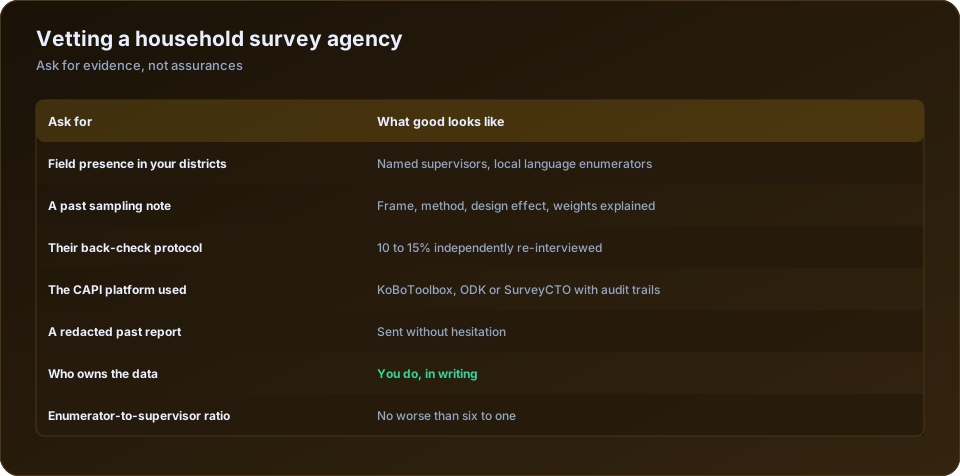
Ask for evidence, not assurances
Every agency will say it has experienced enumerators and rigorous quality control. The difference between agencies shows up only when you ask for the artefacts.
| Ask for | What a strong agency produces | What a weak one says |
|---|---|---|
| A past sampling note | A document stating frame, method, design effect and weights | "We use random sampling" |
| The back-check protocol | A written procedure: 10 to 15%, independent supervisor, defined discrepancy rules | "Our supervisors check the work" |
| A redacted past report | Sent within a day | Confidentiality cited for everything |
| The CAPI instrument from a past study | An exported form showing skip logic and validation | Screenshots, or nothing |
| Enumerator training materials | A manual and a certification test | "We brief them before starting" |
| Names of field supervisors for your districts | Actual names and languages spoken | "We will arrange a team" |
| A cleaning log from a past project | A record of what was changed and why | The clean dataset only |
Two of these carry unusual diagnostic weight. An agency that has never written a sampling note has probably never had its sampling questioned, which tells you about the scrutiny its previous work received. And an agency that cannot produce a cleaning log has no reproducible pipeline — the clean dataset arrived by unrecorded manual editing.
The specification you should send
Agencies price what they are asked for. A vague brief produces quotes that cannot be compared and a project that changes scope halfway through.
| Specify | Example |
|---|---|
| Population and geography | Rural households, 4 blocks of Dhar district |
| Target sample and how it was derived | 1,000 households, ±5% with DEFF 1.6 and 85% response |
| Sampling method required | Multi-stage PPS, 25 households in each of 40 villages |
| Instrument status | Draft attached, 45 minutes, needs Hindi translation |
| Mode | CAPI on Android tablets, with GPS capture |
| Quality requirements | 12% back-checks, daily HFC dashboard, audio audits on 5% |
| Deliverables | Clean dataset, cleaning log, codebook, syntax, report |
| Data ownership | Client owns data and instruments |
| Timeline with milestones | Training week 3, fieldwork weeks 4 to 7 |
Specifying the quality requirements yourself is what makes quotes comparable. If you leave back-check rates unstated, one agency will price 15% and another will price zero, and the second will look cheaper for reasons that have nothing to do with efficiency.
Comparing quotes without being misled
| Quote appears low because | How to check |
|---|---|
| No back-checks or supervision priced in | Ask for the supervisor-to-enumerator ratio and back-check % |
| Enumerators paid per interview, not per day | Piece rates reward speed over accuracy — ask directly |
| Cleaning and analysis excluded | Confirm the deliverable list line by line |
| Translation excluded | Ask who translates and who back-translates |
| Fewer villages, more households each | Check the cluster design; this raises the design effect |
| Travel and revisits not budgeted | Ask how many revisit attempts are funded |
| Sample listing excluded | If no frame exists, listing is a real cost |
The piece-rate question is the most revealing single question you can ask about field quality. An enumerator paid per completed interview has a direct financial incentive to shorten interviews, skip modules and accept the first answer given. Day rates with a reasonable expected output align incentives far better.
Capability, matched to your study
Different studies need genuinely different agencies, and the best agency for one is often wrong for another.
| Your study | What matters most |
|---|---|
| Impact evaluation with a comparison group | Analytical capability, not just fieldwork |
| EIA socio-economic baseline | Familiarity with ToR requirements and public hearings |
| CSR baseline and impact assessment | Board-ready reporting, statutory formats |
| Multi-state study | Genuine presence in each state, not subcontracting chains |
| Sensitive topics — health, violence, caste | Female enumerators, ethics protocol, referral procedures |
| Tribal or remote areas | Local language enumerators, community entry experience |
| Panel study across years | Tracking systems and staff continuity |
Ask specifically whether fieldwork will be subcontracted. Multi-state work often passes through two or three layers of subcontracting, and by the third layer nobody you spoke to has met the enumerators. That is not automatically disqualifying, but you should know about it and be able to name who is accountable.
Red flags
Disqualifying. Piece rates with no supervision. Refusal to allow you to observe fieldwork. Unwilling to give you the raw data. No written back-check protocol. Guaranteed response rates above 95%.
Serious. No named supervisor for your districts. Quotes given without seeing the instrument. Sample size proposed without any calculation. No prior work in your kind of study.
Worth probing. Very fast promised timelines — fieldwork has physical limits. Prices far below the market, which usually means quality control was not priced. A very long client list with no releasable examples.
The guaranteed-response-rate flag is worth explaining. Rural household surveys with proper revisit protocols achieve 85 to 90%; urban surveys often less. An agency promising 98% is either planning to substitute households freely or planning to fabricate. Both destroy the sample.
For scoping before you approach anyone, see how much does a socio-economic survey cost and how to determine sample size for a household survey. For what the agency should be doing in the field, data quality control in large-scale surveys. Our socio-economic and baseline survey service works to the specification described above. The World Bank's survey solutions guidance covers procurement standards for household data collection.
The takeaway
The cheapest quote is rarely the best value — bad field data costs you far more in wrong decisions. Weigh field reach, sampling rigour, quality control, and transparency, and you will find an agency whose numbers you can actually trust.
Frequently Asked Questions
How do I choose a household survey agency?
Ask for artefacts rather than assurances: a past sampling note, a written back-check protocol, a redacted report, training materials, and the names of supervisors for your districts. Agencies that can produce these have had their work scrutinised before.
What should a survey agency's back-check rate be?
Ten to fifteen percent of completed interviews, re-administered independently by a supervisor rather than the original enumerator, with a written procedure for what happens when responses disagree. Specify this in your brief so quotes are comparable.
Why is one survey quote much cheaper than another?
Usually because quality control was not priced in — no back-checks, thin supervision, enumerators on piece rates, or cleaning and translation excluded. Compare quotes line by line against a specification you wrote, not against each other.
Should enumerators be paid per interview or per day?
Per day. Piece rates create a direct incentive to shorten interviews, skip modules and accept the first answer offered. Day rates with a reasonable expected output produce better data at a similar total cost.
Can I observe the fieldwork?
Yes, and any agency that resists should be excluded. Accompanying enumerators for a day early in fieldwork is the single most informative quality check available to a client, and it surfaces problems while they are still cheap to fix.
Does the survey agency or the client own the data?
The client should, and it belongs in writing in the contract along with instruments, translations and the cleaned dataset. Confirm it before signing rather than after fieldwork is complete.
How DSTechnoverse Runs Your Survey
DSTechnoverse is a full-service socio-economic and baseline survey agency based in Indore. We do not just advise — we run the whole study end to end and hand you evidence you can defend:
- Design — objectives, indicators, and sampling (random, stratified, cluster, or multi-stage), with a piloted questionnaire translated into local languages.
- Field data collection — trained enumerators using CAPI (tablet) tools such as KoBoToolbox, ODK, and SurveyCTO-style apps, with GPS stamping, audio audits, and built-in skip-logic validation.
- Quality control — back-checks, spot-checks, and daily high-frequency data monitoring so problems are caught in the field, not after.
- Analysis — SPSS, R, Python, and Excel for indicators, cross-tabulations, and impact estimates, including baseline–endline difference-in-differences.
- A detailed report — cleaned datasets, indicator tables, charts, GIS maps, and clear interpretation, with interactive Power BI / Tableau dashboards on request.
Our survey experience in Indore includes Smart City citizen-feedback surveys, Startup India & MSME surveys, Swachh Survekshan (Swachh Bharat) cleanliness surveys, and skill-development impact evaluations — delivered for government, municipal, corporate, and NGO clients.
Planning a socio-economic, baseline, endline, or willingness-to-pay survey? Talk to our survey team for a scope and quote.