
Corporate Social Responsibility (CSR) and development spending is under more scrutiny than ever. Boards, funders, and regulators want proof that money changed lives — not just that it was spent. A baseline survey is where that proof begins.
Why CSR projects need a baseline
Increasingly, CSR is expected to be outcome-driven, not activity-driven. It is no longer enough to report "we built 10 wells" — stakeholders ask "and what changed as a result?" Answering that requires:
- A baseline of conditions before the project
- An endline afterward to measure change
- The ability to attribute change credibly
Without a baseline, a CSR project can describe its activities but never prove its impact.
What a CSR baseline typically measures
Depending on the project's theme:
- Education projects — enrolment, attendance, learning outcomes
- Health projects — access, nutrition, health indicators
- Livelihood projects — income, employment, skills
- WASH projects — water access, sanitation, hygiene practices
- Community infrastructure — access to and use of services
The baseline focuses on the specific outcomes the project intends to change.
Benefits beyond compliance
A good baseline does more than satisfy reporting requirements:
- Better project design — real data reveals actual needs, so interventions fit
- Targeting — identifies who most needs the programme
- Credible impact reporting — evidence for annual reports and boards
- Funder confidence — rigorous M&E attracts and retains funding
- Learning — insight into what works, to improve future projects
Doing it right
CSR baselines benefit from the same rigour as any survey:
- Representative sampling of the target community
- A focused questionnaire on the project's outcome indicators
- Trained, local enumerators who can build trust
- Quality control so the data is defensible
- Comparability with the future endline
The reporting payoff
When endline arrives, a strong baseline lets a CSR team say something powerful and specific: not "we spent X," but "household incomes in our target villages rose by Y% over the project period." That is the kind of statement boards, funders, and regulators actually value.
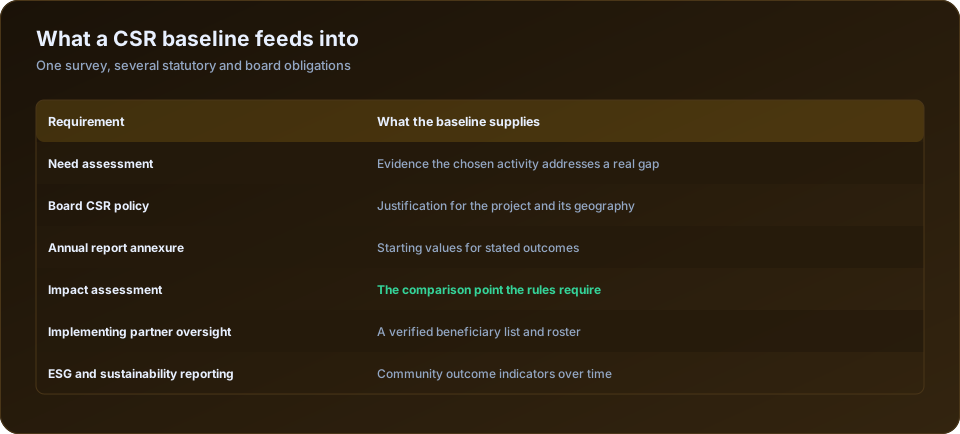
The obligations a baseline actually serves
Under Section 135 of the Companies Act and the CSR Rules, a qualifying company's obligations extend well past spending the money. A single well-designed baseline feeds several of them at once, which is the practical argument for doing it properly rather than minimally.
| Obligation | What the baseline supplies |
|---|---|
| Need assessment before project selection | Evidence that the chosen activity addresses a real, measured gap |
| Board-approved CSR policy and annual action plan | Justification for the project, its geography and its beneficiaries |
| Annual report annexure | Starting values against which outcomes are later stated |
| Impact assessment for larger projects | The comparison point without which impact cannot be assessed |
| Implementing agency oversight | A verified beneficiary roster the company itself holds |
| BRSR and ESG reporting | Community outcome indicators tracked consistently over years |
The impact assessment requirement is the one that most often arrives as a surprise. Companies above the specified spending threshold must have qualifying projects independently assessed for impact — and impact cannot be assessed without a starting point. Discovering this in year three, with no baseline, leaves only weak options: a recall-based reconstruction, or an assessment that describes activities rather than outcomes.
Where CSR baselines differ from academic ones
A CSR baseline has a different audience and a different set of pressures, and designing it like a research study produces something the board will not use.
| Research baseline | CSR baseline | |
|---|---|---|
| Primary audience | Peer reviewers | Board, CSR committee, auditors |
| Priority | Methodological completeness | Decision relevance and defensibility |
| Indicator count | As many as the questions require | Focused — 15 to 25 that map to stated outcomes |
| Reporting cycle | Once, at publication | Annually, for years |
| Sensitivity | Low | High — it is a public document |
| Success criterion | Valid inference | Evidence a committee can act on and disclose |
The indicator discipline matters most. CSR baselines routinely balloon to eighty indicators because every stakeholder adds a request, and then only six ever appear in a report. Each additional indicator lengthens the interview, raises refusal rates and lowers data quality for everything else.
The test to apply to each proposed indicator: which sentence in next year's annual report does this number complete? If nobody can answer, it comes out. This is the same dummy-table discipline described in how to conduct a socio-economic survey step by step, and it is worth applying strictly here.
Aligning indicators to Schedule VII
CSR activities must fall within Schedule VII of the Act, and baselines are most useful when their indicators map directly onto the activity category being funded.
| Schedule VII area | Baseline indicators that matter |
|---|---|
| Education | Enrolment and attendance by age and gender, dropout, learning level, distance to school |
| Health and sanitation | Illness episodes, out-of-pocket cost, toilet access and use, water source and distance |
| Nutrition | Meal frequency, dietary diversity, child anthropometry where feasible |
| Livelihoods and skilling | Occupation, days of paid work, income sources, existing skills, migration |
| Women's empowerment | Workforce participation, decision-making say, account ownership, mobility |
| Environment | Fuel type, tree cover on holdings, waste practice, water use |
| Rural development | Road and market access, electricity hours, bank and mobile access |
Mapping this way has a reporting benefit beyond tidiness: it lets the company state outcomes in the same categories the statutory annexure uses, rather than translating between a survey report and a disclosure format every year.
Getting it done in a corporate timeline
CSR baselines face a constraint academic studies do not: the funds must be committed within the financial year, and the implementing partner is often ready to start before the baseline is designed.
| Constraint | Practical response |
|---|---|
| Implementation is about to begin | Survey the first cohort's villages before any activity reaches them |
| Financial year deadline | Run a lean baseline on core indicators; add depth at midline |
| Multiple locations, one budget | Sample locations rather than covering all exhaustively |
| Partner already has a beneficiary list | Verify it independently — do not treat it as a sampling frame |
| Board wants results this quarter | Report the baseline as a needs assessment; it has value on its own |
The beneficiary-list point is worth emphasising. A list supplied by an implementing agency is a record of who they intend to serve, not a sample of the population. Using it as the sampling frame means the baseline describes participants only, and the company loses any ability to compare participants with non-participants later — which is precisely what an impact assessment will need. See how baseline and endline surveys power impact evaluation.
What a CSR baseline costs
| Scale | Indicative cost (INR) | Typical use |
|---|---|---|
| 250 to 400 households, one cluster | 2,50,000 to 5,00,000 | Single-location project |
| 800 to 1,200 households, one district | 7,00,000 to 15,00,000 | District programme with impact assessment planned |
| 2,000+ households, multi-state | 18,00,000 to 40,00,000 | Flagship programme across geographies |
As a share of programme spend, a baseline typically runs at 2 to 5% — proportionate against the cost of discovering in year three that the programme addressed a problem the community did not have, or that impact cannot be demonstrated because nothing was measured at the start.
For the survey mechanics see what is a baseline survey and key socio-economic indicators every baseline should measure. Our socio-economic and baseline survey service runs CSR baselines and impact assessments with board-ready reporting. The Ministry of Corporate Affairs CSR portal holds the current text of Section 135 and the CSR Rules.
The takeaway
For CSR and development projects, a baseline survey is the foundation of credible impact. It sharpens project design, targets the right people, and — most importantly — makes it possible to prove, later, that the investment truly made a difference.
Frequently Asked Questions
Is a baseline survey mandatory for CSR projects?
The CSR Rules require a need assessment before project selection and independent impact assessment for larger qualifying projects. Impact assessment is not meaningfully possible without baseline measurement, so in practice a baseline is required for any project that will need one.
When should a CSR baseline be conducted?
Before any programme activity reaches the community, including awareness and mobilisation work. If implementation is already scheduled, survey the villages in the first cohort before activities reach them rather than abandoning the baseline entirely.
How much should a CSR baseline cost?
Typically 2 to 5% of programme spend — roughly 2.5 to 5 lakh for a single-location project of 250 to 400 households, and 7 to 15 lakh for a district programme of around 1,000 households.
How many indicators should a CSR baseline measure?
Fifteen to twenty-five, each mapped to an outcome the programme has publicly committed to. If an indicator does not complete a sentence in next year's report, it should not be in the questionnaire — every extra question lengthens the interview and lowers data quality overall.
Can we use the implementing partner's beneficiary list as the sample?
Not as the sampling frame. It records intended participants, not the population, so it cannot support comparison between participants and non-participants later. Verify the list independently, but draw the sample from the population.
What is the difference between a CSR baseline and a need assessment?
A need assessment establishes that a problem exists and justifies the choice of activity. A baseline measures the specific indicators the programme intends to change. One well-designed survey can serve both, which is the efficient way to satisfy both requirements.
How DSTechnoverse Runs Your Survey
DSTechnoverse is a full-service socio-economic and baseline survey agency based in Indore. We do not just advise — we run the whole study end to end and hand you evidence you can defend:
- Design — objectives, indicators, and sampling (random, stratified, cluster, or multi-stage), with a piloted questionnaire translated into local languages.
- Field data collection — trained enumerators using CAPI (tablet) tools such as KoBoToolbox, ODK, and SurveyCTO-style apps, with GPS stamping, audio audits, and built-in skip-logic validation.
- Quality control — back-checks, spot-checks, and daily high-frequency data monitoring so problems are caught in the field, not after.
- Analysis — SPSS, R, Python, and Excel for indicators, cross-tabulations, and impact estimates, including baseline–endline difference-in-differences.
- A detailed report — cleaned datasets, indicator tables, charts, GIS maps, and clear interpretation, with interactive Power BI / Tableau dashboards on request.
Our survey experience in Indore includes Smart City citizen-feedback surveys, Startup India & MSME surveys, Swachh Survekshan (Swachh Bharat) cleanliness surveys, and skill-development impact evaluations — delivered for government, municipal, corporate, and NGO clients.
Planning a socio-economic, baseline, endline, or willingness-to-pay survey? Talk to our survey team for a scope and quote.