Case Study: A Business Aviation Operator Crossing the CORSIA Threshold
· DSTechnoverse · CORSIA & Carbon Markets
Two aircraft added to the fleet took an operator from comfortably exempt to a full CORSIA obligation, and nobody noticed until the year had closed. The sequence, the exposure, and how the threshold should be monitored.
An Indian business aviation operator with a mixed fleet of mid-size and long-range jets had established, correctly, that it sat below the CORSIA threshold. International CO2 from its flights ran at around 6,200 tonnes a year against a 10,000 tonne threshold. The position was reviewed once, documented, and then treated as settled.
Two aircraft were added over the following eighteen months. Nobody reassessed. The operator crossed the threshold during a year that had already closed by the time anyone realised.
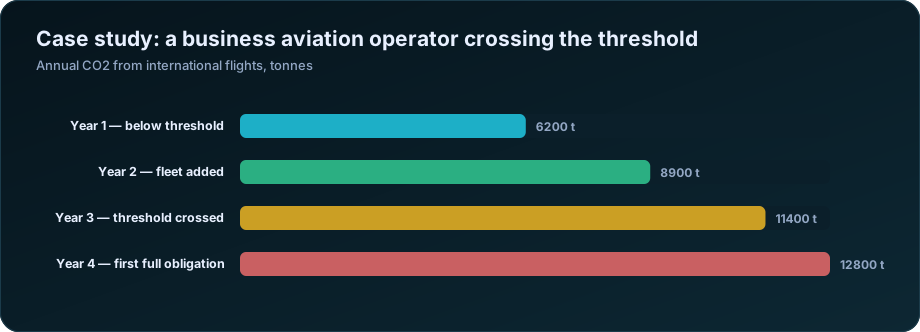
How the threshold was crossed
| Year | International CO2 (tonnes) | Position |
|---|---|---|
| Year 1 | 6,200 | Below threshold, no obligation |
| Year 2 | 8,900 | Below threshold, but 89% of it |
| Year 3 | 11,400 | Above threshold, obligation triggered |
| Year 4 | 12,800 | First full compliance year |
Year 2 is the point at which this should have been caught. An operator at 89% of the threshold with two aircraft joining the fleet is not a borderline case requiring judgement — it is a near-certainty, visible a full year before it crystallised.
What made it invisible was that nobody owned the number. The original assessment had been done by an external adviser, delivered as a report, filed, and never converted into a recurring internal check.
Why business aviation is structurally exposed
| Characteristic | Effect on threshold monitoring |
|---|---|
| Fleet changes frequently | Aircraft join and leave on management agreements |
| Ad-hoc routing | Annual flying varies substantially year to year |
| Owner-driven demand | A single new client can shift annual hours materially |
| Aircraft managed for third parties | Ambiguity over which operator reports |
| Long-range types | High fuel burn per sector concentrates emissions |
| No scheduled network | No stable baseline to extrapolate from |
The fourth row is the one that most often produces genuine confusion. Where an aircraft is owned by one party and operated under another party's AOC, the CORSIA obligation follows the operator, not the owner. An operator that manages aircraft for third-party owners must count those aircraft's international emissions in its own total. Many operators assume the reverse.
The variability point matters too. A scheduled airline can project next year's emissions from this year's schedule with reasonable confidence. A charter operator cannot, which means threshold monitoring has to run continuously rather than annually.
What crossing the threshold actually triggered
The operator's initial assumption was that it now needed to start reporting from the following year. That is not how it works, and the correction was expensive.
| Obligation | Timing |
|---|---|
| Monitoring plan submission | Required, retrospectively for the year crossed |
| Emissions reporting | For the year in which the threshold was crossed |
| Verification | For that same year |
| Offsetting obligation | Applies from the year of crossing, per state pair |
| Ongoing reporting | Every subsequent year, regardless of falling below again |
That last row is the one that surprises operators most. Once an operator has an obligation, falling back below the threshold in a later year does not simply end it. The rules on continuing obligations need to be checked case by case, but the safe planning assumption is that crossing the threshold is a one-way door.
Because the crossing was identified after year end, the operator was reconstructing fuel data for a completed year with no monitoring plan in place — the position described in reconstructing missing fuel uplift records, with the additional difficulty that the monitoring plan itself had to be submitted retrospectively.
The remediation path
The operator did four things, in this order:
Established the actual figure. Before anything else, a defensible calculation of international CO2 for the year in question. This confirmed the crossing rather than assuming it — worth doing, because a scope review at the same time found that several sectors previously counted as international were between state pairs that did not generate an offsetting obligation.
Approached the authority proactively. Disclosing a late-identified obligation voluntarily produced a materially better outcome than waiting to be found. The remediation path is covered in missing a CORSIA deadline.
Reconstructed the data. Fuel dockets, supplier records and technical logs for the year in question, with a documented data gap procedure for the residual.
Built the ongoing monitoring. Both the emissions monitoring plan and, separately, a quarterly internal check of the threshold position.
The threshold monitor that should have existed
The control that would have prevented all of this is a quarterly calculation, taking perhaps two hours, tracking four numbers:
| Metric | Purpose |
|---|---|
| Year-to-date international CO2 | The actual position |
| Annualised projection | Where the year lands at current run rate |
| Percentage of threshold | The trigger indicator |
| Fleet changes in the quarter | The leading indicator |
With a rule attached: at 70% of the threshold on the annualised projection, begin preparing. At 85%, submit a monitoring plan regardless of whether the threshold is ultimately crossed.
Preparing early and not crossing costs a monitoring plan that sits unused. Crossing without preparing costs a retrospective reconstruction, a late disclosure and a compressed verification. The asymmetry is stark, and it argues for triggering early.
For operators newly in scope, CORSIA for new airlines in India and CORSIA for business aviation in India cover the initial build. The threshold definition itself is in CORSIA scope and thresholds, and the ICAO CORSIA states and scope documentation is the authoritative source.
Frequently Asked Questions
What is the CORSIA threshold for operators?
An aeroplane operator producing more than 10,000 tonnes of CO2 annually from international flights using aeroplanes above 5,700 kg maximum take-off mass falls within CORSIA. Below that, the operator is exempt, but the position must be monitored as the fleet and network change.
What happens if you cross the CORSIA threshold without realising?
The obligation applies from the year of crossing, not the following year. That means retrospective monitoring plan submission, reconstruction of fuel data for a completed year, verification of that year, and any offsetting requirement — all under time pressure.
Do managed aircraft count towards an operator's CORSIA threshold?
Yes. The obligation follows the operator under whose AOC the aircraft is flown, not the owner. Operators managing aircraft for third-party owners must include those aircraft's international emissions in their own total.
If we fall below the threshold again, does the obligation end?
Not automatically. Once an obligation exists, continuing reporting requirements generally apply, and the position should be checked against the current rules rather than assumed. The safe planning assumption is that crossing the threshold is a one-way door.
How should an operator monitor its CORSIA threshold position?
A quarterly calculation of year-to-date international CO2, an annualised projection, the percentage of threshold, and any fleet changes in the quarter. Begin preparing at 70% of threshold on the projection and submit a monitoring plan at 85%.
Why is business aviation particularly at risk of crossing unnoticed?
Fleets change frequently under management agreements, annual flying varies substantially with client demand, there is no scheduled network to extrapolate from, and long-range types concentrate high fuel burn into relatively few sectors.
Planning your CORSIA position? DSTechnoverse provides CORSIA carbon credit services for Indian operators and project developers — scope and readiness assessment, monitoring plans, data pipelines, verification support, unit sourcing and second-phase modelling. We are based in Indore, Madhya Pradesh and work across India.
Apply as a CORSIA buyer or seller
Talk to our carbon markets team about your position.