Does CORSIA Apply to Helicopter Operators in India?
· DSTechnoverse · CORSIA & Carbon Markets
Most rotorcraft sit below the mass threshold and most rotorcraft flying is domestic, so the usual answer is no. The exceptions — offshore and heavy transport — are worth checking properly.
Helicopter operators receive CORSIA correspondence and reasonably wonder whether a scheme built around international airline emissions applies to them. For most Indian rotorcraft operations the answer is no, and the reasoning is worth recording rather than assumed — because "we assumed it did not apply" is a weaker position than a documented assessment.
Two filters, both usually decisive
CORSIA applies to aeroplane operators flying international sectors with aircraft above 5,700 kg maximum take-off mass. Rotorcraft operations typically fail at least one and often both filters.
| Filter | Typical rotorcraft position |
|---|---|
| Aircraft mass above 5,700 kg | Many types are below it |
| International flights | Most rotorcraft flying is domestic |
| Operator above 10,000 tonnes annually | Rarely reached on rotorcraft alone |
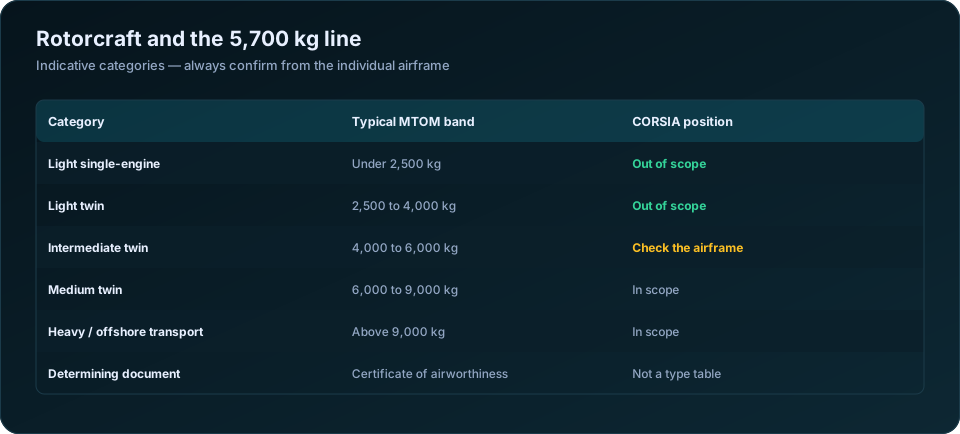
The mass filter varies by category:
| Rotorcraft category | Typical MTOM band | Position |
|---|---|---|
| Light single-engine | Under 2,500 kg | Out of scope |
| Light twin | 2,500 to 4,000 kg | Out of scope |
| Intermediate twin | 4,000 to 6,000 kg | Check the individual airframe |
| Medium twin | 6,000 to 9,000 kg | In scope |
| Heavy offshore transport | Above 9,000 kg | In scope |
The intermediate band is where the assessment has to be done properly. Several types sit close to the line and are produced in variants either side of it, so the type designator does not settle the question — the certificate of airworthiness for the individual airframe does. See aircraft mass and CORSIA.
Where rotorcraft operations do fly international sectors
| Operation | International character |
|---|---|
| Offshore energy support | Usually within national waters and domestic |
| Cross-border corporate transport | Genuinely international |
| Regional connectivity to neighbouring states | International |
| Aeromedical evacuation across a border | International, but often exempt by purpose |
| Disaster relief across a border | International, but usually exempt by purpose |
| Ferry flights for maintenance abroad | International, and not exempt |
The last row is the one operators overlook. A helicopter ferried to a maintenance facility in another country is on an international sector and is not covered by any purpose-based exemption. For an operator otherwise entirely domestic, a handful of such ferry sectors a year would not approach the threshold, but they belong in the assessment.
Aeromedical and disaster relief sectors may qualify for the humanitarian or medical exemption, which requires contemporaneous documentation rather than an assertion at reporting time — see flights excluded from CORSIA.
Mixed fleets
Many rotorcraft operators also run fixed-wing aircraft, and this is where a genuine obligation most often arises.
| Fleet | Assessment |
|---|---|
| Rotorcraft only, all below the mass | No CORSIA exposure at all |
| Rotorcraft only, some above the mass, all domestic | No obligation; monitor if international flying begins |
| Rotorcraft plus fixed-wing above the mass | Assess the fixed-wing international emissions |
| Rotorcraft plus business jets | The jets usually drive any obligation |
The threshold calculation includes only aircraft above 5,700 kg operating international sectors. An operator with a large rotorcraft fleet and two mid-size jets assesses its position on the jets alone, and including the rotorcraft can produce a phantom crossing.
Documenting a negative conclusion
Where the conclusion is that CORSIA does not apply, the assessment should be written down. It takes about an hour.
| Element | Content |
|---|---|
| Fleet list by registration | Every aircraft operated, rotary and fixed wing |
| MTOM per aircraft | Referenced to the certificate of airworthiness |
| International sectors flown | Including ferry and positioning flights |
| Emissions calculation | For in-scope aircraft on international sectors |
| Conclusion | Below threshold, or no in-scope aircraft |
| Date and review trigger | Any fleet change, plus an annual review |
The review trigger matters most for operators that grow. Adding a medium twin for offshore work, or a fixed-wing type for regional connectivity, changes the assessment — and an operator with a documented position and a review trigger notices, while one that concluded informally three years ago does not. The monitoring routine is in new entrants and threshold crossings.
What still applies
Even where CORSIA does not, other obligations may. Indian operators may face domestic reporting requirements, state carbon market developments under the Carbon Credit Trading Scheme, and customer-driven ESG reporting from corporate charter clients.
None of these are CORSIA, and it is worth being precise about which framework a request relates to. A corporate client asking for emissions data for its own Scope 3 reporting is not asking about CORSIA at all, and the calculation basis is different. See CORSIA vs CCTS for Indian companies and ESG reporting and carbon credits.
For the general scope rules see CORSIA scope and thresholds. Requirements are set out in the ICAO CORSIA implementation elements.
Frequently Asked Questions
Does CORSIA apply to helicopters?
Rarely. CORSIA covers aeroplane operators using aircraft above 5,700 kg maximum take-off mass on international flights. Many rotorcraft are below that mass and most rotorcraft flying is domestic, so both filters usually exclude them.
Which helicopters exceed the CORSIA mass threshold?
Medium and heavy twins, typically those above about 6,000 kg — offshore and heavy transport types. Intermediate twins sit close to the line and must be checked against the individual aircraft's certificate of airworthiness rather than a type table.
Do offshore helicopter flights count as international?
Usually not. Flights to installations within national waters are domestic. Sectors crossing into another state's territory are international, as are ferry flights to overseas maintenance facilities.
Are medical evacuation helicopter flights exempt?
They may qualify for the medical flight exemption, but it must be documented contemporaneously — the tasking authority, the nature of the mission and a reference number recorded at the time, not reconstructed during reporting.
Do rotorcraft count towards an operator's CORSIA threshold?
Only if they exceed 5,700 kg and fly international sectors. Aircraft below the mass are outside CORSIA entirely, and including them in the threshold calculation overstates the position.
Should we document a conclusion that CORSIA does not apply?
Yes. Record the fleet list with MTOM per aircraft referenced to source documents, international sectors flown including ferry flights, the calculation, the conclusion, and a review trigger for fleet changes. It takes about an hour.
Planning your CORSIA position? DSTechnoverse provides CORSIA carbon credit services for Indian operators and project developers — scope and readiness assessment, monitoring plans, data pipelines, verification support, unit sourcing and second-phase modelling. We are based in Indore, Madhya Pradesh and work across India.
Apply as a CORSIA buyer or seller
Talk to our carbon markets team about your position.