Who Reports CORSIA Emissions for a Leased Aircraft?
· DSTechnoverse · CORSIA & Carbon Markets
The obligation follows operational control, not ownership. What that means for dry leases, managed aircraft, sub-charters and aircraft that change hands mid-year.
An aircraft on an Indian register, owned by a leasing company in Ireland, financed by a bank in Singapore and flown under an Indian AOC generates CORSIA emissions attributable to exactly one party. It is not the owner, the financier or the registry state. It is the operator.
The principle is short and its application is where most of the difficulty lives.
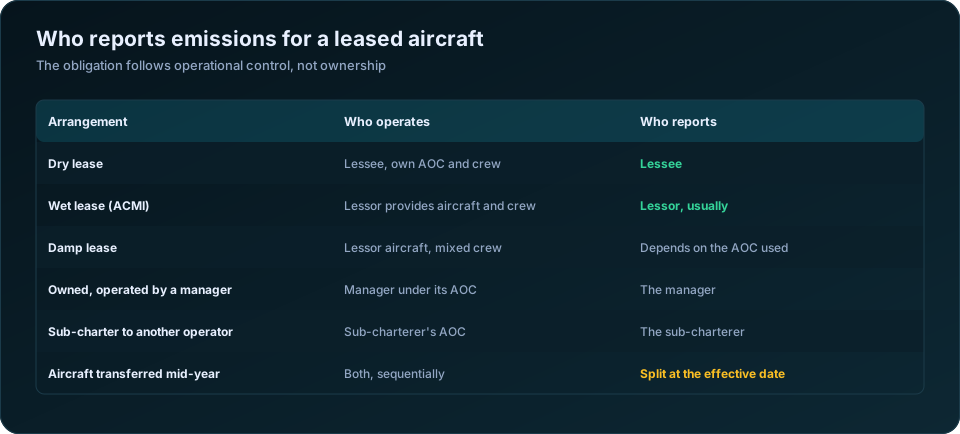
The attribution rule
CORSIA obligations attach to the aeroplane operator — the entity that exercises operational control over the flight. In practice, for Indian operations, that is the holder of the Air Operator Certificate under which the flight is conducted.
| Arrangement | Who exercises operational control | Who reports |
|---|---|---|
| Dry lease | Lessee, using its own AOC and crew | The lessee |
| Owned aircraft, own AOC | The owner-operator | The owner-operator |
| Owned aircraft, managed by a third party | The management company under its AOC | The management company |
| Sub-charter to another operator | The sub-charterer, under its AOC | The sub-charterer |
| Aircraft leased out to another operator | The other operator | Not you, for those sectors |
| Aircraft transferred mid-year | Both, sequentially | Split at the effective date |
The row that most often surprises owners is the third. An individual or company that owns an aircraft and places it with a management company for operation has no CORSIA obligation for it. The management company does, and must count those emissions in its own threshold assessment — a point examined in a business aviation operator crossing the threshold.
Why ownership is the wrong test
Ownership is easy to establish and irrelevant, because CORSIA is measuring emissions arising from the conduct of flights. The party deciding whether, where and how the aircraft flies is the party whose decisions generate the emissions.
| Test | Relevance |
|---|---|
| Who holds title | None |
| Who financed the aircraft | None |
| Which state the aircraft is registered in | None for attribution |
| Whose AOC the flight is conducted under | Decisive |
| Whose crew operates it | Strong indicator |
| Who holds the operating licence for the route | Strong indicator |
| Who pays for the fuel | Indicative, not decisive |
The fuel payment row is worth flagging because it is the test operators intuitively reach for, and it is unreliable. Fuel arrangements vary by commercial deal and can sit with either party under any lease structure. Follow the AOC.
Aircraft transferred mid-year
This is the case that produces the most practical difficulty, because the year's emissions belong to two operators and must be split cleanly.
| Requirement | Practice |
|---|---|
| Effective date and time | Recorded to the hour, in a stated time zone |
| Last sector under the outgoing operator | Identified specifically |
| First sector under the incoming operator | Identified specifically |
| Fuel on board at transfer | Attributed to whichever operator burns it |
| Uplifts around the transfer | Allocated by sector, not by invoice date |
| Documentation | Both operators hold the same record |
The fuel-on-board question is a real one. An aircraft transferring with several tonnes in its tanks will burn that fuel under the incoming operator's control, and the uplift that put it there occurred under the outgoing operator's. The defensible treatment is to attribute fuel to the operator that burned it, with the transfer quantity documented and agreed by both parties.
Both operators should hold an identical transfer record. Where they hold different records, two emissions reports will disagree, and a verifier examining either will find the discrepancy.
What to put in the lease documentation
Lease agreements rarely mention CORSIA, and adding a short clause removes most subsequent argument.
| Clause | What it should cover |
|---|---|
| Attribution acknowledgement | Which party is the aeroplane operator for CORSIA |
| Data provision | Fuel and flight records for the lease period, in a defined format |
| Transfer records | Effective date, time, fuel on board, last and first sectors |
| Retention | Five years, with a right to request after redelivery |
| Cooperation on verification | Access to records if a verifier requires them |
| Sub-lease restriction | Notification if the aircraft is sub-chartered |
The retention and cooperation clauses matter after the lease ends. An operator verifying a prior year needs records for an aircraft it no longer holds, and without a contractual right that request depends on goodwill. Redelivery is a poor moment to discover that.
Threshold implications
Because attribution follows operational control, an operator's threshold position moves with its lease book rather than its balance sheet.
| Event | Effect on the threshold |
|---|---|
| Take an aircraft on dry lease | Its international emissions count toward you |
| Lease an aircraft out | Those emissions leave your total |
| Take on a management contract | The managed aircraft counts toward you |
| Sell an aircraft but keep operating it | No change — you still operate it |
| Buy an aircraft already leased to another operator | No effect until you operate it |
An operator that grows by managing third-party aircraft can cross the threshold without buying anything, which is exactly how threshold crossings go unnoticed. The quarterly monitoring routine described in CORSIA scope and thresholds should be driven by the operated fleet, not the owned fleet.
For the wet and damp lease cases, which turn on a different question, see CORSIA reporting for wet and damp leases. For group structures with several AOCs, CORSIA across a group with three AOCs. The operator definition is in the ICAO CORSIA implementation elements.
Frequently Asked Questions
Who reports CORSIA emissions for a leased aircraft?
The operator exercising operational control — in practice the holder of the AOC under which the flight is conducted. Ownership, financing and registration state are irrelevant to attribution.
If I own an aircraft managed by someone else, do I have a CORSIA obligation?
No. The management company operating the aircraft under its own AOC is the aeroplane operator and carries the obligation, including counting those emissions towards its own threshold.
How are emissions split when an aircraft changes operator mid-year?
At the effective date and time of transfer, recorded to the hour in a stated time zone, with the last sector under the outgoing operator and the first under the incoming one identified specifically. Fuel is attributed to whichever operator burns it.
Does taking an aircraft on lease affect my CORSIA threshold?
Yes. Emissions from any aircraft you operate count towards your threshold regardless of who owns it, and emissions from aircraft you lease out do not. An operator's threshold position tracks its operated fleet, not its owned fleet.
What should a lease agreement say about CORSIA?
Which party is the aeroplane operator, the obligation to provide fuel and flight data in a defined format, transfer records including fuel on board, five-year retention with a right to request after redelivery, cooperation on verification, and notification of any sub-charter.
Who pays for the fuel — does that determine attribution?
No. Fuel payment arrangements vary by commercial deal and can sit with either party under any lease structure. Attribution follows the AOC under which the flight is operated, not the party that settles the fuel invoice.
Planning your CORSIA position? DSTechnoverse provides CORSIA carbon credit services for Indian operators and project developers — scope and readiness assessment, monitoring plans, data pipelines, verification support, unit sourcing and second-phase modelling. We are based in Indore, Madhya Pradesh and work across India.
Apply as a CORSIA buyer or seller
Talk to our carbon markets team about your position.