State Aircraft and CORSIA: Where the Exclusion Actually Applies
· DSTechnoverse · CORSIA & Carbon Markets
Military, customs and police flights are excluded. A commercial charter carrying government officials is not. The distinction turns on the service the aircraft is in, not the passenger list.
CORSIA excludes state aircraft — those used in military, customs and police service. The exclusion is narrower than the phrase "government aircraft" suggests, and the common misreading is expensive in the direction of under-reporting.
The test is the service the aircraft is in, not who is on board, who paid, or who owns the aircraft.
What is and is not a state aircraft flight
| Situation | Position |
|---|---|
| Air force transport aircraft on a military task | Excluded |
| Customs enforcement aircraft on patrol | Excluded |
| Police aviation unit conducting operations | Excluded |
| Government-owned aircraft in a government aviation unit | Generally excluded |
| Commercial operator chartered by a ministry | Not excluded |
| Commercial operator carrying a head of state | Not excluded |
| Government-owned aircraft operated commercially | Assess the service it is in |
| State-owned airline operating scheduled services | Not excluded |
The fifth and sixth rows are where the misreading occurs. A commercial operator flying a government delegation under an ordinary charter contract is conducting a commercial flight. The passengers' status does not convert the flight into a state aircraft operation, and the operator must count those sectors like any other.
The last row is worth stating too. A state-owned airline is a commercial air transport undertaking. Public ownership does not make its scheduled services state aircraft flights, and no significant carrier has ever seriously argued otherwise.
Why the distinction sits where it does
State aircraft operate outside much of the international civil aviation framework because they are performing sovereign functions — defence, law enforcement, border control. That is a long-standing distinction in international aviation law, and CORSIA follows it rather than inventing a new one.
Commercial air transport, by contrast, is exactly what CORSIA is designed to address, and the identity of the customer does not change the character of the activity. A charter operator flying a ministry is competing in the same market and burning the same fuel as one flying a corporation.
Mixed government aviation
Some government aviation units operate a mixed function, and the assessment has to be made per flight rather than per aircraft.
| Flight | Assessment |
|---|---|
| Government aircraft on a defence task | Excluded |
| Same aircraft transporting officials on state business | Assess against the service it is in |
| Same aircraft chartered to a commercial customer | Not excluded |
| Same aircraft on a humanitarian relief mission | Excluded under the humanitarian category |
| Same aircraft repositioning between the above | Follows the mission it supports |
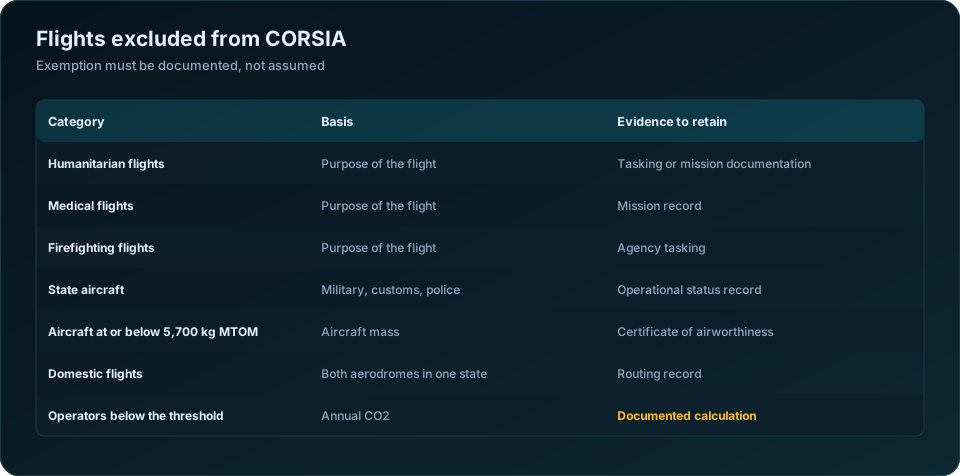
Where a unit operates flights of different character, the practical control is a field in the flight record capturing the flight's classification, completed at the time by operations staff. Reconstructing the character of individual flights months later is difficult and unpersuasive — the same principle that governs all purpose-based exemptions, set out in flights excluded from CORSIA.
For commercial operators serving government customers
| Practice | Reason |
|---|---|
| Count government charter sectors like any other | They are commercial flights |
| Include them in the threshold calculation | They are in scope |
| Do not classify by passenger identity | The service the aircraft is in governs |
| Retain the charter contract | Evidence of the commercial character |
| Distinguish genuine state tasking, if it arises | Rare, and requires documentation |
An operator excluding government charter work from its emissions could materially understate its position and its threshold. For a business aviation operator with substantial government custom, that could be the difference between concluding it is below the threshold and discovering later that it was not — the position described in a business aviation operator crossing the threshold.
Documenting a state aircraft exclusion
Where the exclusion genuinely applies, keep a file supporting it:
| Element | Content |
|---|---|
| The aircraft and its operating unit | Which body operates it |
| The service it is in | Military, customs or police |
| Legal or administrative basis | The instrument establishing the unit |
| Flight-level classification | Where the unit conducts mixed operations |
| Contemporaneous records | Created at the time, not later |
| Review | When the unit's function changes |
For an aviation unit whose entire function is military or law enforcement, this is a short standing document. For a mixed unit it needs flight-level records, and building the classification into the operations system at the point of despatch is far easier than assembling it afterwards.
For scope rules generally see CORSIA scope and thresholds and aircraft mass and CORSIA. Exclusion definitions are set out in the ICAO CORSIA implementation elements.
Frequently Asked Questions
What counts as a state aircraft under CORSIA?
An aircraft used in military, customs or police service. The test is the service the aircraft is in, not who owns it, who is on board, or whether a government paid for the flight.
Is a charter flight for a government department excluded?
No. A commercial operator flying government officials under an ordinary charter contract is conducting a commercial flight and must count those sectors like any other, including in its threshold calculation.
Are state-owned airlines excluded from CORSIA?
No. A state-owned airline operating scheduled commercial services is a commercial air transport undertaking. Public ownership does not make its flights state aircraft operations.
How should a mixed government aviation unit handle CORSIA?
Assess per flight rather than per aircraft, with a field in the flight record capturing the classification completed by operations staff at the time. Reconstructing the character of individual flights afterwards is difficult and unpersuasive.
Does carrying a head of state make a flight exempt?
No. The passengers' status does not change the character of the operation. A commercial operator flying a head of state under a charter contract is operating a commercial flight.
What documentation supports a state aircraft exclusion?
The operating unit and the service it is in, the legal or administrative instrument establishing it, flight-level classification records where operations are mixed, and contemporaneous records created at the time rather than assembled during reporting.
Planning your CORSIA position? DSTechnoverse provides CORSIA carbon credit services for Indian operators and project developers — scope and readiness assessment, monitoring plans, data pipelines, verification support, unit sourcing and second-phase modelling. We are based in Indore, Madhya Pradesh and work across India.
Apply as a CORSIA buyer or seller
Talk to our carbon markets team about your position.