Aircraft Mass and CORSIA: Where the 5,700 kg Line Falls
· DSTechnoverse · CORSIA & Carbon Markets
Aircraft at or below 5,700 kg maximum take-off mass sit outside CORSIA entirely. What that means for mixed fleets, variant-specific mass, and operators whose fleet straddles the line.
Aircraft with a maximum take-off mass at or below 5,700 kg are outside CORSIA. Their emissions are not reported, do not count towards the operator's threshold, and generate no offsetting obligation.
The line itself is unambiguous. Applying it is less so, because mass is a property of the individual aircraft rather than of the type, and operators whose fleets straddle the boundary need a rule they can apply consistently.
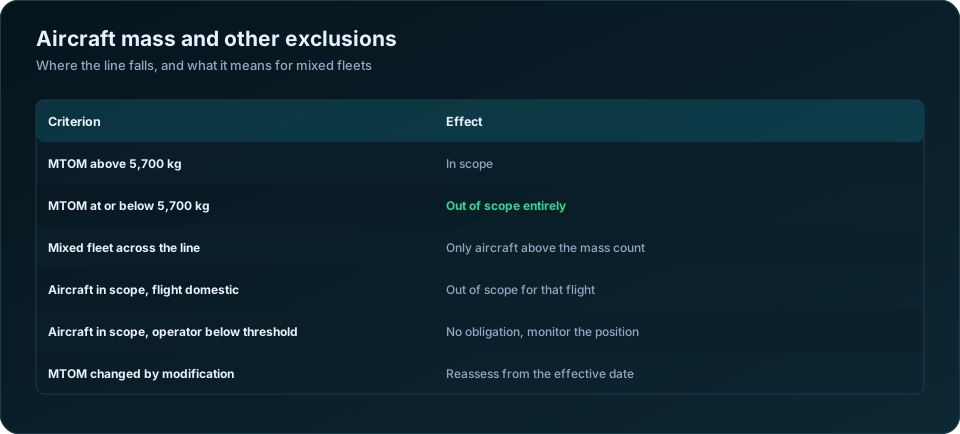
What the exclusion does
| Situation | Effect |
|---|---|
| Fleet entirely at or below 5,700 kg | No CORSIA obligation at all |
| Mixed fleet across the line | Only aircraft above the mass are in scope |
| Aircraft above the mass, flight domestic | Out of scope for that flight |
| Aircraft above the mass, operator below the threshold | No obligation, but monitor the position |
| MTOM changed by modification | Reassess from the effective date |
The second row is the practically important one. An operator running a mixed fleet does not have a partial obligation — it has a full obligation in respect of the aircraft above the mass, and none in respect of those below. The threshold calculation counts only the in-scope aircraft.
That matters for threshold monitoring. An operator with four light aircraft and two mid-size jets assesses its threshold on the two jets alone. Including the light aircraft in the calculation overstates the position and can produce a phantom crossing.
Mass is an aircraft property, not a type property
Several aircraft types are produced in variants both above and below 5,700 kg, and some can be certificated at different masses depending on configuration or operator election.
| Determinant | Reliability |
|---|---|
| Certificate of airworthiness for the individual aircraft | Definitive |
| Aircraft flight manual | Definitive |
| Type certificate data sheet | Shows the range, not the individual aircraft |
| A published type table | Indicative only |
| A general reference or database | Not sufficient |
| The registration document | Often states MTOM; check it matches |
The rule is to determine mass from the documents for the individual airframe, not from the type designator. For an operator with a single variant this is a one-time check. For an operator with several aircraft of a type in different configurations, it must be done per registration and recorded.
Where a modification changes MTOM — a gross weight increase, or a reduction elected for operational reasons — the position changes from the effective date of the modification, and the aircraft may move into or out of scope mid-year.
Practical handling for a straddling fleet
| Control | Purpose |
|---|---|
| Maintain an MTOM register by registration | One row per airframe, with the source document |
| Record the effective date of any change | Modifications move the boundary |
| Flag in-scope aircraft in the flight record | Classification is then automatic |
| Exclude out-of-scope aircraft at the data layer | Not by manual filtering later |
| Review the register when any aircraft joins or leaves | It is a fleet control, not an annual task |
| Retain the source documents | A verifier will ask for the basis |
Flagging at the data layer is the control that matters. An operator that filters out light aircraft manually when preparing the report will eventually forget, or will apply the filter inconsistently between the threshold calculation and the emissions report. A flag on the aircraft record, applied automatically wherever the fleet is referenced, cannot drift.
The interaction with the operator threshold
Two separate tests, applied in order:
- Is the aircraft in scope? MTOM above 5,700 kg.
- Is the operator above the threshold? Annual international CO2 from in-scope aircraft above 10,000 tonnes.
An operator can fail the second test while passing the first for several aircraft, in which case it has no obligation but should monitor the position quarterly. An operator whose entire fleet fails the first test has no CORSIA exposure at all and no need to monitor anything.
This ordering is why the MTOM register comes first in any scoping exercise. Determining which aircraft are in scope is the prerequisite for calculating the threshold, and an operator that calculates the threshold across its whole fleet has answered a question CORSIA did not ask. See new entrants and threshold crossings.
Documenting the position
Where an operator concludes it has no obligation because its fleet falls below the mass, that conclusion should be documented rather than simply acted on:
| Element | Content |
|---|---|
| Fleet list by registration | Every aircraft operated |
| MTOM per aircraft | With the source document referenced |
| Conclusion | Which aircraft are in scope, if any |
| Date of assessment | Positions change as fleets change |
| Review trigger | Any fleet change, plus an annual review |
An operator that has never documented its scope assessment, and is later asked to demonstrate why it did not report, is reconstructing an argument rather than producing a file. Given that the assessment takes an hour, documenting it is straightforward insurance.
For the other exclusion categories see flights excluded from CORSIA; for business aviation specifically, CORSIA for business aviation in India. Scope definitions are set out in CORSIA scope and thresholds and the ICAO CORSIA implementation elements.
Frequently Asked Questions
What is the aircraft mass threshold for CORSIA?
Aircraft with a maximum take-off mass above 5,700 kg are in scope. Those at or below it are excluded entirely — their emissions are not reported and do not count towards the operator's threshold.
How is MTOM determined for CORSIA purposes?
From the documents for the individual airframe — the certificate of airworthiness or aircraft flight manual — not from the type designator. Several types are produced in variants both above and below the line, so a type table is indicative only.
What happens with a fleet that straddles the 5,700 kg line?
Only aircraft above the mass are in scope. The operator's threshold calculation counts emissions from those aircraft alone, and including the lighter aircraft overstates the position and can produce a phantom crossing.
Does a modification changing MTOM affect CORSIA scope?
Yes, from the effective date of the modification. An aircraft can move into or out of scope mid-year, and the MTOM register should record the change and its date.
Should out-of-scope aircraft be filtered manually when reporting?
No. Flag in-scope aircraft on the aircraft record so the classification applies automatically wherever the fleet is referenced. Manual filtering eventually drifts, particularly between the threshold calculation and the emissions report.
Do we need to document a conclusion that CORSIA does not apply?
Yes. Record the fleet list by registration, MTOM per aircraft with its source document, the conclusion, the assessment date and a review trigger. The assessment takes about an hour and is far easier than reconstructing the argument later.
Planning your CORSIA position? DSTechnoverse provides CORSIA carbon credit services for Indian operators and project developers — scope and readiness assessment, monitoring plans, data pipelines, verification support, unit sourcing and second-phase modelling. We are based in Indore, Madhya Pradesh and work across India.
Apply as a CORSIA buyer or seller
Talk to our carbon markets team about your position.