Charter Brokers and CORSIA: Who Carries the Obligation
· DSTechnoverse · CORSIA & Carbon Markets
A broker arranges the flight; an operator flies it. The obligation follows the AOC, not the contract or the brand — and sub-charter chains make the distinction worth tracing carefully.
A charter broker sells a flight, invoices the client, arranges the aircraft and manages the relationship. It does not hold an AOC and does not operate the aircraft. For CORSIA, that makes it not an aeroplane operator, and it carries no obligation.
The principle is simple. What complicates it is that brokers, operators and clients often assume the obligation follows the money or the brand, and sub-charter chains can make the operating party several steps removed from the customer.
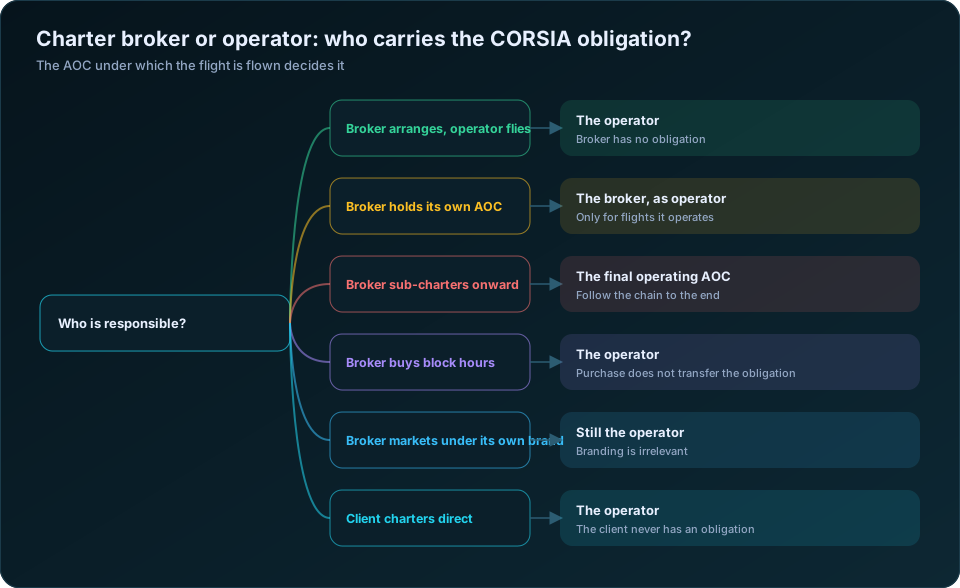
Who is responsible in each arrangement
| Arrangement | Responsible party |
|---|---|
| Broker arranges, operator flies under its own AOC | The operator |
| Broker holds its own AOC and flies the sector | The broker, acting as operator |
| Broker sub-charters onward to another operator | The final operating AOC holder |
| Broker buys block hours from an operator | The operator |
| Broker markets the flight under its own brand | Still the operator |
| Client charters an operator directly | The operator |
| Client owns the aircraft, a manager operates it | The manager |
The brand row is worth emphasising because it feels counter-intuitive. A broker that markets flights under its own name, with its own livery on the marketing material, still has no CORSIA obligation if another company's AOC authorises the flight. Branding, ticketing and invoicing are commercial arrangements; the AOC is the regulatory one.
Sub-charter chains
Cargo and ad-hoc charter markets routinely produce chains: a client contracts A, A sub-charters to B, B sub-charters to C, and C actually flies the sector.
| Position in the chain | CORSIA obligation |
|---|---|
| Client | None |
| A, the contracting party | None, unless A operates it |
| B, the intermediate | None, unless B operates it |
| C, the operating AOC holder | The obligation sits here |
The practical problem is that C may be several steps removed from the client and, in a short-notice arrangement, may not have been identified in advance. Two consequences follow.
For the operator at the end of the chain: these sectors count towards your threshold and your reporting, and you must capture fuel and flight data for them like any other sector. Ad-hoc sub-charter work is exactly the kind of flying that goes uncounted, because it sits outside routine scheduled processes.
For everyone else in the chain: a contractual requirement to notify sub-charter is worth including, so each party knows who ultimately operated the flight. This matters commercially as well as for CORSIA.
The attribution principle is the same one that governs leasing, set out in who reports CORSIA emissions for a leased aircraft and CORSIA reporting for wet and damp leases.
When a broker does have an obligation
Some brokers hold an AOC and operate a small fleet alongside their broking activity. In that case the obligation attaches to the flights they operate, and only those.
| Activity | Obligation |
|---|---|
| Flights operated under the broker's own AOC | In scope, subject to mass and route |
| Flights brokered to third-party operators | Not in scope for the broker |
| Flights the broker sub-charters onward | Not in scope for the broker |
| Threshold calculation | Counts only flights the broker operates |
An entity doing both must be careful not to include brokered volume in its own threshold assessment, which would substantially overstate its position — the same error as assessing a group total across several AOCs, described in CORSIA across a group with three AOCs.
What clients increasingly ask for
Brokers have no CORSIA obligation and are increasingly asked about emissions anyway, because corporate clients need data for their own reporting.
| Request | What it actually concerns |
|---|---|
| "What are the emissions of this flight?" | The client's Scope 3 reporting |
| "Can you offset this flight?" | A voluntary offsetting arrangement |
| "Is this operator CORSIA compliant?" | The operator's regulatory status |
| "Can you provide a certificate?" | Voluntary market retirement documentation |
None of these are CORSIA obligations for the broker, and all are legitimate commercial services a broker can provide. The distinction to hold onto is that a voluntary offset purchased for a client's reporting is not a CORSIA unit, does not need to be CORSIA eligible, and should not be described as such — see CORSIA carbon credit vs voluntary carbon credit and ESG reporting and carbon credits.
Brokers offering flight-level emissions figures should also be clear about the calculation basis. A figure derived from aircraft type and distance is an estimate, not the operator's reported CORSIA emissions, and it will not match.
For scope rules see CORSIA scope and thresholds and the ICAO CORSIA implementation elements.
Frequently Asked Questions
Does a charter broker have a CORSIA obligation?
No, unless it holds its own AOC and operates flights itself. The obligation attaches to the aeroplane operator — the AOC holder under which the flight is conducted — not to the party that arranged, marketed or invoiced it.
Who reports in a sub-charter chain?
The operator at the end of the chain, whose AOC authorises the flight. Intermediate contracting parties and the client have no obligation, however many steps separate them from the operating carrier.
Does buying block hours transfer the CORSIA obligation?
No. Purchasing capacity from an operator does not make the purchaser an aeroplane operator. The operator flying the sectors retains the obligation regardless of how the capacity was sold.
If a broker markets flights under its own brand, does that change anything?
No. Branding, ticketing and invoicing are commercial arrangements. The AOC under which the flight is operated determines the CORSIA obligation.
Can a broker offset flights for clients?
Yes, as a voluntary commercial service. Such offsets are voluntary-market units for the client's own reporting, are not CORSIA units, need not be CORSIA eligible, and should not be described as CORSIA compliance.
What emissions figure should a broker give a client?
An estimate based on aircraft type and distance, described as such. It is not the operator's reported CORSIA emissions and will not match them, since CORSIA figures derive from measured fuel rather than modelled burn.
Planning your CORSIA position? DSTechnoverse provides CORSIA carbon credit services for Indian operators and project developers — scope and readiness assessment, monitoring plans, data pipelines, verification support, unit sourcing and second-phase modelling. We are based in Indore, Madhya Pradesh and work across India.
Apply as a CORSIA buyer or seller
Talk to our carbon markets team about your position.