Why CORSIA Registry Account Applications Get Rejected, and How to Fix Them
· DSTechnoverse · CORSIA & Carbon Markets
Almost every registry rejection is documentary rather than substantive. The seven recurring reasons, what each requires, and why the entity name is the one that catches most applicants.
A registry account is required before an operator can hold or cancel units, and account opening sits on the critical path to meeting an offsetting obligation. Applications are rejected routinely, almost always for documentary reasons, and each rejection costs weeks.
The registries are not being obstructive. They operate under anti-money-laundering and know-your-customer obligations comparable to a financial institution, and an application that would satisfy a casual commercial counterparty will not satisfy them.
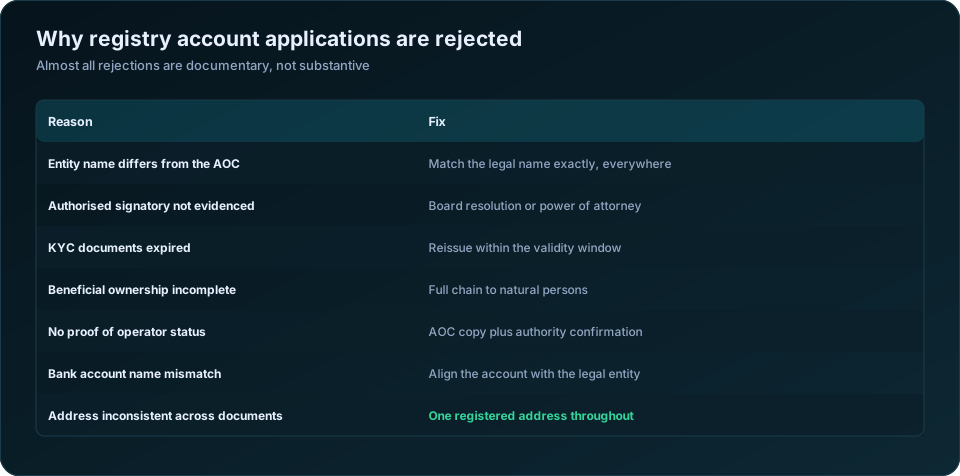
The seven recurring reasons
| Reason | What the registry needs |
|---|---|
| Entity name differs across documents | The exact legal name, identically, everywhere |
| Authorised signatory not evidenced | A board resolution or power of attorney naming the individual |
| KYC documents expired | Documents within their validity window at submission |
| Beneficial ownership incomplete | The chain traced to natural persons |
| Operator status not proven | AOC copy plus confirmation from the civil aviation authority |
| Bank account name mismatch | Account in the applicant's exact legal name |
| Address inconsistent across documents | One registered address used consistently |
The first is the most common by a considerable margin, and it is entirely avoidable.
The entity name problem
An Indian company may appear in its own documents as "Example Airlines Private Limited", "Example Airlines Pvt Ltd", "Example Airlines Pvt. Ltd." and "M/s Example Airlines Private Limited" — often within the same application pack, because different documents were prepared at different times by different people.
A registry treats these as potentially different entities and rejects. The fix costs nothing and must be done before submission:
- Take the legal name exactly as it appears on the certificate of incorporation.
- Use that string, character for character, in every field of every form.
- Where an existing document uses a variant, provide a covering explanation rather than hoping it passes.
- Check the bank account name matches the same string.
The same applies to addresses. The registered office address on the incorporation certificate is the one to use throughout, even where the operational address differs — and if a different correspondence address is needed, label it explicitly rather than substituting it.
Beneficial ownership, done properly
Registries require identification of the natural persons who ultimately own or control the applicant. For a simple company with individual shareholders this is straightforward. For a layered structure it is not, and partial disclosure is a rejection.
| Structure | What must be shown |
|---|---|
| Individual shareholders | Identity documents for those above the threshold |
| Corporate shareholder | Ownership of that company, and upward, to natural persons |
| Trust in the chain | Settlor, trustees and beneficiaries |
| Listed company in the chain | Usually the listing satisfies the requirement at that level |
| Government entity | Documentation of the state holding |
| Nominee arrangements | The beneficial owner behind the nominee |
The trust case causes the most delay. Trust documentation is often confidential and the registry's requirement is not negotiable, so establishing early what can be disclosed avoids an application that stalls indefinitely.
Where the ownership chain is genuinely complex, a structure chart submitted with the application — showing every entity, jurisdiction and percentage from the applicant up to natural persons — substantially reduces back-and-forth. Registries are trying to construct that chart themselves from the documents provided; supplying it saves everyone time.
Proving operator status
The registry needs to establish that the applicant is an aeroplane operator with a CORSIA obligation. Requirements vary, and the usual pack is:
- A current AOC in the applicant's exact legal name.
- Written confirmation from the civil aviation authority that the applicant is an aeroplane operator under CORSIA.
- The approved emissions monitoring plan, or evidence of its submission.
- A statement of the compliance period the account relates to.
The authority confirmation is the item with the longest lead time and should be requested first, not last. Where the authority issues such confirmations on a defined cycle, the application timeline follows that cycle regardless of how quickly everything else is assembled.
Timeline and sequencing
| Stage | Typical duration |
|---|---|
| Assembling documentation | 2 to 4 weeks |
| Authority confirmation of operator status | 2 to 6 weeks |
| Registry review of a complete application | 3 to 8 weeks |
| Response to queries | 1 to 3 weeks per round |
| Rejection and resubmission | Adds 4 to 10 weeks |
A clean application takes roughly two to three months end to end. One rejected on entity name and resubmitted takes four to five. Against an offsetting deadline, that difference is the whole margin.
Open the account well before it is needed. An operator waiting until units must be cancelled to discover its application needs a board resolution is in an avoidable and expensive position. See CORSIA registry account setup in India and, for what happens once the account exists, CORSIA registry cancellation process and a registry cancellation error.
A pre-submission checklist
| Confirmed |
|---|
| Legal name identical, character for character, across every document |
| Registered address identical across every document |
| Board resolution naming the authorised signatory, signed and dated |
| Every KYC document within its validity window |
| Ownership chart to natural persons, with percentages |
| Identity documents for every beneficial owner above the threshold |
| Current AOC in the exact legal name |
| Authority confirmation of operator status obtained |
| Bank account in the exact legal name |
| One named person responsible for query responses |
Thirty minutes with this list before submission is worth more than any amount of follow-up afterwards.
Registry procedures are published by the individual programmes; general requirements are summarised in the ICAO CORSIA documentation.
Frequently Asked Questions
Why was my CORSIA registry account application rejected?
Almost always for a documentary reason — most commonly the legal entity name appearing in slightly different forms across documents, an unevidenced authorised signatory, expired KYC documents, or an incomplete beneficial ownership chain.
How long does it take to open a registry account?
Two to three months for a clean application, covering documentation assembly, authority confirmation of operator status and registry review. A rejection and resubmission typically adds four to ten weeks.
What is beneficial ownership disclosure for a registry?
Identification of the natural persons who ultimately own or control the applicant, traced through every layer of the ownership chain. Corporate shareholders must be traced upward; trusts require settlor, trustee and beneficiary details.
How do I prove I am an aeroplane operator?
With a current AOC in the applicant's exact legal name, written confirmation from the civil aviation authority that you are an aeroplane operator under CORSIA, and the approved emissions monitoring plan or evidence of its submission.
Why does the entity name matter so much?
Because a registry operating under anti-money-laundering obligations treats name variants as potentially different entities. "Pvt Ltd" and "Private Limited" in different documents is enough to trigger a rejection, and the fix costs nothing if done before submission.
When should a registry account be opened?
Well before units need to be held or cancelled. Account opening sits on the critical path to meeting an offsetting obligation, and discovering a documentation requirement with weeks to go leaves no room to recover.
Planning your CORSIA position? DSTechnoverse provides CORSIA carbon credit services for Indian operators and project developers — scope and readiness assessment, monitoring plans, data pipelines, verification support, unit sourcing and second-phase modelling. We are based in Indore, Madhya Pradesh and work across India.
Apply as a CORSIA buyer or seller
Talk to our carbon markets team about your position.