CORSIA and Flight Training Organisations: Where Training Flights Sit
· DSTechnoverse · CORSIA & Carbon Markets
Training fleets are light and training flights are mostly domestic, so FTOs rarely have an obligation. The cases that need checking are cross-border navigation exercises and ferry flights.
A flight training organisation operating single-engine trainers and light twins on domestic circuits and navigation exercises has no CORSIA obligation. That covers the substantial majority of Indian FTOs and can be established in an afternoon.
The cases worth checking are the ones at the edges: cross-border navigation training, ferry flights, and organisations that also operate charter or corporate flights alongside training.
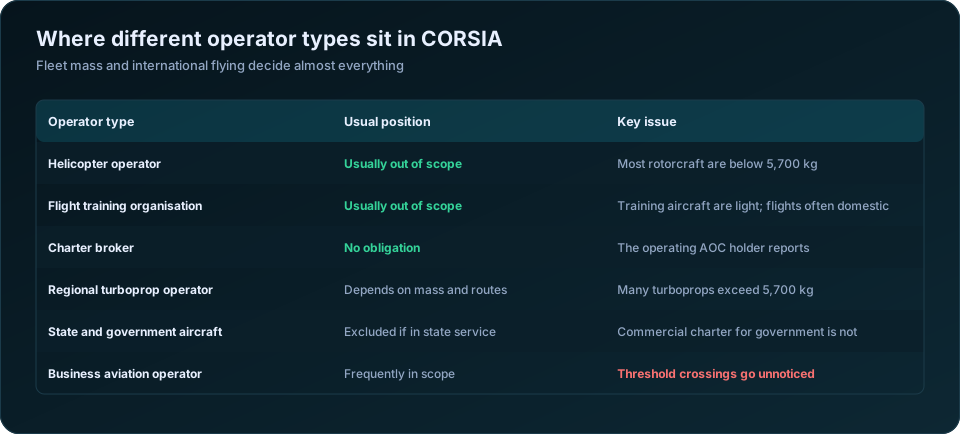
Why training fleets fall outside
| Filter | Typical FTO position |
|---|---|
| Aircraft above 5,700 kg MTOM | Trainers are almost always well below |
| International flights | Training is overwhelmingly domestic |
| Operator above the emissions threshold | Not reached on light aircraft |
Typical training aircraft masses put the question beyond argument:
| Aircraft category | Typical MTOM | Position |
|---|---|---|
| Single-engine trainer | 750 to 1,200 kg | Out of scope |
| Light twin trainer | 1,800 to 2,500 kg | Out of scope |
| Turboprop trainer | 2,500 to 4,500 kg | Out of scope |
| Jet trainer or light jet | 4,000 to 8,000 kg | Check the airframe |
| Full flight simulator | Not an aircraft | Out of scope entirely |
Only the fourth row requires an individual check, and it applies to a small number of organisations. Everything below 5,700 kg is outside CORSIA regardless of how it is flown or where.
The edge cases
Cross-border navigation training. An organisation conducting navigation exercises into neighbouring airspace is flying international sectors. If the aircraft are below the mass threshold this changes nothing — they remain outside CORSIA. If a heavier type is used, the sectors are in scope and should be counted.
Ferry flights. An aircraft delivered from an overseas manufacturer, or ferried abroad for maintenance, is on an international sector. For a light aircraft this is immaterial to CORSIA. For an organisation operating heavier types it belongs in the assessment.
Type rating training on transport aircraft. An organisation providing type rating training on aircraft above 5,700 kg is operating in-scope aircraft. Whether it has an obligation depends on whether those flights are international and whether the emissions reach the threshold — usually they do not, because type rating training is typically conducted domestically or in a simulator.
Mixed operations. Many FTOs also hold charter or corporate approvals. The training fleet may be entirely out of scope while a separate charter operation is in scope, and the assessment must cover the whole operated fleet under the relevant AOC or approval.
Simulators
Worth stating plainly because the question is asked: a full flight simulator is not an aircraft, conducts no flights, burns no fuel and is outside CORSIA entirely.
Simulator training does reduce an organisation's actual emissions by replacing airborne hours. That has genuine environmental value and no CORSIA reporting consequence — the scheme measures fuel burned on international flights, and hours not flown simply do not appear.
The assessment to keep on file
| Element | Content |
|---|---|
| Fleet list by registration | Every aircraft operated under the approval |
| MTOM per aircraft | From the certificate of airworthiness |
| Any aircraft above 5,700 kg | Identified specifically |
| International sectors flown | Including navigation exercises and ferry flights |
| Conclusion | No in-scope aircraft, or below threshold |
| Review trigger | Fleet change, new approval, or new route |
An FTO adding a heavier type or taking on charter work should revisit the assessment, which is the reason for the review trigger. The general procedure is in aircraft mass and CORSIA and new entrants and threshold crossings.
What FTOs are more likely to face
CORSIA is not the framework most relevant to training organisations. Two others are more likely to reach them.
Corporate client reporting. Organisations providing training to airline customers may be asked for emissions data supporting the customer's own reporting. That is a Scope 3 question with a different calculation basis and no relationship to CORSIA.
Domestic developments. India's Carbon Credit Trading Scheme and related domestic measures may reach sectors outside CORSIA's international scope over time. See CORSIA vs CCTS for Indian companies and the Indian carbon market and CCTS explained.
For general scope rules see CORSIA scope and thresholds and the ICAO CORSIA implementation elements. Indian training approvals are administered by the Directorate General of Civil Aviation.
Frequently Asked Questions
Does CORSIA apply to flight training organisations?
Almost never. Training aircraft are well below the 5,700 kg mass threshold and training flights are overwhelmingly domestic, so both CORSIA filters exclude them. Only organisations operating heavier types on international sectors need a fuller assessment.
Are cross-border navigation training flights in scope?
They are international sectors, but only matter if the aircraft exceeds 5,700 kg. Light trainers flying into neighbouring airspace remain outside CORSIA entirely.
Do flight simulators count for CORSIA?
No. A simulator is not an aircraft, conducts no flights and burns no fuel. Simulator training genuinely reduces emissions by replacing airborne hours, but hours not flown do not appear in CORSIA reporting at all.
What if an FTO also operates charter flights?
The assessment must cover the whole operated fleet. A training fleet entirely below the mass threshold may sit alongside a charter operation using heavier aircraft on international sectors, which could create an obligation.
Is type rating training on large aircraft in scope?
The aircraft are in scope by mass, but type rating training is typically conducted domestically or in simulators, so the international emissions rarely approach the threshold. Assess the international sectors specifically.
What should an FTO keep on file?
A fleet list by registration with MTOM from certificates of airworthiness, any aircraft above 5,700 kg identified, international sectors flown including ferry flights, the conclusion, and a review trigger for fleet or approval changes.
Planning your CORSIA position? DSTechnoverse provides CORSIA carbon credit services for Indian operators and project developers — scope and readiness assessment, monitoring plans, data pipelines, verification support, unit sourcing and second-phase modelling. We are based in Indore, Madhya Pradesh and work across India.
Apply as a CORSIA buyer or seller
Talk to our carbon markets team about your position.