When Fuel Records and Flight Records Do Not Match: Diagnosing CORSIA Exceptions
· DSTechnoverse · CORSIA & Carbon Markets
Every uplift should map to a sector and every sector to an uplift. The six reasons they fail to, how to tell them apart, and why the date-off-by-one case is the most dangerous.
A working CORSIA data pipeline produces a reconciliation: every fuel uplift matched to the sector it fuelled, every sector matched to the fuel that fuelled it. Anything that fails to match is an exception, and the exception report is the single most useful artefact an operator can build.
Exceptions are not errors in themselves. Most have ordinary explanations. What matters is being able to tell them apart quickly, because the harmless ones and the dangerous ones look identical in a spreadsheet.
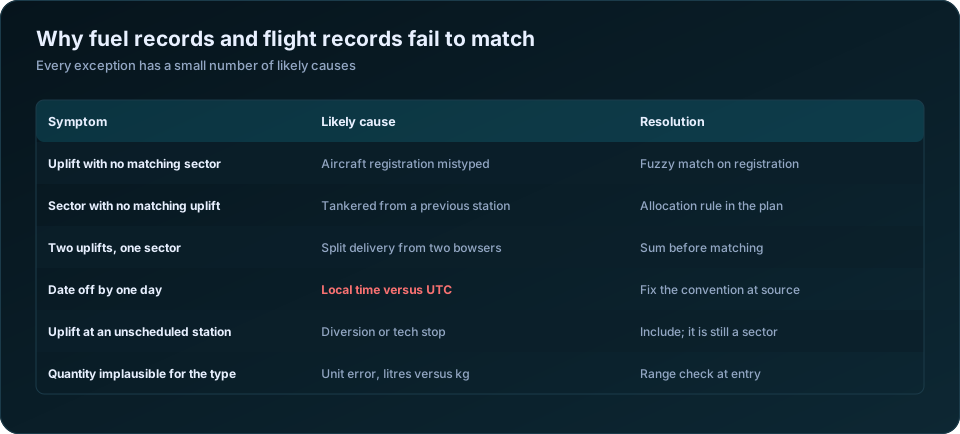
The six causes, and how to distinguish them
| Symptom | Likely cause | Resolution |
|---|---|---|
| Uplift with no matching sector | Aircraft registration mistyped on the docket | Fuzzy match on registration, then correct at source |
| Sector with no matching uplift | Fuel tankered from a previous station | Apply the allocation rule from the monitoring plan |
| Two uplifts, one sector | Split delivery from two bowsers | Sum before matching |
| Date off by one day | Local time versus UTC convention | Fix the convention at source, not in the data |
| Uplift at an unscheduled station | Diversion or technical stop | Include it — the sector still occurred |
| Quantity implausible for the aircraft type | Unit error, litres recorded as kilograms | Range check at the point of entry |
The registration typo is the most common and the least consequential. VT-ABC entered as VT-ACB produces an orphaned uplift and an orphaned sector, and a fuzzy match resolves it in seconds. Worth automating rather than investigating case by case.
Why the date mismatch is the dangerous one
An uplift dated one day away from its sector looks like a trivial timestamp issue. It is the exception most likely to produce a genuine misstatement, for a structural reason.
Fuel dockets are commonly timestamped in local time. Flight records are commonly held in UTC. For most of the day the two agree on the calendar date. For flights operating across the local midnight — which for Indian operators means a substantial share of long-haul and cargo departures — they do not.
| Consequence | Effect on reporting |
|---|---|
| Uplift assigned to the wrong day | Minor, if the year is unaffected |
| Uplift assigned to the wrong month | Distorts monthly reconciliation |
| Uplift at a year boundary | Assigned to the wrong reporting year |
| Sector counted in one year, its fuel in another | Both years misstated |
The year boundary case is the one that matters. An uplift on 31 December local time that belongs to a 1 January UTC sector, or the reverse, moves fuel between reporting years. Two annual figures are then wrong, and because the error is small relative to each year's total it can pass unnoticed until a verifier tests the boundary — which they do, because it is a known weak point.
The fix is not to adjust the data. It is to fix the convention: record both local and UTC timestamps at the point of capture, define which governs in the monitoring plan, and apply it consistently. Adjusting after the fact leaves no audit trail and invites the question of what else was adjusted.
Tankering and the allocation rule
A sector with no matching uplift is usually not missing data. It is a sector flown on fuel uplifted somewhere else, which is normal and commercially deliberate — operators tanker fuel from stations with favourable pricing.
CORSIA accommodates this, but the monitoring plan must describe how fuel is allocated across sectors when one uplift fuels several. Without a stated rule, the allocation is an undocumented judgement, and a verifier cannot assess whether it was applied consistently.
| Allocation approach | Suits |
|---|---|
| Fuel burn per sector from the technical log | Operators with reliable log data |
| Proportional to block hours | Simple, defensible for similar sectors |
| Proportional to great circle distance | Where sectors differ substantially in length |
| Aircraft type burn model | Where log data is thin |
Any of these is acceptable if stated in the plan and applied consistently. None is acceptable if chosen sector by sector after the fact.
Building the exception report
| Field | Purpose |
|---|---|
| Exception type | Which of the six categories |
| Aircraft registration | The matching key |
| Date and station | Location of the exception |
| Quantity involved | Materiality |
| Age of the exception | Days since it arose |
| Assigned owner | Who resolves it |
| Resolution and evidence | What was done and on what basis |
Two operational rules make the report work. Run it monthly, not annually — an exception investigated within thirty days is usually resolvable by asking the station, while the same exception at year end requires reconstruction. And track the exception rate over time: a rate falling from 6% to under 1% across three months demonstrates a system that surfaces and fixes its own problems, which is exactly what a verifier is looking for.
An operator presenting a clean reconciliation with no exception history is in a weaker position than one presenting a declining exception rate with documented resolutions. The first looks like a system that has never been tested.
For the underlying data architecture see CORSIA data systems and automation; for missing records specifically, missing fuel uplift records; and for the formal gap procedure, CORSIA data gap procedures. Monitoring requirements are defined in the ICAO CORSIA implementation elements.
Frequently Asked Questions
What is a fuel and flight data exception in CORSIA?
An uplift that cannot be matched to a sector, or a sector that cannot be matched to an uplift. Most have ordinary explanations — registration typos, tankering, split deliveries — but they must be identified and resolved rather than left in the dataset.
Why do fuel uplift dates not match flight dates?
Usually because dockets are timestamped in local time while flight records are held in UTC. The two agree for most of the day and diverge across local midnight, which affects a meaningful share of long-haul and cargo departures.
Why does a date mismatch at the year boundary matter so much?
Because it moves fuel between reporting years, misstating both. It is small relative to each year's total, so it can pass unnoticed — and verifiers test year boundaries specifically because it is a known weak point.
How should tankered fuel be handled in CORSIA?
Through an allocation rule stated in the monitoring plan — fuel burn from the technical log, proportional to block hours, proportional to distance, or a type burn model. Any is acceptable if applied consistently; none is acceptable if chosen after the fact.
How often should the exception report be run?
Monthly. An exception investigated within thirty days is usually resolvable by contacting the station; the same exception discovered at year end typically requires reconstruction from secondary sources.
Is a zero exception rate a good sign?
Not necessarily. A reconciliation that has never produced exceptions may simply never have been tested. A declining exception rate with documented resolutions gives a verifier more confidence than an unexplained clean sheet.
Planning your CORSIA position? DSTechnoverse provides CORSIA carbon credit services for Indian operators and project developers — scope and readiness assessment, monitoring plans, data pipelines, verification support, unit sourcing and second-phase modelling. We are based in Indore, Madhya Pradesh and work across India.
Apply as a CORSIA buyer or seller
Talk to our carbon markets team about your position.