Quick answer: Rapid microbial detection methods find, count or identify microorganisms in minutes to hours instead of the days conventional culture takes. The main technologies are ATP bioluminescence, flow and solid-phase cytometry, PCR and LAMP, impedance and CO2-based growth detection, enzyme substrate media, immunoassays, MALDI-TOF identification and real-time fluorescence air monitors. Each answers a different question, and each must be validated before it replaces a compendial method.
Traditional microbiology answers "is there anything growing?" by waiting for it to grow. That wait — two days for a total viable count, fourteen for a sterility test — is the single largest source of delay in releasing pharmaceutical, food and water products.
Rapid microbial detection exists to shorten it, and in many cases also to give information a plate cannot, such as the identity of an organism within minutes or a live alert while a filling line is still running. This guide covers what the technologies actually measure, what they can and cannot replace, and how to choose one without buying an expensive instrument that answers the wrong question.
What "Rapid" Actually Means
A rapid microbiological method (RMM) is any method that produces a microbiological result faster than the compendial growth-based method it replaces. It does not necessarily mean instant, and it does not necessarily mean better.
Rapid methods fall into three families, and confusing them is the most expensive mistake in this field:
| Family | Question answered | Example technologies |
|---|---|---|
| Qualitative | Is anything there, yes or no? | ATP bioluminescence, PCR presence/absence, rapid sterility |
| Quantitative | How much is there? | Flow cytometry, solid phase cytometry, impedance |
| Identification | What is it? | MALDI-TOF, 16S rRNA sequencing, riboprinting |
A method that gives you a fast yes/no cannot replace a method that produces a count, however impressive its detection limit. Start from the decision — release, investigate, or trend — and the family follows.
The Technologies, Compared
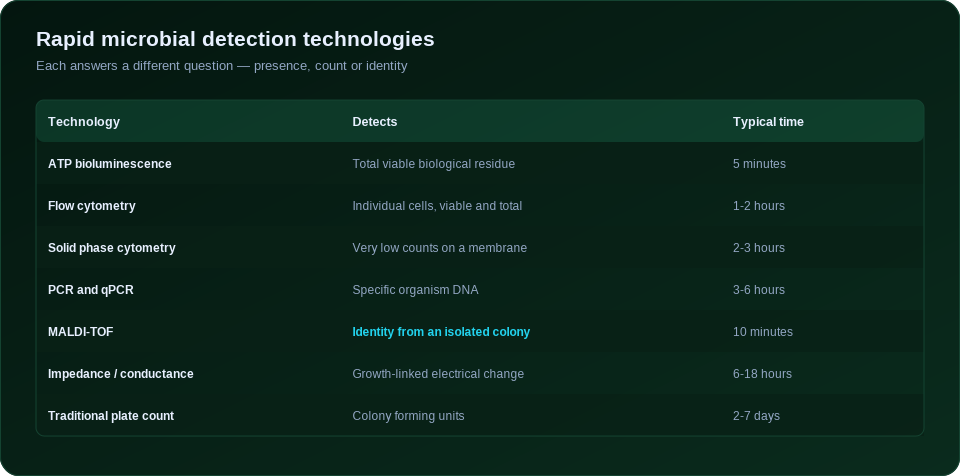
| Technology | Detects | Typical time | Detection limit |
|---|---|---|---|
| ATP bioluminescence | Total viable biological residue | 5 minutes | ~10³-10⁴ cells (surface), lower with enrichment |
| Flow cytometry | Individual cells, viable and total | 1-2 hours | 1-100 cells/mL depending on volume |
| Solid phase cytometry | Very low counts on a membrane | 2-3 hours | Single cell on the membrane |
| PCR / qPCR | Specific organism DNA | 3-6 hours | 1-100 genome copies |
| MALDI-TOF MS | Identity from an isolated colony | 10 minutes | Requires a colony first |
| Impedance / conductance | Growth-linked electrical change | 6-18 hours | Detects growth, not initial count |
| Traditional plate count | Colony forming units | 2-7 days | 1 CFU per plated volume |
ATP bioluminescence
Measures adenosine triphosphate using the luciferase reaction, producing light in proportion to biological material present. Fast, cheap and portable — and its weakness is the same as its strength: ATP is present in any living cell, including residual product and human cells, so it measures biological residue, not specifically microorganisms.
That makes it excellent for cleaning verification and useless for a release decision requiring a count. Our comparison of ATP testing versus microbiological swabbing covers where each belongs.
Flow cytometry
Cells pass single-file through a laser, and fluorescent stains distinguish viable from non-viable. Gives a genuine count in one to two hours, and can distinguish live, injured and dead cells — something a plate count cannot do at all. Widely used in water testing and in-process control. Requires clean sample matrices; particulates and autofluorescent product interfere.
Solid phase cytometry
Concentrate the sample on a membrane, label viable cells, and scan the membrane with a laser. Detects single cells, which makes it the strongest option for very low bioburden applications like water for injection and rapid sterility. Slow per sample and instrument-intensive.
PCR and qPCR
Amplifies a target DNA sequence. Extremely specific and sensitive — the method of choice when you need to know whether a particular organism is present, such as Salmonella in food or Burkholderia cepacia complex in non-sterile products.
The critical limitation: PCR detects DNA, not life. Dead cells and free DNA amplify identically to living organisms, which is why a PCR-positive result is not automatically a contamination event. Viability PCR using PMA/EMA dyes addresses this partially.
MALDI-TOF mass spectrometry
Identifies an organism in minutes from a protein fingerprint. It has effectively replaced biochemical identification kits in most laboratories, reducing identification turnaround from days to minutes. It needs an isolated colony to start from, so it accelerates the identification step, not the detection step. See microbial identification methods.
Impedance and conductance
Measures electrical changes in the medium as organisms metabolise. Time-to-detection correlates with initial load, so it produces a quantitative estimate. Moderate speed gain, robust with difficult matrices, well established in dairy and beverage testing.
Enzyme substrate methods
Media containing substrates that change colour or fluoresce when a target enzyme is present, so coliforms and E. coli can be detected and counted in about 18 to 24 hours without confirmation steps. Widely used for drinking and process water, and in food testing.
Immunological methods (ELISA and lateral flow)
- ELISA and enzyme-linked fluorescent assays — antibodies capture target organisms or toxins after an enrichment step.
- Lateral flow tests — simple strip tests for specific pathogens after enrichment, cheap and quick once the enrichment is done.
Widely used for food pathogen screening, where presence or absence of a named organism matters more than a total count.
Real-time fluorescence air monitors
- Laser-induced fluorescence air monitors — count airborne particles continuously and flag those that fluoresce like biological material, giving real-time viable particle alerts in cleanrooms. Some inert particles also fluoresce, so counts are not equivalent to CFU, and these instruments are usually run alongside conventional air sampling.
The Time Saving in Practice
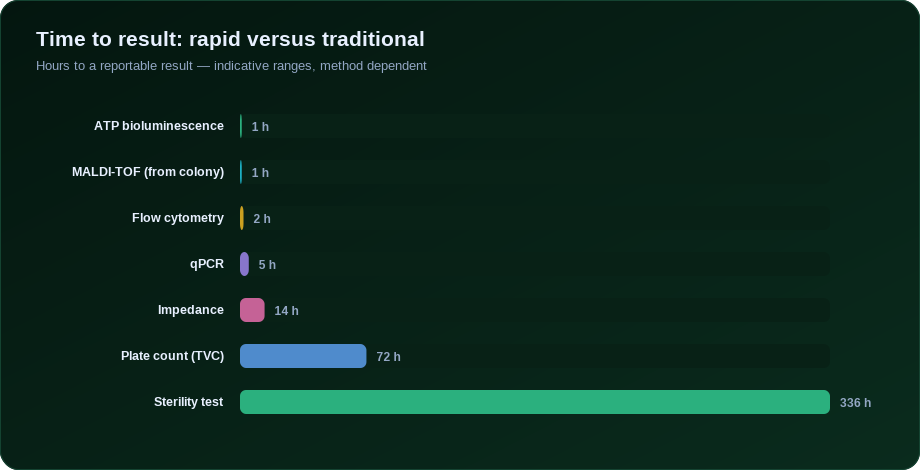
Indicative hours to a reportable result:
| Method | Time to result | Traditional equivalent |
|---|---|---|
| ATP bioluminescence | ~1 hour | 48 hours (surface plate count) |
| MALDI-TOF from a colony | ~1 hour | 48-72 hours (biochemical ID) |
| Flow cytometry | ~2 hours | 48-72 hours (TVC) |
| qPCR | ~5 hours | 72-120 hours (selective enrichment) |
| Impedance | ~14 hours | 48-72 hours |
| Rapid sterility (growth-based) | 120-168 hours | 336 hours (14-day USP 71) |
The commercial value is rarely the laboratory time. It is the inventory sitting in quarantine. For a manufacturer holding two weeks of finished goods awaiting a sterility result, halving that wait releases working capital that usually exceeds the total annual testing budget — which is why rapid sterility is the application with the clearest return.
Matching the Method to the Application
| Application | Best-fit rapid method | Why |
|---|---|---|
| Cleaning verification | ATP bioluminescence | Immediate feedback on the line, before restart |
| Purified water / WFI monitoring | Flow or solid phase cytometry | Low counts, clean matrix, fast trending |
| In-process bioburden | Flow cytometry or impedance | Counts within a shift |
| Sterility testing | Growth-based rapid (CO₂ or fluorescence) | Regulatory acceptance is best established |
| Pathogen screening in food | PCR / qPCR | Specific, sensitive, avoids long enrichment |
| Environmental monitoring | Rapid ID on recovered isolates | Speeds investigation, not detection |
| Contamination investigation | MALDI-TOF plus strain typing | Identity is the whole point |
Note the pattern: rapid methods work best where the decision is time-critical and the matrix is clean. They struggle where the sample is complex, the count is legally defined as CFU, or the regulatory expectation is explicitly compendial.
Rapid Microbial Testing in Dairy and Food
Dairy and food plants use rapid methods mainly for speed of release and process control:
| Application | Conventional method | Common rapid alternatives |
|---|---|---|
| Raw milk total bacteria count | Standard plate count, 48 to 72 h; MBRT (methylene blue reduction test) for grading | Flow cytometry, ATP-based methods, resazurin reduction |
| Pathogen screening (Salmonella, Listeria) | Culture with enrichment and confirmation, 3 to 5 days | PCR, LAMP or immunoassay after enrichment, about 24 to 48 h for a negative result |
| Coliforms and E. coli in water and products | Membrane filtration or MPN, 24 to 48 h | Enzyme substrate methods, about 18 to 24 h |
| Hygiene of cleaned surfaces | Swab and plate count, 24 to 72 h | ATP bioluminescence, seconds |
| Yeast and mould in beverages | Plate count, 5 to 7 days | Flow cytometry or impedance, 1 to 3 days |
In India, the FSSAI runs a scheme for approving Rapid Analytical Food Testing (RAFT) kits and equipment, so food businesses and laboratories using rapid kits for regulatory purposes should check approval status. For food pathogens internationally, rapid methods are usually validated against reference methods under ISO 16140 or certified through AOAC programmes.
Rapid Methods for Pharmaceutical Water Systems
Purified water and water for injection are tested more often than almost anything else in a pharmaceutical plant, and the conventional count takes up to five days on low-nutrient media. By the time a high count is known, the water has long been used. Rapid options include:
- Online bioburden monitors that use laser-induced fluorescence to detect biological particles in the water continuously, flagging an excursion within minutes.
- Flow cytometry or solid-phase cytometry on grab samples, giving a viable count in hours.
- Microcolony imaging of membrane-filtered samples, roughly halving the time to a count.
Total organic carbon and conductivity are monitored online already, but they are chemical measures, not microbial ones. Rapid microbial data turns water monitoring from a historical record into a control tool. Because results from fluorescence or cytometry methods are often higher than plate counts, alert and action levels must be set from the new method's own data rather than copied from the old CFU limits.
Rapid Methods for Cleanroom Environmental Monitoring
Environmental monitoring generates more samples than any other microbiology activity in a sterile facility, and conventional plates take five to seven days to read. Rapid options change what the data can be used for:
- Microcolony imaging of settle, contact and air plates gives counts in roughly half the time, and some systems read the same plates automatically, reducing manual reading errors.
- Continuous laser-induced fluorescence monitors in Grade A zones give real-time alerts during filling, so an intervention or airflow problem can be acted on before the batch finishes.
- MALDI-TOF identification of recovered isolates within hours makes trending by species practical and speeds up investigations.
Annex 1 encourages manufacturers to consider rapid and alternative methods where they improve contamination control. The usual approach is to add rapid methods for faster detection while keeping validated conventional methods for formal limits until equivalence is fully demonstrated. See our environmental monitoring service.
Worked Example: Choosing a Method for a Beverage Plant
A packaged juice and flavoured water plant releases each batch after a yeast and mould count, which takes five days on conventional plates. Spoilage yeasts are the main risk, the products are clear liquids, and the plant runs about 15 batches a day across three lines.
- The decision: release or hold each batch. That needs a count against a specification, not just a hygiene indicator, so ATP alone is not enough.
- The matrix: clear, low-particulate liquids, which suit filtration-based and cytometry methods well.
- The detection limit: the specification is set per 100 mL, so the method must handle that volume, which favours membrane filtration followed by a rapid read.
- The options shortlisted: flow cytometry with viability staining (results in about two hours), microcolony imaging of membranes (about two to three days) and impedance (about one to two days).
- The choice: flow cytometry for routine release on the high-volume lines, with conventional plates kept as the referee method and for identification of any positives. ATP swabs are added separately for cleaning verification before line restart.
- The validation: an equivalence study on each product family, comparing flow cytometry counts with plate counts over several weeks, and setting release limits from the paired data.
The result is release within the shift instead of after five days, which frees cold storage and shortens the time from bottling to dispatch. The same reasoning applies in dairy, brewing and bottled water.
Detection Limits, Sample Volume and Why They Matter
Speed is the headline feature of a rapid method, but the detection limit and the volume tested decide whether it can support your specification at all.
- Detection limit is the smallest number of organisms the method reliably detects. Some methods detect a single cell; others need hundreds or thousands of cells in the tested volume.
- Sample volume sets what that limit means. A method that detects 10 cells in 1 mL cannot show compliance with a limit of 10 CFU per 100 mL, because it only looked at one hundredth of the sample.
- Concentration steps such as membrane filtration or enrichment bring low counts into the detectable range, at the cost of time.
- Matrix effects raise the practical detection limit: particles, fats, colours, preservatives and fluorescent ingredients can mask or mimic cells.
Before buying, convert the specification into "cells per tested volume" and check that the method's validated detection limit sits comfortably below it.
Rapid Methods in Other Industries
- Cosmetics and personal care: rapid screening of bioburden and specified organisms such as Pseudomonas aeruginosa and Staphylococcus aureus, often by PCR after enrichment or by ATP-based methods, to speed release of preserved products.
- Breweries and beverages: ATP for hygiene, PCR for beer spoilage organisms, and flow cytometry for yeast counts in fermentation control.
- Hospitals and healthcare: automated blood culture systems and molecular panels for faster diagnosis, and ATP for cleaning audits of wards and theatres.
- Water utilities and packaged drinking water: enzyme substrate methods for coliforms and E. coli, and online monitors for continuous surveillance.
- Medical devices: rapid bioburden and sterility methods, and MALDI-TOF identification for environmental and bioburden isolates.
Rapid Methods for Non-Sterile Product Testing
Tablets, syrups, creams and other non-sterile products are tested against microbial limits for total aerobic count, yeasts and moulds and specified organisms under USP <61> and <62> or the equivalent pharmacopoeial chapters. Conventional testing takes three to five days for counts and longer for specified organisms. Rapid options include:
- Microcolony imaging for total aerobic and yeast and mould counts, giving CFU-equivalent results in roughly half the time.
- Growth-based detection systems that flag whether a count exceeds a threshold within one to two days.
- PCR after enrichment for specified organisms such as E. coli, Salmonella, Pseudomonas aeruginosa, Staphylococcus aureus and Burkholderia cepacia complex.
Because the results feed release decisions, these need full equivalence validation on each product, including method suitability with the product's preservatives. See our guide to microbial limit testing under USP <61> and <62>.
What Rapid Methods Cannot Do
They cannot skip validation. A regulator will accept a rapid method only when you have demonstrated equivalence to the compendial method for your specific product. That study is often the largest cost in the project — see validating rapid microbiological methods.
They rarely give CFU. Cytometry counts cells; plate counts count colonies, and a colony may arise from a clump of cells. The two units are not interchangeable, which is why equivalence studies establish a relationship rather than an identity.
They may not recover the organism. Non-destructive methods keep the isolate for identification and investigation; some rapid methods consume the sample. If a positive result triggers an investigation, and it will, losing the isolate is a serious operational problem.
They do not fix a bad sampling plan. A faster result from an unrepresentative sample is a faster wrong answer. Sampling design determines what any test can prove — see microbiological sampling plan design.
The Regulatory Position
Rapid methods are explicitly permitted and increasingly encouraged. The relevant references:
- USP General Chapter 1223, Validation of Alternative Microbiological Methods — the primary framework for equivalence studies. Available via USP.
- European Pharmacopoeia 5.1.6, Alternative methods for control of microbiological quality — the parallel EU framework, published by the EDQM.
- PDA Technical Report 33, Evaluation, Validation and Implementation of Alternative and Rapid Microbiological Methods — the most practical implementation guidance, from the PDA.
- ICH Q9 for the risk assessment that should sit behind the choice.
None of these require you to use rapid methods. All of them tell you what you must demonstrate if you do.
How to Choose: Six Questions
- What decision does this result drive? Release, investigate, or monitor a trend. Each tolerates different evidence.
- Do I need a number, a yes/no, or a name? This determines the technology family before anything else.
- How clean is the matrix? Product interference kills more rapid method projects than instrument performance does.
- What is the required limit of detection? A method that detects 100 cells/mL cannot support a specification of 10 CFU/100 mL.
- Does the result need to be destructive? If a positive triggers an investigation, you need the isolate.
- What will the equivalence study cost, and against what baseline? Compare it against the inventory value released, not against the per-test price.
If the answers to 1 and 2 are unclear, no instrument demonstration will resolve it. That is a specification and process question, not a technology question.
What a Rapid Method Really Costs
The per-test price on a quotation is only part of the cost. Budget for:
| Cost element | What it covers |
|---|---|
| Instrument | Purchase or lease, installation and qualification (IQ, OQ, PQ) |
| Consumables | Cartridges, reagents, swabs or kits per test, often the largest running cost |
| Validation | Equivalence study, product-by-product suitability, documentation and regulatory filing |
| Parallel testing | Running rapid and conventional methods side by side during validation and transition |
| Training | Analyst training and periodic requalification |
| Service | Annual maintenance contract, calibration and spare parts |
| Data systems | Software validation, user access, audit trails and backups |
| Space and utilities | Bench space, clean areas for molecular work, stable power |
Against these, the savings are released inventory, shorter quarantine, faster investigations and less product at risk when something goes wrong. The detailed calculation is in the business case for rapid microbiological methods, and validation is covered in validating rapid microbiological methods.
Practical Considerations for Indian Laboratories
Rapid methods that work well in a supplier's demonstration can disappoint in daily use if the practicalities are not planned:
- Service and support: check that the supplier has trained engineers in India, how quickly they respond, and whether spare parts are held locally. An instrument that is down for three weeks forces a return to the conventional method.
- Consumables: many systems use proprietary cartridges, reagents or swabs, often imported. Check shelf life, cold-chain needs, lead times and the cost per test in rupees, including duties and exchange-rate risk.
- Infrastructure: PCR needs separated areas to avoid contamination; some cytometers and online monitors need stable power and controlled temperature.
- Regulatory filings: replacing a release test method for a registered product is a change that may need notification or approval from CDSCO and from export-market regulators, so plan the change control and filing timeline alongside the validation.
- Data integrity: instrument software must meet electronic records expectations, with audit trails, user access control and backups, especially at sites supplying regulated export markets.
- Parallel running: most sites run the rapid and conventional methods side by side for months before switching, which doubles the testing workload for that period.
Questions to Ask a Rapid Method Supplier
- Which regulatory submissions or approvals has this method supported, and for which applications?
- What validation package do you provide, and what remains for us to do?
- What is the limit of detection, and how was it shown?
- How does the result relate to CFU, and what correlation data exist for products like ours?
- Which sample matrices are known to interfere?
- What is the cost per test, including consumables, maintenance and service contracts?
- Where are your service engineers and spare parts, and what uptime do customers achieve?
- Does the software meet electronic records and data integrity requirements?
- Can we trial the instrument on our own samples before buying?
Frequently Asked Questions
Which rapid methods are used in the dairy industry? Flow cytometry and ATP-based methods for total bacteria in raw milk, dye reduction tests such as MBRT and resazurin for grading, PCR or immunoassays for pathogens, and ATP swabs for cleaning verification.
Are rapid food testing kits approved in India? The FSSAI runs an approval scheme for Rapid Analytical Food Testing (RAFT) kits and equipment. Check a kit's approval status before relying on it for regulatory testing.
What is the fastest microbial detection method? ATP bioluminescence, which gives a reading in seconds to minutes, but it measures biological residue rather than counting microorganisms. For an actual count, flow cytometry and solid-phase cytometry are the fastest, at one to three hours.
Can rapid methods detect specific pathogens? Yes. PCR, LAMP and immunoassays detect named organisms such as Salmonella, Listeria or E. coli O157, usually after a short enrichment so that only live, growing cells are detected.
Can rapid methods be outsourced to a contract laboratory? Yes. Many manufacturers use contract laboratories for rapid identification such as MALDI-TOF, PCR-based pathogen screening or rapid sterility testing before deciding whether to invest in their own instruments. The laboratory's method must still be validated for your products.
What is rapid microbial detection? Any method that detects, counts or identifies microorganisms faster than the traditional growth-based method it replaces — typically hours instead of days.
How fast are rapid microbial detection methods? From five minutes (ATP bioluminescence) to around 18 hours (impedance), against 48 hours to 14 days for traditional culture.
Are rapid methods accepted by regulators? Yes, when validated for equivalence to the compendial method under USP 1223 or Ph. Eur. 5.1.6. Acceptance rests on the validation package, not on the technology itself.
Do rapid methods replace plate counts? For specific validated applications, yes. Most laboratories run both for a period, and many keep the compendial method as the referee method for disputed results.
What is the most sensitive rapid method? Solid phase cytometry and PCR both detect at the single-cell or single-genome level. PCR detects DNA regardless of viability, which is a different kind of sensitivity.
Can rapid methods identify the organism? Detection and identification are separate steps. MALDI-TOF and sequencing identify; ATP and cytometry detect without identifying.
Which rapid method is best for water testing? Flow cytometry or solid phase cytometry — clean matrix, low counts, and fast trending suit both well. See water microbiology testing.
Are rapid methods more expensive? Higher instrument and consumable cost per test, usually offset by released inventory and shorter investigations. See the business case for rapid microbiological methods.
Can I use a rapid method for release testing? Yes, once validated for that product and specification. The validation package is the gate, not the method category.
What is the difference between rapid and alternative methods? "Alternative" is the regulatory term for any non-compendial method; "rapid" describes the subset that is faster. Most rapid methods are alternative methods, and the same validation framework applies.
Evaluating a rapid microbiological method? DSTechnoverse supports method selection, equivalence study design, validation protocols and data review for rapid microbial detection — alongside routine industrial microbiological testing by compendial methods. We are based in Indore, Madhya Pradesh and serve clients across India. Talk to our microbiology team about the decision your test result has to support.
Sources and Further Reading
Official and primary sources for the standards, rules and data discussed on this page.
- US FDA: Sterile Drug Products Produced by Aseptic Processing: FDA guidance on aseptic processing, media fills and monitoring.
- EudraLex Volume 4: EU GMP Guidelines: includes Annex 1 (2022) on the manufacture of sterile medicinal products.
- WHO: GMP guidelines for pharmaceutical production: WHO good manufacturing practice texts, including water and sterile products.
- Central Drugs Standard Control Organisation (CDSCO): India’s drug and medical device regulator, including revised Schedule M.