
Microbial limit testing is the compendial framework for non-sterile products. It answers two questions: how many organisms are present, and are any of them organisms that must not be there at all. Together those form the microbiological specification for the great majority of pharmaceutical, nutraceutical and cosmetic products on the market.
The Two Halves
The compendia split the work, and the two are frequently confused in specifications.
USP <61> — Microbiological Examination of Nonsterile Products: Microbial Enumeration Tests. Counts what is there.
USP <62> — Tests for Specified Microorganisms. Absence testing for organisms that must not be present.
USP <1111> provides the acceptance criteria. It is informational rather than mandatory in itself, but it is what specifications are built from. The Ph. Eur. equivalents are 2.6.12, 2.6.13 and 5.1.4, and they are harmonised.
A complete specification normally requires both halves. Writing "microbial limit test as per USP <61>" and expecting pathogen screening is a common specification error.
Enumeration: TAMC and TYMC
Total Aerobic Microbial Count (TAMC) — culturable aerobic bacteria on Soybean Casein Digest Agar, 30–35 °C, 3 to 5 days. Reported as CFU per gram or millilitre.
Total Combined Yeasts and Moulds Count (TYMC) — fungi on Sabouraud Dextrose Agar, 20–25 °C, 5 to 7 days.
Three method options are recognised, and the choice affects the limit of detection materially.
| Method | When used | Typical LOD |
|---|---|---|
| Membrane filtration | Filterable liquids, antimicrobial products | 1 CFU per quantity filtered |
| Plate count (pour or spread) | Most solids and non-filterable liquids | 10 CFU/g at 1:10 dilution |
| Most probable number (MPN) | Only where the other two are unworkable | Poor precision; last resort |
Membrane filtration is preferred wherever possible because rinsing removes inhibitory residues and because filtering a large volume gives a far lower limit of detection than plating a 1 mL aliquot.
Specified Organisms Under USP <62>
- Escherichia coli — oral products
- Salmonella species — oral products, natural-origin materials
- Staphylococcus aureus — topical, oromucosal
- Pseudomonas aeruginosa — topical, inhalation, aqueous
- Bile-tolerant Gram-negative bacteria — natural-origin products, quantified or qualified
- Candida albicans — vaginal, certain topicals
- Clostridia — specific categories
Each test follows the same shape: enrichment in a non-selective or selectively enriching broth, subculture onto selective agar, then confirmation of presumptive colonies. That last step is skipped surprisingly often. Presumptive colonies on selective media are frequently not the target organism, and reporting an unconfirmed presumptive as a positive triggers an unnecessary investigation.
Acceptance Criteria by Route
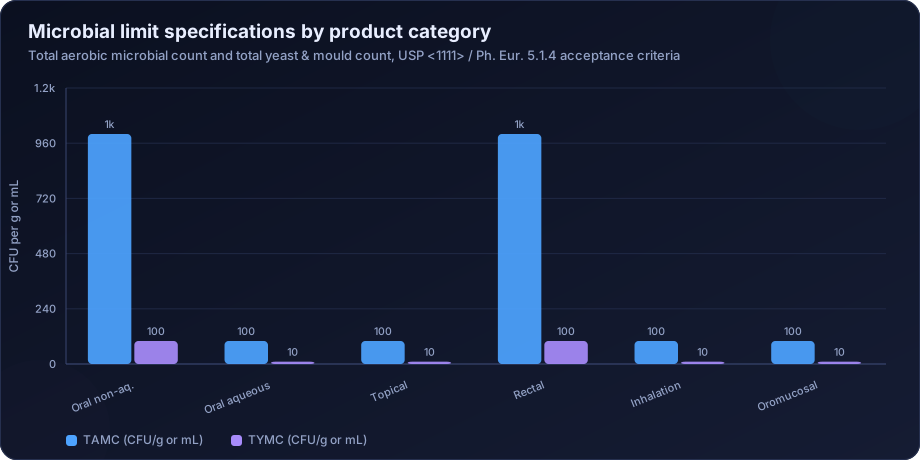
| Category | TAMC | TYMC | Specified organisms |
|---|---|---|---|
| Non-aqueous oral | 1000 CFU/g | 100 CFU/g | E. coli absent in 1 g |
| Aqueous oral | 100 CFU/mL | 10 CFU/mL | E. coli absent in 1 mL |
| Rectal | 1000 CFU/g | 100 CFU/g | — |
| Oromucosal, cutaneous, nasal, auricular | 100 CFU/g | 10 CFU/g | S. aureus, P. aeruginosa absent in 1 g |
| Vaginal | 100 CFU/g | 10 CFU/g | Above plus C. albicans |
| Inhalation | 100 CFU/g | 10 CFU/g | Above plus bile-tolerant Gram-negatives |
| Transdermal patch | 100 CFU/patch | 10 CFU/patch | S. aureus, P. aeruginosa absent |
The pattern is consistent: limits tighten as the route reaches more vulnerable tissue and as water activity rises. A non-aqueous tablet cannot support growth at all, which is why its limits are the most permissive.
Three Details That Decide Pass or Fail
The 2x interpretation rule. Compendial count limits carry a twofold allowance because plate counting is inherently variable. A TAMC limit of 1000 CFU/g is exceeded at results above 2000 CFU/g. This applies to counts only — never to specified organism absence, which is absolute.
Absence is always tied to a quantity. "Absence of Salmonella" is not a specification; "absence of Salmonella in 25 g" is. A specification omitting the quantity cannot be enforced consistently.
TYMC is combined. Yeasts and moulds are counted together against a single limit, not reported separately.
Sample Preparation by Matrix
Preparation determines whether organisms present ever reach the plate, and a single generic approach across a product range reliably under-reports.
- Water-soluble solids — dissolve in pH 7.0 buffered sodium chloride peptone solution, typically 1:10, with gentle mixing.
- Non-water-soluble solids — suspend with a wetting agent such as polysorbate 80, since hydrophobic powders otherwise float and never contact the diluent.
- Tablets and capsules — disintegrate rather than grind aggressively; heat and shear from over-milling kill vegetative organisms before they are counted.
- Oils and oily preparations — emulsify with polysorbate 80, warming to no more than 40 °C. Higher temperatures cause thermal death and a falsely low count.
- Creams and ointments — warm to no more than 45 °C with a suitable emulsifier; the emulsion must hold long enough for filtration or plating.
- Aerosols — chill and release contents aseptically, accounting for propellant evaporation in the volume calculation.
- Transdermal patches — remove the liner and extract from the whole patch surface, since the adhesive holds organisms that rinsing alone will not release.
- Effervescent products — allow gas evolution to complete before dilution, or the count is distributed unpredictably.
Incubation Conditions Matter More Than Expected
Getting the temperature wrong quietly under-reports the count, and it is a silent failure because nothing about the result looks wrong.
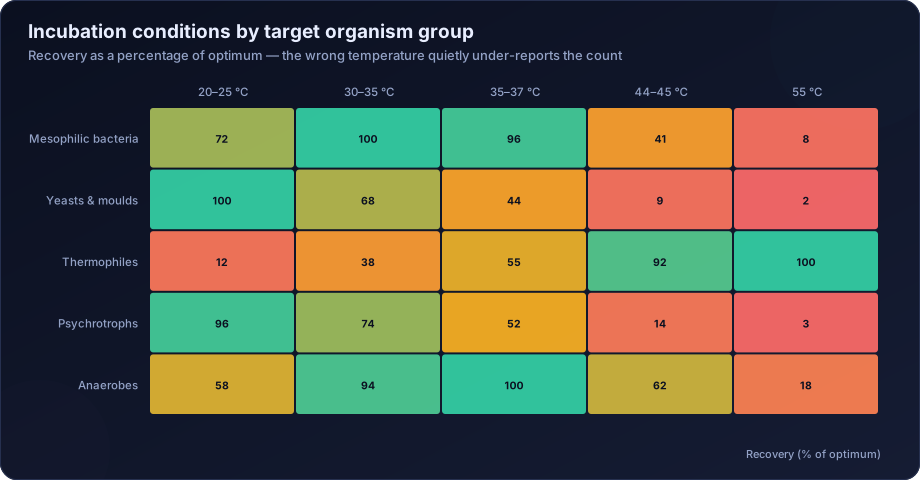
Bacteria and fungi need separate conditions. Running everything at 30–35 °C under-recovers yeasts and moulds substantially; running everything at 20–25 °C under-recovers mesophilic bacteria. Incubators must be temperature-mapped rather than trusted to their display, monitored continuously, and their loaded behaviour validated — a full incubator behaves differently from the empty one used at qualification.
Growth Promotion and Controls
Every media lot must be growth-promotion tested before use, using the compendial organisms, with documented acceptance. Without it, a "no growth" result is uninterpretable — it may mean a clean product or a medium that could not support growth.
Negative controls, diluent sterility checks and a positive control on each test occasion complete the picture. A laboratory that cannot produce these records for a given result cannot defend that result.
What Recovered Organisms Tell You
Reporting a count and discarding the plate throws away the actionable half of the result. The species usually names the source — Pseudomonads point to water, spore formers to botanicals or dust, staphylococci to personnel, coliforms to faecal contamination. See microbial identification.
This matters even when the count is compliant. A result of 40 CFU/g against a limit of 1000 is a pass; if the organism is Burkholderia cepacia in an aqueous oral liquid, it is also a serious finding regardless of the count. See objectionable organisms.
Running the Specified Organism Tests
Each absence test follows a defined sequence, and the confirmation step at the end is the one most often truncated under time pressure.
Escherichia coli — pre-enrich in soybean casein digest broth, transfer to MacConkey broth at 42–44 °C, subculture to MacConkey agar. Presumptive colonies are brick-red with a bile precipitate, and must be confirmed biochemically. A great many lactose-fermenting organisms look convincing on MacConkey and are not E. coli.
Salmonella — pre-enrich in soybean casein digest broth, transfer to Rappaport Vassiliadis salmonella enrichment broth, subculture to xylose lysine deoxycholate agar. Presumptive colonies are red with black centres, requiring biochemical and serological confirmation.
Pseudomonas aeruginosa — enrich in soybean casein digest broth, subculture to cetrimide agar. Confirmation includes oxidase positivity and, characteristically, fluorescein and pyocyanin pigment production under UV.
Staphylococcus aureus — enrich, subculture to mannitol salt agar. Yellow colonies with yellow zones are presumptive; coagulase testing confirms.
Bile-tolerant Gram-negative bacteria — pre-enrich in a non-selective broth to allow resuscitation of stressed cells, then enterobacteria enrichment broth Mossel, then violet red bile glucose agar. The resuscitation step matters: cells stressed by a preservative will not grow directly on selective media.
Candida albicans — enrich in Sabouraud dextrose broth, subculture to Sabouraud dextrose agar, then confirm on a chromogenic medium or by germ tube test.
The recurring theme is that selective media give presumptive results, not confirmed ones. Reporting an unconfirmed presumptive as a positive triggers an unnecessary investigation and, occasionally, an unnecessary batch rejection.
Common Failures
- Method suitability never performed, so an antimicrobial product reports clean regardless of content.
- Presumptive positives reported without confirmation, or confirmed positives reported without identification.
- Single-temperature incubation, under-recovering one organism group.
- Excessive dilution to overcome inhibition, raising the LOD above the specification limit.
- The 2x rule applied to absence tests, where it does not belong.
- Sample quantity omitted from absence specifications.
- Over-milling of solids, killing organisms during preparation.
- Media growth promotion not documented.
- Results filed rather than trended against batch history.
Trending Release Data Rather Than Filing It
A binary comparison against the limit discards most of what the testing generates. The batches worth attention are frequently the ones that passed.
A result of 400 CFU/g against a limit of 1000 is compliant. If every prior batch of that product ran below 50, it is also the most important number the laboratory produced that month — something in the process has changed, and the change is currently invisible because the specification was not breached.
- Chart on log-transformed counts, since microbiological data is log-normally distributed and raw-count control limits are mathematically wrong.
- Chart per product and per line rather than aggregating, because an average hides the one product that is drifting.
- Apply run rules — seven consecutive results above the median, or a sustained run of increases — rather than only checking the limit.
- Calculate capability against the specification, which distinguishes a process running at 5 per cent of its limit from one running at 40 per cent. Both have perfect release records; only one is robust.
- Review formally at a defined interval and record the action taken, since an unactioned signal is worse than no chart.
A process drifting toward its limit typically gives eight to twelve weeks of warning in the data. See microbiological trend analysis.
How DSTechnoverse Helps
We run microbial limit testing as our highest-volume service, and the gap we most often find in an incoming programme is method suitability rather than technique.
That covers specification review against route and market, method suitability and neutralisation validation per formulation, routine TAMC, TYMC and the full specified organism panel, membrane filtration for antimicrobial products, objectionable organism assessment beyond the compendial list, organism identification on recoveries, statistical trending of release data, and OOS investigation support.
Our laboratory is in Indore, Madhya Pradesh, and we hold capacity for the batch release schedules our regular clients run across India.
Frequently Asked Questions
What is the difference between USP <61> and <62>?
<61> is enumeration — counting TAMC and TYMC. <62> is absence testing for specified organisms. A complete specification normally needs both.
Does the 2x rule apply to Salmonella?
No. The twofold allowance applies to counts only. Absence requirements are absolute — a single confirmed colony in the specified quantity is a failure.
Which enumeration method should we use?
Membrane filtration wherever the product can be filtered, because rinsing removes inhibitors and a large filtered volume gives a much lower limit of detection. Plate count otherwise. MPN only where neither works.
Why did our preserved product show no growth?
Almost certainly unneutralised antimicrobial activity. A preserved product tested without validated neutralisation will nearly always report clean. See method suitability and neutralisation.
Do dietary supplements need microbial limit testing?
Yes, and botanical-based supplements typically need the full panel including Salmonella and E. coli at every lot, because agricultural raw materials carry high and variable loads.
What if a count exceeds the limit?
A documented OOS investigation — confirm the result, identify the organism, assess whether it is objectionable regardless of count, review the batch and raw materials. Retesting without investigation is not acceptable.
A microbial limit result without method suitability is not a result. DSTechnoverse provides microbial limit testing under USP <61> and <62>, Ph. Eur. and IP, with neutralisation validation for every formulation. Based in Indore, Madhya Pradesh, serving manufacturers across India. Talk to our microbiology team.
Related services
Related articles
- Finished Product Microbiological Release Testing: Specifications, Sampling and What It Proves
- Industrial Microbiological Testing: The Complete Guide for Indian Manufacturers
- Objectionable Organisms in Non-Sterile Products: Why Compendial Compliance Is Not Enough
- Herbal and Nutraceutical Finished Products: Setting Microbial Specifications