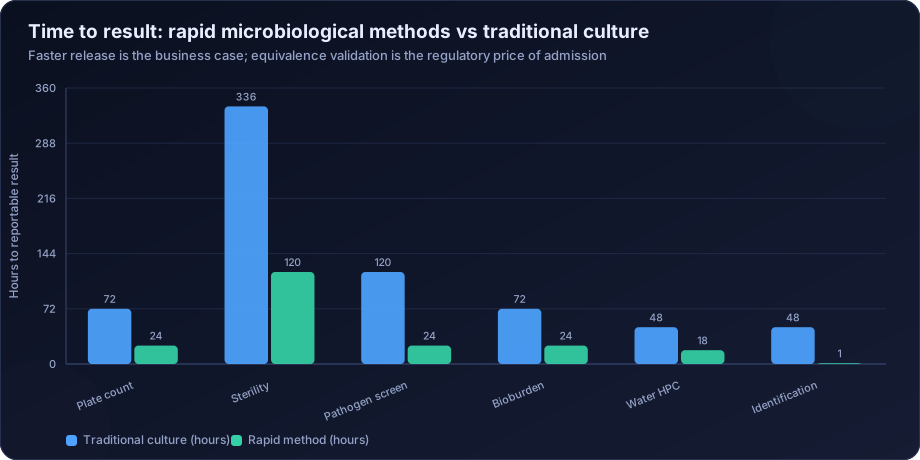
Traditional microbiology is slow because organisms grow slowly. A plate count needs three to five days, sterility needs fourteen, and no amount of laboratory efficiency changes that. Rapid microbiological methods sidestep the growth requirement — or shorten it — and can compress release timelines dramatically. The price of admission is an equivalence validation, and whether that price is worth paying is a genuine commercial question rather than a technical one.
Why Speed Matters Commercially
The business case is almost always about working capital and shelf life rather than laboratory cost.
- Inventory carrying cost. A batch sitting in quarantine for fourteen days is capital that cannot be deployed. For a high-volume manufacturer this is a substantial and continuous cost.
- Shelf life consumed before release. For short-dated products the testing period eats a meaningful fraction of the saleable life.
- Products that expire before results exist. Radiopharmaceuticals, cell and gene therapies and some compounded preparations cannot wait fourteen days for a sterility result at all.
- Faster corrective action. A contamination detected in 24 hours rather than 5 days means four fewer days of potentially affected production.
- Reduced retest and investigation cycles, since faster results allow problems to be caught and resolved within the same production window.
The Main Method Categories
Growth-based methods
These still require organisms to multiply, but detect growth earlier than the human eye can see a colony.
- Respiration detection — CO₂ production or O₂ consumption monitored continuously, detecting growth days before visible turbidity. Widely used for rapid sterility.
- Impedance and conductance — metabolic activity changes the electrical properties of the medium, giving detection in hours for high-inoculum samples.
- Automated colony counting with early imaging — micro-colonies detected at 1/3 to 1/2 the conventional incubation time.
Viability-based methods
These detect living cells directly, without requiring multiplication.
- ATP bioluminescence — adenosine triphosphate reacts with luciferase to emit light. Very fast, but ATP is present in non-microbial material too, which limits specificity.
- Solid-phase cytometry — cells are labelled with a viability fluorophore, captured on a membrane and counted by laser scanning. Detects single cells within hours.
- Flow cytometry — cells counted and characterised in suspension, giving results in under an hour with good quantitative performance.
- Direct epifluorescent filter technique — membrane filtration with fluorescent staining and microscopy.
Nucleic acid-based methods
- PCR and qPCR — amplification of target DNA, extremely sensitive and specific, results in hours. The key caveat is that DNA persists after cell death, so a positive does not necessarily mean a viable organism.
- Viability PCR — a dye such as PMA blocks amplification of DNA from membrane-compromised cells, addressing the dead-cell problem substantially.
- 16S rRNA sequencing — for identification rather than enumeration, covered in microbial identification.
Mass spectrometry
- MALDI-TOF — protein fingerprinting for identification in under an hour, now the routine workhorse in higher-volume laboratories.
Comparing Time to Result
| Application | Traditional | Rapid method | Typical rapid approach |
|---|---|---|---|
| Plate count | 72 h | 24 h | Early imaging, impedance |
| Sterility | 336 h (14 d) | 120 h (5 d) | Respiration detection |
| Pathogen screen | 120 h | 24 h | PCR after short enrichment |
| Bioburden | 72 h | 24 h | Solid-phase cytometry |
| Water HPC | 48 h | 18 h | Enzyme substrate, flow cytometry |
| Identification | 48 h | 1 h | MALDI-TOF |
Validation Under USP <1223>
Regulatory acceptance is not automatic. USP <1223> and Ph. Eur. 5.1.6 set out the validation framework, and the burden is to demonstrate that the alternative method is at least equivalent to the compendial one for the specific application and product matrix.
The validation parameters depend on whether the method is qualitative, quantitative or an identification method.
- Accuracy — the alternative recovers a comparable count to the compendial method across the relevant range.
- Precision — repeatability and intermediate precision within acceptable variability.
- Specificity — the method detects the target organisms and is not confounded by product components. For ATP methods this is the hardest parameter.
- Limit of detection — for qualitative methods, demonstrated detection at a low inoculum, typically under 5 CFU.
- Limit of quantification — the lowest count reliably quantified.
- Linearity and range — for quantitative methods, proportional response across the working range.
- Robustness — performance under deliberate small variations in method parameters.
- Ruggedness — consistency across analysts, instruments, days and reagent lots.
- Equivalence — direct statistical comparison against the compendial method on the actual product matrix, using a defined organism panel including stressed and product-relevant isolates.
The organism panel deserves particular attention. Validating only against healthy laboratory reference strains is the common shortcut. Sub-lethally injured organisms — which is exactly what a partially effective sterilisation produces — behave differently, and a method that misses them is not equivalent regardless of how it performs on healthy cultures.
The Product Matrix Problem
Validation is method-specific and product-specific. A rapid method validated for one formulation is not validated for another, and the reason is usually interference.
- ATP methods are confounded by product-derived ATP in anything containing biological material — a real limitation for food, nutraceutical and botanical products.
- Fluorescence methods are affected by autofluorescent or coloured products, and by particulates that scatter light.
- PCR is inhibited by a long list of common formulation components including polyphenols, humic acids, high salt, EDTA and certain excipients.
- Impedance methods are affected by high-conductivity products where the baseline swamps the metabolic signal.
- Filtration-based rapid methods face the same filterability limits as compendial membrane filtration.
Each of these is manageable, but each must be demonstrated rather than assumed, and each new product means new validation work.
Judging the Business Case
The validation effort is significant — commonly three to nine months of work and a meaningful capital outlay. Whether it pays depends on volume and on what the delay actually costs.
It usually pays when:
- Batch volume is high and continuous, so inventory carrying cost accumulates.
- Product shelf life is short enough that testing time is a material fraction of it.
- The product cannot be released at all under conventional timelines.
- The same method covers many products, amortising the validation.
- Contamination events are frequent enough that faster detection materially reduces exposure.
It usually does not pay when:
- Production is occasional or campaign-based.
- The product is long-dated and quarantine cost is negligible.
- Only one product would use the method.
- The regulatory market is conservative and the approval risk is material.
We advise clients on this honestly, and the answer is frequently that conventional methods remain the right choice.
Where Rapid Method Validations Go Wrong
Validation failures are rarely caused by the instrument. They are caused by decisions made before the protocol was written.
- Healthy reference strains only. The organism panel omits sub-lethally injured cells, so the method is validated against a population that does not resemble what a real sterilisation failure produces. This is the most consequential omission.
- Feasibility skipped. Full validation is launched before anyone confirmed the product does not interfere with the detection chemistry. Months of work then discover a problem a two-week screening study would have found.
- Equivalence assessed by comparing means. Two methods with the same average can have very different detection profiles at low counts, which is exactly where equivalence matters. Proper statistical equivalence testing is required.
- Validation on one product, routine use on many. Each matrix needs its own demonstration; a family approach requires justification based on compositional similarity.
- Limit of detection assumed from the manufacturer's claim rather than established in the specific product.
- No parallel period. The compendial method is retired immediately on approval, leaving no data to fall back on if the alternative behaves unexpectedly in routine use.
- Regulatory filing left until last. The change is implemented and then filed, rather than filed and then implemented, which creates an avoidable compliance exposure.
What Implementation Actually Looks Like
A realistic rapid sterility implementation for a mid-size sterile manufacturer runs roughly as follows. Month one is feasibility: candidate method screening against the product, interference testing and a go/no-go decision. Months two and three cover protocol development and instrument qualification — installation, operational and performance qualification.
Months four to seven are the validation execution: accuracy, precision, specificity, detection limit, robustness and ruggedness, followed by equivalence testing across a defined number of batches with parallel compendial testing throughout. The organism panel includes compendial strains, stressed variants and facility isolates drawn from the environmental monitoring flora library.
Month eight is data analysis, statistical equivalence assessment and validation reporting. Months nine onward cover the regulatory filing and the parallel-running transition period, which typically continues for a further three to six months before the compendial method is retired.
The total is close to a year and the cost is not trivial. For a manufacturer releasing several batches a week of a short-dated product, it repays quickly. For one releasing a batch a month of a two-year-dated product, it does not.
Implementation Sequence
- Define the application and the specific decision the faster result enables.
- Quantify the current cost of delay — carrying cost, shelf life consumed, investigation exposure.
- Select candidate methods against the product matrix, screening for known interference early.
- Run a feasibility study on the actual product before committing to full validation.
- Design the validation protocol against USP <1223> parameters, with an organism panel including stressed cells and facility isolates.
- Execute validation with parallel compendial testing across a defined number of batches.
- Perform statistical equivalence analysis rather than a visual comparison of means.
- File the change with the relevant regulator, allowing time for questions.
- Run both methods in parallel through a transition period before retiring the compendial method.
How DSTechnoverse Helps
We evaluate whether a rapid method is worth implementing before anyone commits to it, then design and execute the validation if it is.
That includes feasibility screening against your product matrix, validation protocol design to USP <1223> and Ph. Eur. 5.1.6, statistical equivalence analysis, stressed-organism panel preparation, parallel-testing programme management and regulatory documentation. Where the business case does not support implementation, we say so — that answer costs a client far less than a validation that is completed and then abandoned.
Frequently Asked Questions
Are rapid methods accepted by regulators?
Yes, when properly validated. Both USP <1223> and Ph. Eur. 5.1.6 explicitly provide for alternative methods. The requirement is a demonstrated equivalence, not a prohibition.
Can rapid methods replace the 14-day sterility test?
They can, with validation. Respiration-based systems commonly report in 5 to 7 days and some approaches are faster. The validation burden is highest for sterility because the consequence of a false negative is greatest.
Why does PCR sometimes give a positive with no growth?
Because DNA persists after cell death. A conventional PCR cannot distinguish a viable organism from the DNA of one killed by a sterilisation process. Viability PCR using PMA or similar dyes largely addresses this, and should be specified where the distinction matters.
How long does validation take?
Typically three to nine months depending on the number of products, the organism panel and whether interference problems emerge. Feasibility screening first can prevent a long validation on a method that was never going to work in your matrix.
Is ATP testing a rapid microbiological method?
For hygiene screening, it is a useful rapid indicator, but it measures total ATP including non-microbial sources. It is not a microbial count and should never be reported as one — a point covered further in surface and swab testing.
Do we have to keep running the compendial method?
Not permanently, but a parallel period during transition is standard practice and is generally expected. Once the alternative is validated and approved, it becomes the routine method.
Need microbiological testing backed by a defensible sampling plan? DSTechnoverse provides industrial microbiological testing for pharmaceutical, food, cosmetic and manufacturing operations. We are based in Indore, Madhya Pradesh and serve clients across India — raw materials, in-process, water, environment and finished product against pharmacopoeial and ISO methods. Talk to our microbiology team about your product and specification.