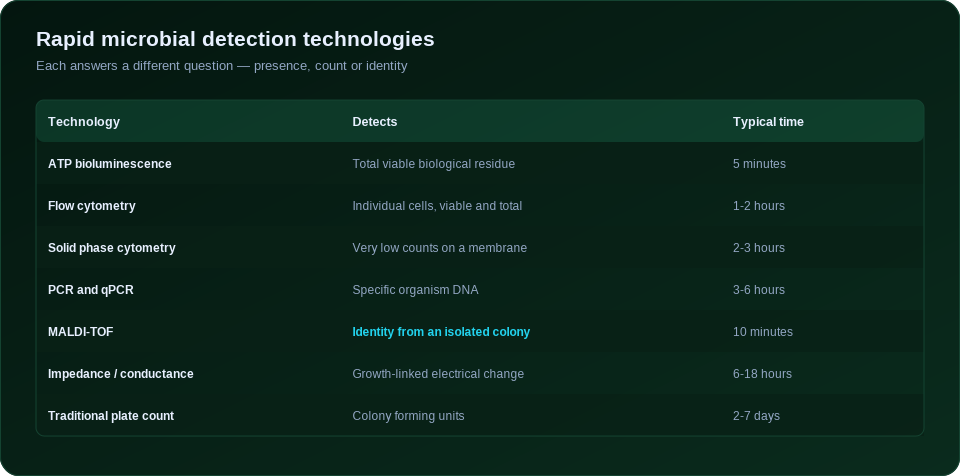
ATP bioluminescence is the most widely deployed rapid method in industry, and the most widely misunderstood. It gives an answer in under a minute — but the answer is to a narrower question than most users assume.
The Chemistry
Adenosine triphosphate is the energy currency of every living cell. The firefly enzyme luciferase reacts with ATP to emit light, and the light output is proportional to the amount of ATP present.
ATP + luciferin + luciferase + O₂ → oxyluciferin + light
A luminometer measures that light and reports it in Relative Light Units (RLU). RLU is an instrument-specific unit, not a standard measurement — RLU values from different manufacturers' systems are not comparable, and neither are values from different swab chemistries on the same instrument.
What It Actually Measures
This is the point that determines every correct and incorrect use of the technique.
ATP is present in all living cells, and persists for a while after they die. A swab of a food contact surface picks up ATP from:
| Source | Contributes ATP? | Relevance to hygiene |
|---|---|---|
| Bacteria and yeasts | Yes, but relatively little per cell | The organisms you care about |
| Food and product residue | Yes, often overwhelmingly | Soil, not necessarily contamination |
| Human skin cells | Yes | Handling residue |
| Free ATP from lysed cells | Yes | Historical, not current, contamination |
| Spores | Very little — spores are metabolically dormant | Missed almost entirely |
| Sanitiser residue | No, but may quench the reaction | Causes false low readings |
Two consequences follow directly.
ATP testing is a cleanliness test, not a microbiological test. A high RLU means organic residue is present. It usually correlates with poor cleaning, and poor cleaning usually correlates with microbial risk — but the reading itself is not a microbial count and cannot be converted into one.
ATP testing is close to blind to spores. A surface contaminated with Bacillus spores can return a low, passing RLU. In an industry where spore-formers are the recurring problem — dairy, spices, low-moisture foods, some pharmaceutical raw materials — this is a serious blind spot. See Bacillus and spore-former control.
Where ATP Testing Belongs
| Application | Suitable? | Notes |
|---|---|---|
| Post-cleaning verification before restart | Yes — ideal | Immediate result, prevents production on a dirty line |
| Sanitation crew feedback and training | Yes | Instant, visible, changes behaviour |
| CIP effectiveness trending | Yes | Consistent surfaces, comparable readings over time |
| Hygiene zone monitoring | Partly | Complement to, not replacement for, swab counts |
| Water system monitoring | Limited | Low ATP levels near the detection floor |
| Product release testing | No | Not a microbial count; no specification maps to RLU |
| Pathogen detection | No | No specificity whatsoever |
| Cleaning validation for pharma | Partly | Supports, but does not replace, residue and micro limits |
The distinction that matters: use ATP as a process control giving fast feedback to the people doing the cleaning, and use culture or another quantitative method as the verification that the process works. Our comparison of ATP testing versus microbiological swabbing works through where each is defensible.
Setting Limits That Mean Something
Manufacturer default limits (commonly pass under 10 RLU, caution 10-30, fail above 30) are starting points, not specifications. Real limits are established from your own surfaces.
How to set them properly:
- Choose the sampling points. Product contact surfaces first, then the hard-to-clean points a sanitation crew would naturally miss — under guards, inside valves, conveyor belt edges.
- Establish a clean baseline. Swab each point 20-30 times immediately after a verified-good clean. Record the distribution, not just the mean.
- Establish a dirty baseline. Swab the same points before cleaning. If the two distributions overlap, the point is not discriminating and needs a different swab technique or a different location.
- Set the pass limit at roughly the 95th percentile of the clean distribution.
- Set the caution limit between pass and the lower end of the dirty distribution.
- Correlate with plate counts at least once, over 20-30 paired samples, to demonstrate the relationship for your process. It will be loose. Document how loose.
- Re-baseline after any change to product, cleaning chemistry, or surface material.
A programme that copies limits from the swab supplier's leaflet without step 2 will either fail constantly or pass everything, and both destroy confidence in the method within a month.
Sources of Error
Swab technique. ATP recovery from a surface depends heavily on pressure, coverage pattern and swab wetting. Two operators can differ by a factor of three on the same surface. Standardise a 10 cm × 10 cm area with a defined stroke pattern, and train against it.
Sanitiser carryover. Quaternary ammonium compounds and chlorine quench the luciferase reaction, producing false low readings. Swab after rinse, not after sanitiser application — otherwise the method reports success precisely when it should not.
Temperature. The enzyme reaction is temperature-sensitive. Cold surfaces and cold swab reagents read low. Let refrigerated swabs equilibrate.
Expiry and storage. Luciferase degrades. Expired swabs read low, which is the dangerous direction to fail in.
Surface material. Porous, scratched or worn stainless steel retains residue and reads high even after adequate cleaning. This is real information about the equipment, not a false positive — worn surfaces genuinely are harder to clean.
Interpreting a Result
| Result | Most likely meaning | Action |
|---|---|---|
| Low RLU, low plate count | Cleaning is effective | Proceed |
| High RLU, low plate count | Organic residue, few viable organisms | Re-clean; investigate the cleaning step |
| Low RLU, high plate count | Spores, biofilm, or sanitiser quenching | Investigate seriously — the ATP method is not protecting you here |
| High RLU, high plate count | Cleaning failure | Re-clean, hold product, investigate |
The third row is the one to worry about. A recurring low-ATP/high-count pattern usually points to biofilm — where cells are embedded in a matrix that swabbing does not lift — or to spore-formers. Both need a different detection approach entirely. See biofilm in water systems and recovery efficiency in surface sampling.
Building a Programme
A workable ATP programme has five components:
- A written sampling plan — fixed points, fixed frequency, defined by risk rather than convenience.
- Trained operators with a standardised swabbing technique, verified periodically.
- Established, site-specific limits with documented derivation.
- A defined response to caution and fail results, including who authorises restart.
- Trending, not just pass/fail. A point drifting upward within the pass range is the earliest warning you will get.
Point 5 is what turns ATP from a gate into an early warning system. Individual results tell you about one clean; the trend tells you about the cleaning process, and about equipment that is beginning to wear. The statistical approach is the same as for any other microbiological trend — see microbiological trend analysis with SPC.
ATP in Pharmaceutical Cleaning Validation
In a pharmaceutical setting ATP has a narrower role. Cleaning validation must demonstrate removal of the active ingredient to a calculated limit, and ATP does not measure the active. It serves as a rapid supporting check — a fast indicator that the cleaning cycle behaved as it did during validation — alongside specific residue analysis and microbial limits.
The regulatory expectation is that the validated cleaning procedure is followed, with verification against defined analytical limits. Using ATP as the sole release criterion for cleaned equipment will not survive an inspection. See cleaning validation for shared equipment.
Cost and Practical Deployment
ATP is the cheapest rapid method to deploy, which is why it is usually the first one a site adopts.
| Item | Consideration |
|---|---|
| Luminometer | One-off, modest; handheld units are portable enough for the production floor |
| Swabs | Recurring per test, and the dominant running cost |
| Storage | Refrigeration required; expired swabs read low |
| Training | Hours, not days — but technique standardisation matters |
| Software | Most units log results and export for trending |
| Calibration | Periodic verification against a positive control standard |
The running cost is driven entirely by test frequency, which makes the sampling plan a budget decision as well as a technical one. A common and workable pattern: every product contact point after every clean on high-risk lines, with lower-risk zones on a rotating weekly or monthly schedule so every point is covered over a defined cycle.
Two deployment mistakes to avoid. The first is testing everywhere at low frequency, which produces a thin dataset at every point and a trend at none. The second is testing only the easy-to-reach points, which produces an encouraging pass rate that says nothing about the places where residue actually accumulates.
Choose fewer points, chosen by risk, tested often enough to trend. A dozen well-chosen points with 50 results each is a far more useful dataset than a hundred points with six results each.
Frequently Asked Questions
What does ATP bioluminescence measure? Adenosine triphosphate from all biological sources — microorganisms, product residue and human cells — reported as relative light units. It measures cleanliness, not microbial count.
What is a good RLU reading? Site-specific. Typical starting defaults are under 10 RLU for pass and over 30 for fail, but valid limits come from baselining your own clean and dirty surfaces.
Can ATP testing detect bacteria? Indirectly and non-specifically. It detects the ATP within bacterial cells, but cannot distinguish them from product residue, and it detects spores very poorly.
Does ATP testing replace microbiological swabbing? No. It is a fast process-control check; culture-based swabbing remains the verification that the cleaning programme works.
Why did my ATP test pass but the plate count fail? Most likely spore-formers, biofilm, or sanitiser residue quenching the reaction. All three warrant investigation.
How long does an ATP test take? Around 10-30 seconds of measurement, under a minute end to end including swabbing.
Are RLU values comparable between systems? No. RLU is instrument- and chemistry-specific. Changing supplier means re-baselining every limit.
How often should surfaces be swabbed? Risk-based. Product contact surfaces after every clean on high-risk lines; lower-risk zones weekly or monthly with rotation across points.
Can ATP testing be used for water? Only with specialised low-level systems. Standard hygiene swabs sit near their detection floor in clean water, which makes results unreliable.
Evaluating a rapid microbiological method? DSTechnoverse supports method selection, equivalence study design, validation protocols and data review for rapid microbial detection — alongside routine industrial microbiological testing by compendial methods. We are based in Indore, Madhya Pradesh and serve clients across India. Talk to our microbiology team about the decision your test result has to support.
Sources and Further Reading
Official and primary sources for the standards, rules and data discussed on this page.
- WHO: GMP guidelines for pharmaceutical production: WHO good manufacturing practice texts, including water and sterile products.
- United States Pharmacopeia (USP): the compendial microbiology chapters such as <61>, <62>, <71> and <1116>.
- EudraLex Volume 4: EU GMP Guidelines: includes Annex 1 (2022) on the manufacture of sterile medicinal products.
- Food Safety and Standards Authority of India (FSSAI): food microbiological standards and testing regulations.