Water is the single most common route by which microorganisms enter a manufacturing process, and the most common source of contamination in finished products. It is also the most under-monitored utility in most facilities — tested at a handful of convenient points on a monthly schedule that would not detect a developing distribution problem until it had persisted for weeks.
Water Types and Their Requirements
The standard that applies depends entirely on what the water is for.
| Water type | Standard | Key microbiological requirement |
|---|---|---|
| Potable / municipal | BIS IS 10500 | Coliforms and E. coli absent in 100 mL |
| Packaged drinking water | IS 14543 | Coliforms, E. coli, P. aeruginosa, faecal streptococci, sulphite-reducing anaerobes absent |
| Packaged natural mineral water | IS 13428 | As above, with source protection requirements |
| Purified Water (PW) | IP / USP / Ph. Eur. | Action limit 100 CFU/mL by HPC |
| Water for Injection (WFI) | IP / USP / Ph. Eur. | 10 CFU per 100 mL, endotoxin below 0.25 EU/mL |
| Process / utility water | Set by the product it contacts | Frequently unspecified, and should not be |
| Cooling tower / HVAC | Risk-assessment driven | Legionella monitoring |
| Treated effluent | CPCB / SPCB consent | Faecal coliforms, E. coli, helminth eggs |
The row that causes most trouble is process water. Rinse water, cooling water, humidification water and final-rinse water after cleaning all contact product or product-contact surfaces, and in a large proportion of the facilities we assess none of them has a written microbiological specification at all.
The Parameters and What Each One Tells You
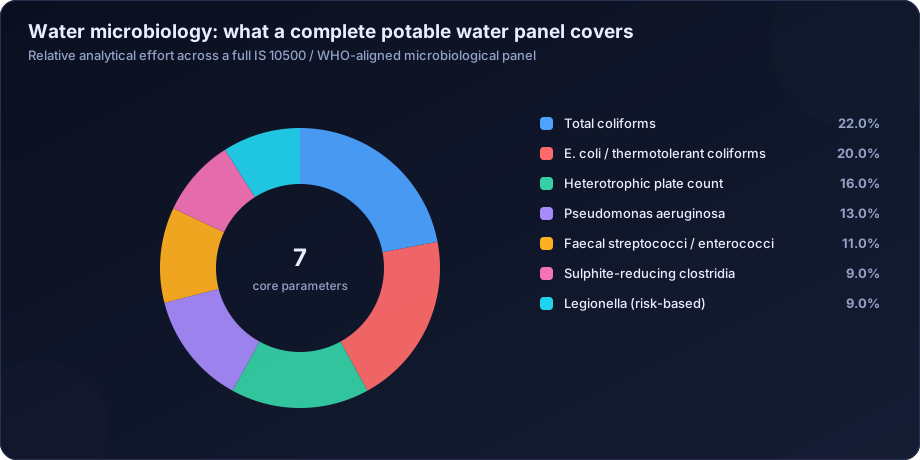
Total coliforms — the classic indicator of treatment failure or distribution ingress. Not a hazard in themselves; a signal that something got in.
Escherichia coli and thermotolerant coliforms — the specific indicator of faecal contamination and the parameter regulators focus on. Presence is a compliance failure everywhere.
Heterotrophic plate count (HPC) — total culturable aerobic bacteria. No direct health significance at typical levels, and consequently ignored by many facilities. It is the most sensitive available indicator that a distribution system is changing, and the number we look at first.
Pseudomonas aeruginosa — an opportunistic pathogen and a hallmark biofilm organism. Critical for packaged water and for any pharmaceutical or cosmetic system.
Faecal streptococci and enterococci — persistent faecal indicators that survive longer in the environment than coliforms, useful for detecting intermittent contamination.
Sulphite-reducing clostridia — spore formers indicating remote or historical faecal contamination that vegetative indicators would have missed.
Legionella pneumophila — for cooling towers, hot water systems, spas and any aerosol-generating system.
Burkholderia cepacia complex — a critical objectionable organism for pharmaceutical and cosmetic aqueous products, discussed in objectionable organisms.
Bacterial endotoxin — for WFI, dialysis water and any water contacting parenteral products. Heat-stable, so it survives sterilisation of the water it came from.
Why HPC Deserves More Attention Than It Gets
A facility whose coliform results are consistently absent will often conclude the water system is fine. Coliforms are a poor early-warning indicator, because by the time they appear the system has usually deteriorated considerably.
HPC moves first. A system whose HPC has risen from 15 to 300 CFU/mL over four months, with coliforms still absent, is telling you clearly that biofilm is establishing. Acting at that point is inexpensive. Acting when coliforms appear means the problem is already mature.
The practical recommendation is to trend HPC per sampling point rather than compare it to a limit, using the approach in microbiological trend analysis. A tenfold rise within an acceptable limit is a more important signal than a marginal single result.
Sampling Water Without Invalidating the Result
A significant proportion of water results are wrong before the sample reaches the laboratory.
- Use sterile containers with sodium thiosulphate for any chlorinated water. Without the neutraliser, residual disinfectant keeps working during transport and produces an artificially low count.
- Decide deliberately between pre-flush and first-draw. Flushing measures the distribution system; first-draw measures the outlet and its fitting. They answer different questions, and the choice must be documented and consistent.
- Do not flame or disinfect the outlet when the question is about the tap itself — you would be removing the contamination you are investigating.
- Fill without rinsing the container with the sample, which would defeat the neutraliser, and leave headspace for mixing.
- Transport at 2–8 °C and analyse within the hold time — six hours ideal, 24 hours typical maximum. Results outside hold time should be reported with that qualification rather than silently.
- Sample the same points consistently. A trend only exists if location, technique and timing are stable.
- Record the operating context — chlorine residual, temperature, flow status, time since last use, recent sanitisation. These explain most anomalous results.
Sampling Points: Cover the Loop, Not the Convenient Taps
Testing the same two accessible taps every month is the most common water monitoring design, and it tells you about those two taps.
- Source or incoming supply, establishing what the system is being asked to handle.
- After each treatment stage — filtration, softening, RO, UV — so a failing unit is attributable.
- Storage tank outlet, since tanks are a common growth point.
- Loop return, which reflects the accumulated state of the whole distribution.
- Every point of use on a rotating schedule, so all outlets are covered over a defined cycle.
- Dead legs and low-use outlets specifically, because these are where biofilm establishes first.
- Final rinse water at each piece of equipment where water contacts product-contact surfaces.
Packaged Drinking Water: Specific Requirements
Packaged water plants operate under IS 14543 and BIS certification, with per-batch testing obligations that go beyond most manufacturing.
- Source water testing at defined frequency, independent of the finished product.
- Every batch tested for coliforms, E. coli, P. aeruginosa, faecal streptococci and sulphite-reducing anaerobes.
- Yeast and mould limits, which many plants overlook until a BIS audit.
- Ozonation control — residual ozone must be sufficient for disinfection and low enough at filling to meet the bromate limit.
- Container and closure microbiological control, since a sterile-filled water in a contaminated bottle is a contaminated product.
- Shelf-life substantiation, since packaged water is not sterile and organisms can proliferate over months of storage.
We work with several packaged water plants around Indore, Pithampur and Dewas, and the most frequent finding is not the water treatment — it is the filling environment and the container handling, which sit outside what most plants think of as water testing.
Wastewater and Effluent
Effluent microbiology answers a different question: whether discharging will create a public health or environmental hazard, and whether the treatment plant is performing as designed.
Consent conditions from the CPCB or a State Pollution Control Board typically specify faecal coliform limits, increasingly E. coli, and helminth egg limits where effluent is used for irrigation. Treatment performance is judged on log reduction across the plant rather than the outlet number alone.
There is also a process microbiology dimension that is frequently misdiagnosed as an engineering fault — activated sludge health, filamentous bulking, nitrifier population collapse and anaerobic digester instability are all microbiological problems presenting as plant performance issues.
Testing Frequency
| System | Typical frequency |
|---|---|
| WFI, Purified Water point of use | Daily on rotation, every point weekly |
| Packaged water | Every batch, plus source at defined interval |
| Potable supply in food facility | Monthly minimum; weekly is better |
| Process water contacting product | Weekly to monthly, risk-based |
| Cooling tower | Quarterly, or monthly where risk assessment requires |
| Effluent | Per consent condition, commonly monthly |
Monthly potable sampling is common and detects a developing biofilm very late. Where the water contacts product, weekly is a more defensible starting point.
Treatment Stages and Where Each One Fails
Understanding the treatment train tells you where to sample and what a failure at each stage looks like microbiologically.
- Multimedia and sand filtration — removes particulates and reduces turbidity. Becomes a microbial contributor when backwash frequency is inadequate, since the bed is a high-surface-area growth environment.
- Activated carbon — removes chlorine and organics, and is consequently the single most common growth point in a treatment train. Removing the chlorine removes the disinfection while providing an ideal nutrient-rich substrate. Carbon beds need frequent sanitisation and are a first place to look when counts rise.
- Water softening — resin beds have the same problem as carbon, with the added factor that regeneration cycles create stagnation.
- Reverse osmosis — an excellent microbial barrier when membranes are intact, but a compromised membrane or a leaking O-ring passes organisms directly into the permeate. Permeate-side sampling is essential.
- Electrodeionisation — polishes conductivity and is not a reliable microbial barrier on its own.
- UV disinfection — effective on organisms passing the lamp at the moment of treatment, with no residual effect. Lamp output degrades well before failure, so hours-of-use tracking matters more than a simple on/off check.
- Final filtration — a 0.2 µm point-of-use filter removes organisms but becomes a growth site on its downstream face if left in place too long, and can shed if integrity is lost.
The pattern worth internalising: every stage that removes a disinfectant or provides surface area is a candidate growth point. Sampling only the final water tells you there is a problem; sampling after each stage tells you where it is.
How DSTechnoverse Helps
Our laboratory is in Indore, Madhya Pradesh, which matters more for water than for most microbiological services — water samples have a six to twenty-four hour hold time, so proximity affects whether the result is valid. We collect directly around Indore, Pithampur, Dewas and the wider Madhya Pradesh industrial belt, and use validated cold-chain courier arrangements for clients elsewhere in India.
Services span full IS 10500 and IS 14543 panels, pharmaceutical water system qualification and routine monitoring, biofilm and distribution system investigation, organism identification of water isolates, per-point trend analysis, and effluent compliance testing against CPCB and SPCB consent conditions.
Frequently Asked Questions
How often should water be tested?
Pharmaceutical PW and WFI loops daily at rotating points of use. Packaged water every batch. Potable supplies in food facilities monthly at minimum, though monthly sampling detects a developing problem late.
What does a high HPC actually mean?
It has no direct health significance at typical levels, but it is the most sensitive indicator that the distribution system is changing. A rise from 15 to 300 CFU/mL with coliforms absent is a genuine warning.
Is coliform absence sufficient?
For regulatory compliance under IS 10500, often yes. For process assurance, no — coliforms are poor indicators of the Pseudomonas, Burkholderia and Ralstonia species that actually contaminate pharmaceutical and cosmetic products.
Why do results improve after sanitisation and then deteriorate?
Because sanitisation killed the planktonic organisms but not the biofilm, which reseeds the water within weeks. See biofilm in water systems.
Do we need Legionella testing?
If you have cooling towers, hot water between ambient and 60 °C, spa pools, decorative fountains or any aerosol-generating water system, a risk assessment is expected and monitoring usually follows from it.
Should we test water at the point of use or at the loop return?
Both, because they answer different questions. Loop return reflects the accumulated state of the whole distribution and is the better early indicator of system-wide deterioration. Point of use reflects what the product actually receives, including any contribution from the outlet valve, hose or filter that the loop sample never sees. A programme sampling only the return can pass while a specific outlet is delivering contaminated water to product.
What is the hold time for a water sample?
Six hours from collection to analysis is ideal and twenty-four hours refrigerated is the usual maximum. Beyond that, populations shift — some organisms die off, others multiply — and the result no longer describes the water as sampled. Results analysed outside hold time should carry that qualification on the report rather than being presented as equivalent.
Can water testing be faster?
Yes. Enzyme substrate methods give coliform and E. coli results in 18 to 24 hours, and rapid ATP or flow cytometry methods give near-real-time system indicators. Regulatory acceptance requires equivalence validation against the reference method.
Water problems are usually system problems, not sampling problems. DSTechnoverse provides water and wastewater microbiology — potable, packaged, purified, WFI, process and effluent testing with biofilm and distribution system investigation. Based in Indore, Madhya Pradesh, serving clients across India. Talk to our microbiology team.