Identification converts an anonymous colony into actionable information. A count tells you how much contamination is present; the identity tells you where it came from, whether it matters, and what to do about it. In practice the identification is the more valuable half of the result, and it is the half most routinely discarded.
Start From the Decision, Not the Method
The question to ask before selecting a method is what decision the identification has to support.
A routine environmental isolate being logged into a flora library needs species-level identification at low cost. A sterility test positive that will appear in a regulatory submission needs sequence-based identification with documented confidence. A recurring contamination needs strain-level typing, because species-level identity cannot establish that two isolates are the same organism.
Selecting by what the laboratory already owns rather than by what the decision requires is how facilities end up with either an expensive answer to a trivial question or an inadequate answer to a serious one.
The Methods Compared
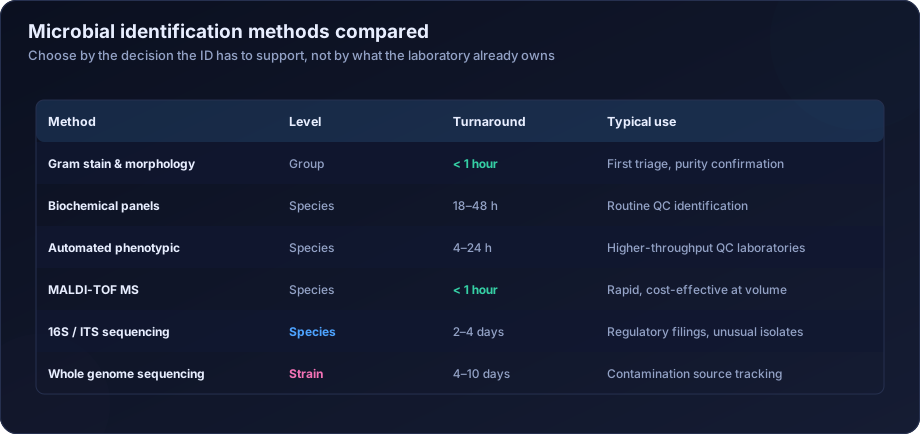
| Method | Resolution | Turnaround | Cost | Best use |
|---|---|---|---|---|
| Gram stain, morphology | Group | Under 1 hour | Negligible | First triage, purity check |
| Differential tests (catalase, oxidase, coagulase) | Group / genus | Under 1 hour | Negligible | Directing the next step |
| Biochemical panels (API and similar) | Species | 18–48 h | Low | Routine QC on common organisms |
| Automated phenotypic (Vitek and similar) | Species | 4–24 h | Low–medium | Higher-throughput QC |
| MALDI-TOF mass spectrometry | Species | Under 1 hour | Low at volume | The volume workhorse |
| 16S rRNA sequencing | Species | 2–4 days | Medium | Regulatory weight, unusual isolates |
| ITS / D2 LSU sequencing | Species | 2–4 days | Medium | Fungi, where phenotype fails |
| Multi-locus sequence typing | Strain-ish | 3–5 days | Medium–high | Portable strain comparison |
| Whole genome sequencing | Strain | 4–10 days | High | Contamination source tracking |
Gram Stain Still Earns Its Place
It is tempting to skip straight to an instrument, and the Gram stain remains worth the fifteen minutes for two reasons.
Purity confirmation. Every identification method assumes a pure isolate. A plate carrying two organisms produces a result that is a blend of both and belongs to neither. A Gram stain showing mixed morphology stops a wasted identification before it starts.
Direction. Gram-negative rods, Gram-positive cocci, spore-forming rods and yeasts each point at different source types and different confirmatory routes. Knowing the category in under an hour frequently narrows a contamination investigation before any instrument is booked.
MALDI-TOF: The Practical Default
MALDI-TOF measures a protein fingerprint and matches it against a reference library. At volume it is fast, cheap per sample and reliable for organisms well represented in the database.
Its limitations are worth knowing. Environmental organisms are less well represented than clinical ones, so an unusual isolate may return a poor score or a wrong nearest match. It requires a pure, fresh, adequately grown colony. And it reports a score value rather than a probability — a score below the manufacturer's species threshold means genus-level confidence at best, and promoting it to a species name is not supportable.
Most laboratories running volume work use MALDI-TOF routinely and confirm by sequencing where the answer carries weight.
Sequence-Based Identification
16S rRNA is the reference standard for bacteria. The gene is universally present, sufficiently conserved to amplify with common primers, and sufficiently variable to discriminate most species.
ITS and D2 LSU are the fungal equivalents, and for fungi they are far more than a confirmatory option — phenotypic fungal identification has high error rates, and sequencing is the practical standard for any fungal result that matters.
Reading the output correctly is where most errors happen. Percentage identity is not a confidence score; it is similarity to the closest entry in whatever database was searched. Conventional thresholds are around 99 per cent for species and 97 per cent for genus. Below those, the honest report is a genus assignment or a nearest-neighbour statement.
Some genera cannot be resolved by 16S at all. Bacillus cereus and B. thuringiensis are essentially identical at this locus, as are several Pseudomonas and Enterobacter species. Resolving those requires additional gene targets or whole genome comparison.
What a Defensible Report Contains
- The method, instrument and database name with version and date.
- For sequencing: percentage identity, query coverage, length of sequence compared, and the next-closest match with its identity.
- For MALDI-TOF: the score value and the manufacturer's interpretation threshold.
- A statement of the confidence level achieved — species, genus, or unresolved.
- The raw data retained, so the identification can be re-examined against an updated database later.
A report giving only a species name conceals exactly the information needed to judge how much weight it can bear. Where two top matches are separated by 0.1 per cent identity and are different species, the identification is genuinely ambiguous and should say so.
Getting the Isolate Right Before Identifying It
Every method downstream assumes a pure, viable, appropriately grown culture. Time spent here is recovered several times over, and skipping it is the most common cause of a wrong answer that nobody detects.
Purity. Streak for single colonies and confirm uniform morphology before proceeding. A plate with two organisms produces a blended result — MALDI-TOF returns a poor score or the dominant organism, and sequencing returns overlapping traces that may still be called by the software.
Age and growth phase. MALDI-TOF works best on fresh, actively growing colonies, typically 18 to 24 hours for common bacteria. An old culture has degraded proteins and gives poorer spectra. Sequencing is more forgiving but still needs adequate biomass.
Medium. Some media interfere. Highly selective agars and those with strong dyes can affect MALDI-TOF spectra, so subculture to a non-selective medium before identification.
Passage number. Each subculture is an opportunity for drift, and plasmid-borne characteristics can be lost. Identify at low passage and archive from an early transfer.
Stressed organisms. Cells recovered from a preserved product or a disinfected surface are sub-lethally injured and may grow poorly or atypically. A resuscitation step on non-selective medium before identification improves both recovery and result quality.
Anaerobes and fastidious organisms. These need appropriate atmosphere and enriched media from the outset. An anaerobe subcultured aerobically simply will not grow, and its absence is easily misread as a contaminated plate rather than a handling error.
Common Pitfalls
- Identifying from a mixed culture, producing a blended result belonging to neither organism.
- Searching a clinical database for an environmental isolate, which returns the nearest clinical relative rather than the right answer.
- Promoting a genus-level result to a species name because the top hit had one.
- Ignoring the next-closest match when the two are indistinguishable.
- Using 16S alone in genera it cannot resolve.
- Identifying fungi by morphology, which varies with medium, temperature and age.
- Trusting an old, repeatedly subcultured isolate, which may have drifted phenotypically or lost plasmid-borne traits.
- Omitting method and database version, making the result impossible to reproduce or defend later.
Matching Level to Consequence
- Group level — routine trending of non-critical environmental sites where only the broad population balance matters.
- Genus level — general hygiene monitoring in food and cosmetic environments.
- Species level — the default for anything informing a decision: alert-limit excursions, all Grade A and B recoveries, raw material failures, water isolates, product recoveries.
- Species with sequence confirmation — regulatory submissions, deviation reports, recall decisions, customer notifications.
- Strain level — establishing whether two isolates are the same organism, which is the only level that supports source attribution. See strain typing.
- Toxigenicity or virulence gene screening — where a species has both harmless and hazardous variants, such as E. coli or Bacillus cereus.
Building an Identification Programme
Deciding what to identify is a policy question rather than a laboratory one, and writing it down converts an inconsistent habit into a programme.
- Define mandatory identification triggers. Every Grade A and B recovery, every excursion above alert level, every product isolate, every sterility positive, every water system result above alert, every raw material failure. These are non-negotiable and should be automatic rather than requested case by case.
- Define periodic identification. A defined proportion of routine recoveries per area per quarter, enough to characterise the normal flora without identifying every plate.
- Assign the method per trigger. MALDI-TOF for routine and periodic work, sequencing for anything with regulatory weight, strain typing reserved for source attribution.
- Set the archiving rule alongside, since identification without retention loses most of the long-term value.
- Name an owner. Programmes without a named owner degrade within months, and the gap only becomes visible during an investigation.
- Budget for it explicitly. Identification competes badly for budget because its benefit arrives during a crisis that has not happened yet. A line item survives; an ad hoc request does not.
- Review annually against the year's recoveries, adjusting triggers where a location or product has proved more or less informative than expected.
The programme is more valuable than any individual identification, because it is what produces the comparison set that makes future results interpretable.
Why This Pays for Itself
A MALDI-TOF identification costs a small fraction of a single day of production downtime. A full strain-typing comparison costs less than a fraction of one wrongly targeted equipment replacement.
The economics favour identifying more than most facilities currently do. The expensive decision is almost always the one taken without knowing what the organism was — and the second most expensive is the investigation that starts from nothing because the plates were discarded. See facility flora library.
How DSTechnoverse Helps
We run tiered identification, matching method and cost to the decision rather than applying one technique to everything.
That covers MALDI-TOF species identification for routine volume work, 16S rRNA, ITS and multi-locus sequencing where regulatory weight or an unusual organism requires it, whole genome sequencing and strain typing for source tracking, facility flora library establishment with cryopreservation and cataloguing, fungal identification where phenotypic methods are least reliable, objectionable organism confirmation, and interpretation of what the organism implies about the likely source.
Our identification laboratory is in Indore, Madhya Pradesh. Cultures travel well, so clients across India get the same turnaround as local ones — an advantage identification has over most microbiological services.
Frequently Asked Questions
Do all isolates need identifying?
No. Identify everything from Grade A and B zones, every excursion above alert level, all product and sterility isolates, and a periodic sample of routine recoveries. Identifying every routine plate is rarely justified.
Is MALDI-TOF as reliable as sequencing?
For common organisms well represented in the library, yes, and it is far faster and cheaper. For unusual environmental organisms, fungi, and results carrying regulatory weight, sequencing is safer.
Why did two laboratories report different species?
Usually different methods or databases, or an organism in a group the method cannot resolve. Common in Bacillus and Pseudomonas, and a reason to request confidence metrics rather than just a name.
What is the difference between species and strain identification?
Species says two isolates are the same kind of organism. Strain says whether they are the same organism. Only the latter supports source attribution.
How long should isolates be retained?
Through product shelf life plus regulatory retention for product-associated isolates, and several years for flora library entries where historical comparison is the point.
Should identification be brought in-house or outsourced?
It depends almost entirely on volume and on which methods you need. MALDI-TOF becomes economic in-house at reasonably high throughput, and the instrument pays back through speed as much as cost. Sequencing and strain typing rarely justify in-house capability outside a large operation, because the equipment, the bioinformatics skill and the database maintenance are all substantial. The common and sensible arrangement is routine identification in-house and sequencing outsourced, with the important caveat that the isolate collection stays under your control regardless of who does the work.
Can identification tell us the contamination source?
It narrows the source type substantially — water, soil, personnel, faecal — usually eliminating most possibilities immediately. Confirming a specific route requires strain typing against candidate facility isolates.
A count tells you how much. The identity tells you where it came from. DSTechnoverse provides microbial identification from rapid MALDI-TOF through 16S and ITS sequencing to whole genome strain typing, with facility flora library development. Based in Indore, Madhya Pradesh — cultures travel well, so clients across India get the same turnaround. Talk to our microbiology team.