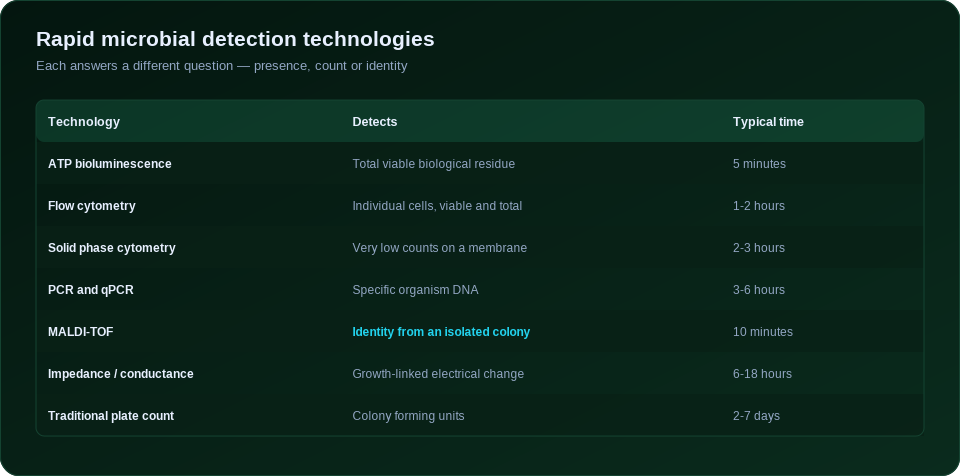
PCR turns a microbiological question into a molecular one. Instead of waiting for an organism to grow into a visible colony, you amplify a signature piece of its DNA until it is detectable. Done well, that turns a five-day pathogen screen into a working shift.
Done without understanding the failure modes, it produces confident answers to questions you did not ask.
How It Works
Polymerase chain reaction repeatedly copies a target DNA sequence. Each cycle doubles the number of copies, so 30-40 cycles turn a handful of molecules into billions — enough to detect.
Three components define a PCR assay:
- Primers — short sequences that bind either side of the target region. These determine specificity: choose primers unique to Salmonella and only Salmonella DNA amplifies.
- Polymerase — the enzyme that copies the DNA.
- Detection chemistry — how you see the product. Endpoint PCR runs a gel afterwards; qPCR (real-time PCR) measures fluorescence during each cycle.
qPCR reports a Ct value (cycle threshold) — the cycle number at which fluorescence crosses a threshold. A low Ct means a lot of starting DNA; a high Ct means very little. Ct correlates with starting quantity, which makes qPCR semi-quantitative against a standard curve.
| Variant | What it adds | Use case |
|---|---|---|
| Endpoint PCR | Presence/absence, gel-based | Basic screening, largely superseded |
| qPCR | Real-time detection, Ct value, quantification | Standard for pathogen screening |
| RT-qPCR | Detects RNA via reverse transcription | RNA viruses, viability indicators |
| Multiplex PCR | Several targets in one reaction | Panels — multiple pathogens at once |
| Digital PCR | Absolute quantification, no standard curve | Low-copy targets, precise quantification |
| Viability PCR (PMA/EMA) | Excludes DNA from membrane-compromised cells | Distinguishing live from dead |
The Central Limitation: DNA Is Not Life
PCR detects DNA. DNA persists after the organism dies.
A heat-treated product may contain no viable Salmonella and still return a PCR-positive result from residual DNA. A sanitised water line may show target DNA from cells killed hours earlier. Neither is a contamination event in any meaningful sense, but both look identical to the assay.
This matters most where a kill step precedes the test — which is exactly where pathogen testing is most often applied. Three mitigations:
- Enrichment before PCR. Grow the sample for 6-18 hours before amplifying. Only viable cells multiply, so viable DNA comes to dominate. This is the standard approach in food pathogen testing and the reason "rapid" PCR screening is usually still an overnight process.
- Viability dyes (PMA/EMA). Propidium monoazide enters membrane-compromised cells and cross-links their DNA under light, preventing amplification. Effective but imperfect — cells with intact membranes but no metabolic activity still amplify.
- Confirm positives by culture. The regulatory expectation in most food and pharmaceutical frameworks anyway: PCR screens, culture confirms.
The practical framing to keep in front of a quality team: a PCR-negative is a strong result; a PCR-positive is a strong reason to investigate. Screening methods should be optimised for sensitivity, with confirmation handling specificity.
Sensitivity, Specificity and Real Matrices
In a clean buffer, qPCR detects single-digit genome copies. In a real sample it rarely does, because real samples contain inhibitors.
| Matrix | Common inhibitors | Effect |
|---|---|---|
| Food (fats, proteins) | Lipids, calcium, proteinases | Reduced amplification, false negatives |
| Plant and botanical material | Polyphenols, polysaccharides | Strong inhibition |
| Blood and biological fluids | Haemoglobin, heparin | Strong inhibition |
| Environmental swabs | Humic acids, sanitiser residues | Variable inhibition |
| Pharmaceutical products | Preservatives, actives, EDTA | Variable, product-specific |
Inhibition produces false negatives, which is the dangerous failure direction. It is detected by including an internal amplification control — a spiked target that must amplify in every reaction. If the internal control fails, the result is invalid, not negative. Any assay without one cannot distinguish "nothing there" from "the reaction did not work".
Controls a Defensible PCR Run Must Include
| Control | Purpose | Failure means |
|---|---|---|
| No-template control (NTC) | Detects contamination of reagents | Discard the run — contamination present |
| Positive control | Confirms reagents and cycling work | Discard the run — assay failed |
| Internal amplification control | Detects inhibition in this sample | That sample's result is invalid |
| Extraction control | Confirms DNA recovery from the matrix | Extraction failed, not the PCR |
| Negative process control | Detects contamination during sampling | Sampling contamination |
Amplicon contamination is the chronic occupational hazard of a PCR laboratory. A single previous reaction aerosolised into the workspace contains billions of copies of exactly the sequence you are looking for. Physical separation of pre-amplification and post-amplification areas, unidirectional workflow, dedicated equipment and dUTP/UNG carryover prevention are all standard for a reason.
Where PCR Is the Right Choice
| Application | Fit | Reason |
|---|---|---|
| Pathogen screening in food | Excellent | Specific, avoids days of selective culture |
| Burkholderia cepacia complex in non-sterile products | Excellent | Difficult to culture reliably; PCR is more sensitive |
| Mycoplasma testing in cell culture | Excellent | Culture takes 28 days; PCR takes hours |
| Objectionable organism screening | Good | Fast targeted answer; confirm positives |
| Water system investigation | Good | Detects organisms present but not readily culturable |
| Total viable count | Poor | PCR does not enumerate all organisms; no CFU equivalence |
| Sterility testing | Poor | Must detect any organism; PCR is target-specific by design |
| Cleaning verification | Poor | ATP or culture is faster and cheaper |
The pattern: PCR excels when you know what you are looking for. It is a poor fit when the question is "is there anything at all?", because a primer set defines its own blind spot — everything it was not designed to amplify.
Validation Expectations
A PCR method used for release or regulatory decisions must be validated like any alternative method. Under USP 1223 and Ph. Eur. 5.1.6, a qualitative method requires specificity, limit of detection, robustness and equivalence to the compendial method; a quantitative one adds accuracy, precision, linearity and range.
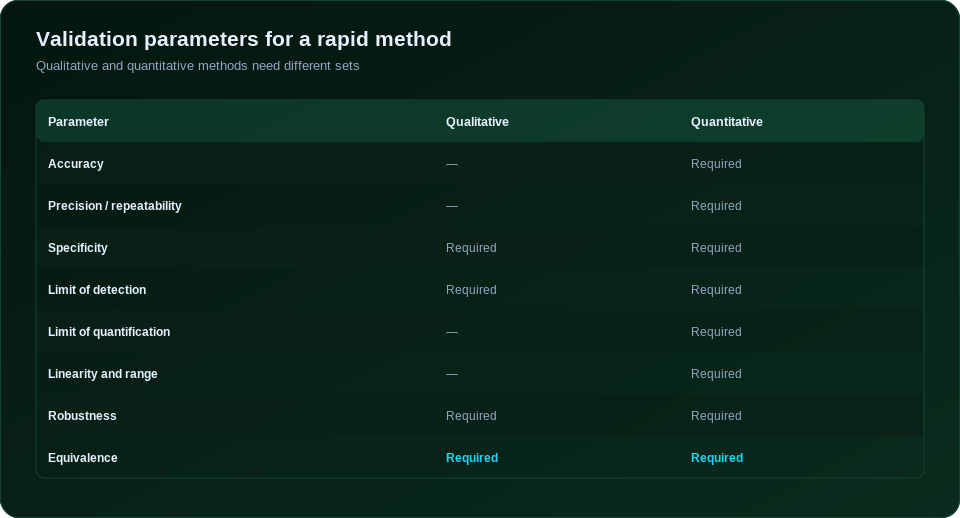
| Parameter | Qualitative PCR | Quantitative qPCR |
|---|---|---|
| Specificity (inclusivity and exclusivity) | Required | Required |
| Limit of detection | Required | Required |
| Limit of quantification | — | Required |
| Accuracy | — | Required |
| Precision / repeatability | — | Required |
| Linearity and range | — | Required |
| Robustness | Required | Required |
| Equivalence to compendial method | Required | Required |
Inclusivity and exclusivity deserve particular attention: the assay must detect all relevant strains of the target (inclusivity) and no closely related non-targets (exclusivity). A Salmonella assay that misses a serovar present in your supply chain is a validated method with a hole in it. Commercial kit vendors publish inclusivity panels — check them against the organisms your product realistically encounters.
Method suitability in your specific matrix is a separate requirement — see method suitability and neutralisation and the full rapid method validation walkthrough.
For food applications, ISO 16140-2 governs validation of alternative methods against a reference, and the ISO and AOAC validation schemes are the usual route to a recognised method.
Cost and Practical Considerations
A qPCR platform is a real capital commitment, and the running costs are dominated by consumables rather than labour. Realistic considerations before committing:
- Throughput. Below roughly 20 samples a week, sending PCR work to an external laboratory is usually cheaper than running it in-house.
- Staff. Molecular work needs a trained analyst and a competence programme. See microbiology analyst training and competence.
- Facility. Separated pre- and post-amplification areas are not optional and often require a room, not a bench.
- Data integrity. Instrument software must support audit trails, user access control and secure raw data retention. See data integrity in the microbiology laboratory.
- Confirmation capability. You still need culture, because positives must be confirmed and isolates recovered for investigation.
Frequently Asked Questions
What is PCR-based microbial detection? Amplification of a target organism's DNA sequence until it is detectable, allowing identification of specific organisms in hours rather than days of culture.
How sensitive is qPCR? Single-digit genome copies in clean matrices; typically 10-100 copies in real samples, depending on inhibition and extraction efficiency.
Does PCR detect live or dead organisms? Both. DNA persists after cell death. Enrichment before PCR, viability dyes such as PMA, or culture confirmation are the ways around this.
How long does a PCR test take? Two to six hours from extracted DNA. With the enrichment step usually required for food pathogen testing, 8-24 hours end to end.
Can PCR replace culture? For targeted screening, largely yes. For enumeration, sterility testing and organism recovery, no — you still need culture.
What is a Ct value? The cycle at which fluorescence crosses the detection threshold. Lower Ct means more starting DNA.
Why did my PCR fail? Most often inhibition from the matrix, poor DNA extraction, degraded reagents, or the target simply not being present. The internal amplification control tells you which.
Is PCR accepted for pharmaceutical release testing? Yes, when validated for equivalence under USP 1223 or Ph. Eur. 5.1.6 for that specific product and decision.
What is multiplex PCR? Several primer sets in one reaction, detecting multiple targets simultaneously. Efficient, but each added target reduces sensitivity slightly and complicates validation.
Do I need a separate room for PCR? In practice yes — separated pre- and post-amplification areas are the standard control against amplicon carryover contamination.
Evaluating a rapid microbiological method? DSTechnoverse supports method selection, equivalence study design, validation protocols and data review for rapid microbial detection — alongside routine industrial microbiological testing by compendial methods. We are based in Indore, Madhya Pradesh and serve clients across India. Talk to our microbiology team about the decision your test result has to support.
Sources and Further Reading
Official and primary sources for the standards, rules and data discussed on this page.
- United States Pharmacopeia (USP): the compendial microbiology chapters such as <61>, <62>, <71> and <1116>.
- WHO: GMP guidelines for pharmaceutical production: WHO good manufacturing practice texts, including water and sterile products.
- Central Drugs Standard Control Organisation (CDSCO): India’s drug and medical device regulator, including revised Schedule M.
- EudraLex Volume 4: EU GMP Guidelines: includes Annex 1 (2022) on the manufacture of sterile medicinal products.