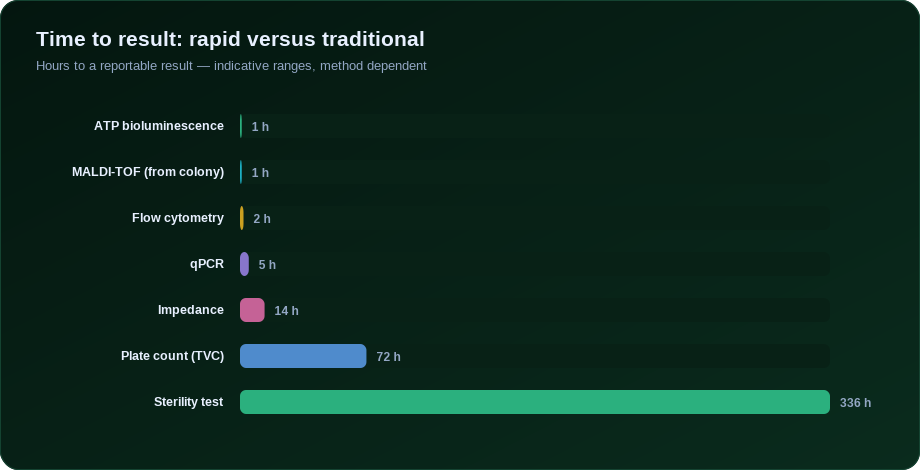
The compendial sterility test takes 14 days. For a sterile manufacturer, that is 14 days of finished product sitting in quarantine, and for short-shelf-life products — cell therapies, radiopharmaceuticals, compounded preparations — it can be longer than the product's useful life.
Rapid sterility testing addresses that. It is also the rapid method application with the highest regulatory scrutiny, because the test it replaces is the last microbiological gate before a product enters a patient.
What the Compendial Test Does
USP General Chapter 71 and Ph. Eur. 2.6.1 specify membrane filtration or direct inoculation into two media — fluid thioglycollate (anaerobes and aerobes, 30-35°C) and soybean-casein digest (aerobes and fungi, 20-25°C) — incubated for 14 days with visual inspection for turbidity.
Its strengths and weaknesses are both structural:
| Property | Reality |
|---|---|
| Detection breadth | Any organism that grows in those two media at those temperatures |
| Sensitivity | Theoretically a single viable cell, given enough incubation |
| Specificity | Determined by visual turbidity — subjective at the margin |
| Statistical power | Weak — a 20-unit sample from a 50,000-unit batch detects only gross contamination |
| Time | 14 days, non-negotiable |
That fourth row is worth sitting with. The sterility test is not a strong statistical guarantee of batch sterility; it is a final check on a process whose validation and control provide the actual assurance. This is why aseptic process simulation, environmental monitoring and container closure integrity carry more weight than the sterility test itself — see media fill and aseptic process simulation.
Understanding that changes the rapid method conversation. You are not replacing a strong guarantee with a fast approximation; you are replacing a weak, slow check with a faster one of comparable capability.
The Rapid Technologies
| Technology | Principle | Typical time | Destructive? |
|---|---|---|---|
| CO₂ / headspace detection | Metabolic gas from growing organisms | 5-7 days | No |
| Fluorescence growth detection | Fluorescent indicator responds to metabolism | 5-7 days | No |
| Solid phase cytometry | Direct labelling and laser scanning of a membrane | 3-5 hours | Yes |
| ATP bioluminescence with enrichment | Growth then ATP detection | 24-72 hours | Yes |
| Isothermal microcalorimetry | Heat output from metabolic activity | 1-5 days | No |
| Respirometry | Oxygen consumption measurement | 2-6 days | No |
Two distinct families again, and the distinction drives everything:
Growth-based rapid methods (CO₂, fluorescence, calorimetry) still incubate — they just detect growth earlier and more sensitively than the human eye detects turbidity. They typically cut 14 days to 5-7. Their great advantage is that the underlying biology is unchanged, which makes the equivalence argument far easier, and the sample is preserved for organism recovery.
Non-growth-based methods (solid phase cytometry) detect cells directly, giving results in hours. Much faster, much harder to validate, and usually destructive — meaning a positive result leaves you without an isolate to identify, which is a real problem when a positive triggers an investigation. See investigating a positive sterility test.
What an Equivalence Study Must Show
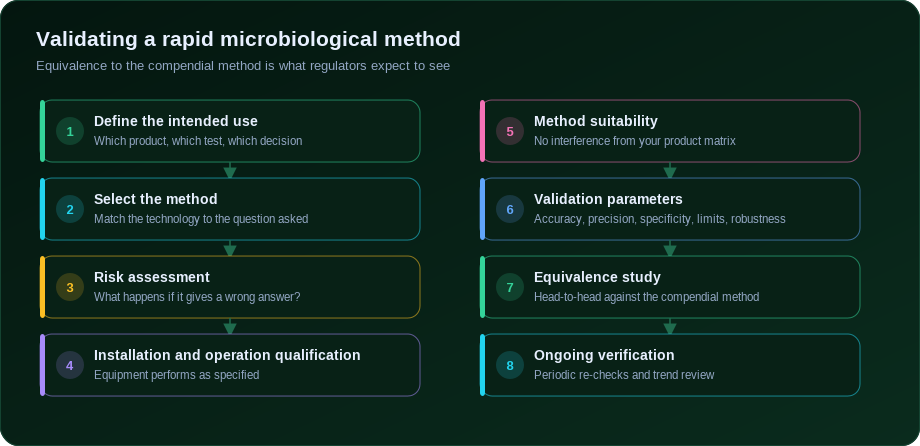
The regulatory framework is USP 1223, Ph. Eur. 5.1.6 and PDA Technical Report 33. For a qualitative sterility application the required demonstration is:
| Parameter | What must be shown |
|---|---|
| Specificity | The method detects the compendial panel — S. aureus, B. subtilis, P. aeruginosa, C. sporogenes, C. albicans, A. brasiliensis — plus relevant environmental isolates from your own facility |
| Limit of detection | Reliable detection at low inoculum, conventionally under 100 CFU and ideally at 1-10 CFU |
| Robustness | Performance holds under deliberate small variations in conditions |
| Method suitability | Your product does not inhibit detection — the equivalent of the compendial bacteriostasis/fungistasis test |
| Equivalence | Head-to-head against USP 71 across a defined number of runs, with no less sensitivity |
The two parts that consistently take longest:
Facility isolates. Regulators expect the panel to include organisms actually recovered from your environment, not just the compendial six. That requires a functioning facility flora library — see building a facility flora library. If you do not have one, that becomes the critical path.
Method suitability for your specific product. Preservatives, antibiotics and actives can suppress growth or interfere with the detection chemistry. Each product presentation needs its own suitability demonstration, which is why "we validated the platform" is never the same as "we validated the test for this product".
The Business Case
The mistake in almost every rapid sterility proposal is comparing cost per test. The per-test cost of a rapid method is usually higher. The value is elsewhere.
| Value driver | How to quantify |
|---|---|
| Released inventory | Batch value × days saved × cost of capital |
| Warehouse and quarantine space | Reduced holding footprint |
| Shorter investigations | Faster detection of a problem batch limits how much product is affected |
| Shelf life delivered to customer | Days not spent in quarantine are days of usable life |
| Feasibility for short-life products | Some products cannot exist without a rapid test |
| Reduced expedited shipping | Less need to make up lost time downstream |
Illustrative calculation. A manufacturer releases 40 batches a year, each worth ₹50 lakh, cutting quarantine from 14 days to 6. Days of inventory saved: 40 × 8 = 320 batch-days. At ₹50 lakh per batch and a 12% annual cost of capital, that is roughly ₹53 lakh of capital released annually — before counting space, shelf life or investigation speed. Against a validation project typically costing ₹15-40 lakh plus instrument capital, the payback period is usually under two years for a mid-size sterile operation.
Run this calculation with your own numbers before the technology evaluation, not after. It determines whether the project is worth starting, and it is the only version of the argument a finance director will engage with. Our microbiological testing cost guide covers the baseline figures.
Implementation Sequence
- Define scope. Which products, which presentations, which decision. Scope creep across product families multiplies the suitability work.
- Risk assessment under ICH Q9. What happens if the method gives a wrong answer, and what controls compensate? See microbiological risk assessment.
- Technology selection. Growth-based if regulatory acceptance and isolate recovery matter most; non-growth-based if hours rather than days is the requirement.
- Supplier qualification and IQ/OQ. Instrument performs as specified in your environment.
- Method suitability per product presentation.
- Validation study against the parameters above.
- Equivalence study head to head with USP 71, typically over three or more batches per product.
- Regulatory submission. A post-approval change for existing licensed products — engage the authority early, and expect the equivalence data package to be the focus.
- Parallel running for a defined period after approval.
- Ongoing verification — periodic re-challenge, trend review, and re-validation triggers written into the SOP.
Step 8 is the one that most often surprises project teams. The validation work is scientific; the approval is regulatory, and its timeline is not under your control. Build it into the plan from the start rather than discovering it after the science is complete.
Where Rapid Sterility Does Not Help
If the process is not in control. A faster sterility test on a facility with recurring environmental excursions accelerates the detection of a problem that should have been prevented. Fix the process first — see environmental monitoring programme design.
If release is limited by something else. If chemical assay or endotoxin testing takes 10 days, cutting sterility from 14 to 6 releases nothing. Map the whole release timeline before assuming sterility is the bottleneck. Bacterial endotoxin testing is frequently the co-constraint.
If batch volume is low. The inventory value released has to justify a validation project measured in tens of lakhs. Below a certain throughput, it will not.
Frequently Asked Questions
What is rapid sterility testing? An alternative to the 14-day compendial sterility test that detects microbial growth or cells sooner — typically in 5-7 days for growth-based methods, or hours for direct detection methods.
Is rapid sterility testing accepted by regulators? Yes, with a validated equivalence package under USP 1223 or Ph. Eur. 5.1.6. Several growth-based platforms have been accepted in approved products in multiple markets.
How fast is it? Growth-based methods typically give a result in 5-7 days. Solid phase cytometry can give one in hours, but is harder to validate and usually destructive.
Does it replace USP 71? For a specific validated product and decision, yes. The compendial method usually remains as the referee method for investigations.
What is the hardest part of validation? Method suitability for each product presentation, and assembling a facility isolate panel. Both take longer than the instrument qualification.
How much does it cost? Instrument capital plus a validation project typically in the tens of lakhs of rupees. Justify it against released inventory value, not against per-test cost.
Can it be used for cell and gene therapy products? This is one of the strongest use cases — short shelf life makes a 14-day test impossible, and regulators have engaged constructively with rapid alternatives in this space.
Does a rapid method change the sampling plan? No. Sample size under USP 71 is unchanged, and so is the underlying statistical limitation. See microbiological sampling plan design.
What happens if the rapid method gives a positive? The same investigation as any sterility failure, with one added consideration: with a destructive method you may not have an isolate, so plan for confirmatory testing in the protocol.
Evaluating a rapid microbiological method? DSTechnoverse supports method selection, equivalence study design, validation protocols and data review for rapid microbial detection — alongside routine industrial microbiological testing by compendial methods. We are based in Indore, Madhya Pradesh and serve clients across India. Talk to our microbiology team about the decision your test result has to support.
Sources and Further Reading
Official and primary sources for the standards, rules and data discussed on this page.
- EudraLex Volume 4: EU GMP Guidelines: includes Annex 1 (2022) on the manufacture of sterile medicinal products.
- US FDA: Sterile Drug Products Produced by Aseptic Processing: FDA guidance on aseptic processing, media fills and monitoring.
- United States Pharmacopeia (USP): the compendial microbiology chapters such as <61>, <62>, <71> and <1116>.
- Central Drugs Standard Control Organisation (CDSCO): India’s drug and medical device regulator, including revised Schedule M.