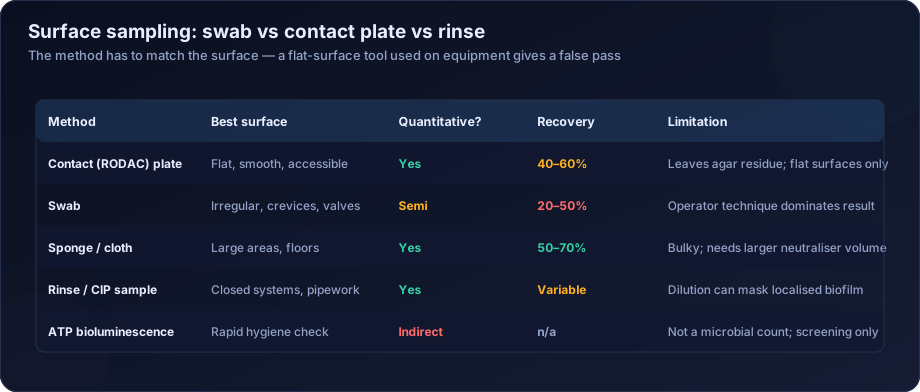
ATP bioluminescence gives a hygiene reading in fifteen seconds, requires no incubation, and lets an operator re-clean a surface before production starts. It is genuinely useful. It is also, more often than any other test in the microbiology toolkit, reported as something it is not.
What ATP Actually Measures
Adenosine triphosphate is the energy-carrying molecule present in all living cells. An ATP swab collects surface residue, a reagent containing luciferase reacts with any ATP present, and the light emitted is measured and reported in Relative Light Units.
The critical point is what contributes to that signal:
- Microbial ATP — from live bacteria, yeasts and moulds on the surface.
- Somatic ATP — from food residue, plant material, meat, dairy, blood, skin cells.
- Free ATP — released from cells that have already died, including organisms killed by the disinfectant you just applied.
Microbial ATP is typically a small fraction of the total on a food or pharmaceutical surface. A high RLU reading usually means product residue, not organisms. A single bacterial cell contains roughly 1 femtogram of ATP; a single somatic cell contains 100 to 1,000 times more.
ATP is a cleanliness indicator, not a microbial count. Reporting an RLU value as hygiene compliance in a microbiological sense is a genuine and common error.
Where ATP Genuinely Helps
Used for what it is, ATP is valuable and we recommend it in the right places.
- Immediate cleaning feedback. An operator can test, see a failure, re-clean and retest within minutes. No microbiological method can do this, and the behavioural effect on cleaning quality is substantial.
- Pre-production release of equipment, where waiting three days for a plate count is not an option.
- Training and technique improvement, because the instant feedback loop teaches operators which areas they habitually miss.
- Screening a large number of sites cheaply, then applying microbiological testing to the failures.
- Detecting residue that would support growth, which is a legitimate hygiene concern independent of current microbial load.
- Trending cleaning performance over time per location, which reveals a procedure degrading before it produces a microbiological failure.
Where ATP Misleads
- It cannot confirm microbiological acceptability. A surface can be ATP-clean and carry spores, which contain very little ATP relative to vegetative cells.
- It over-reads on product residue. A spotless surface with a trace of milk or protein will fail ATP while being microbiologically fine.
- It under-reads on dry surfaces with low-ATP organisms. Bacterial spores and stressed cells give a weak signal.
- Sanitiser residue interferes. Some disinfectants quench the luciferase reaction, producing falsely low readings — precisely on the surfaces most recently disinfected.
- Results do not transfer between instruments. RLU is not a standardised unit. A threshold of 150 RLU on one manufacturer's system means nothing on another's.
- It says nothing about which organism is present, which is the actionable information in any investigation.
Setting RLU Thresholds
Because RLU is instrument-specific, thresholds must be derived locally. There is no valid published number to adopt.
- Choose the instrument and swab and commit to them, since changing either invalidates the thresholds.
- Sample a large number of surfaces in the known-clean state, across all materials and locations in scope.
- Establish the distribution of RLU values on properly cleaned surfaces.
- Set the pass threshold at approximately the 95th percentile of that clean distribution.
- Set a caution band between pass and fail, triggering re-cleaning rather than investigation.
- Set the fail threshold where re-cleaning is mandatory before production.
- Derive thresholds per surface type, since a porous conveyor belt and a polished tank wall have different clean baselines.
- Reassess after any change to cleaning agents, products run, or the instrument itself.
Correlating ATP With Microbiology
The two should be run in parallel initially, to understand how they relate in your specific operation — and to establish honestly where they do not.
Sample the same locations by both methods across a range of cleaning states, from deliberately under-cleaned to fully cleaned. Plot RLU against CFU.
What you will typically find is a weak positive correlation with substantial scatter, and two informative quadrants:
- High ATP, low CFU — product residue present, organisms controlled. The disinfectant worked; the cleaning did not remove soil. A real finding, since residue supports future growth.
- Low ATP, high CFU — clean-looking surface carrying organisms. Often spores, or organisms in a low-ATP dormant state. This quadrant is why ATP cannot replace microbiology.
Documenting that relationship for your operation is what allows you to state, defensibly, what an ATP pass does and does not demonstrate.
Building a Combined Programme
The productive arrangement uses each method for what it does well.
- ATP at every changeover, on every cleaned surface, as an immediate release check with re-clean on failure.
- Microbiological swabbing on a rotating subset of locations at defined frequency, as the actual verification of hygiene.
- Microbiological testing on every ATP failure that persists after re-cleaning, since a surface that will not come clean warrants investigation.
- Microbiology always at worst-case sites identified in cleaning validation, regardless of ATP results.
- Both trended separately per location, since divergence between the two trends is itself informative.
- Never report ATP as a microbiological result in any certificate, batch record or audit response.
A Practical Note on Food Facilities
ATP has been adopted most widely in food processing, where changeover speed matters and product residue is the dominant hygiene concern. In that context the high-ATP-from-residue characteristic is a feature rather than a limitation — residue is exactly what you want to detect.
In pharmaceutical and cosmetic environments the balance shifts. Surfaces carry less organic soil, the organisms of concern include spore formers and water organisms with low ATP signal, and the regulatory expectation is for microbiological evidence. ATP retains value for immediate feedback and operator training, but it carries less of the verification burden.
Alternatives and Adjacent Rapid Methods
ATP is the most widely used rapid hygiene tool but it is not the only one, and some alternatives address its specific weaknesses.
- Protein residue swabs — colourimetric tests detecting protein rather than ATP. Slower than ATP at around ten minutes, but unaffected by the sanitiser quench that distorts ATP readings on freshly disinfected surfaces.
- Adenylate kinase assays — amplify the signal from microbial cells specifically, improving the microbial-to-somatic ratio compared with straight ATP.
- Glucose and lactose residue tests — useful in food environments where carbohydrate soil is the dominant residue and protein tests under-read.
- Fluorescence imaging systems — illuminate organic residue across a whole surface rather than a single swab point, which addresses ATP's most underappreciated weakness: a swab samples perhaps 25 cm² of a several-square-metre surface.
- Direct epifluorescent microscopy — counts cells directly within an hour, genuinely microbiological, but requires equipment and skill beyond a routine hygiene check.
- Solid-phase cytometry — detects viable organisms at single-cell sensitivity in a few hours, sitting between rapid screening and full culture.
That fourth point deserves emphasis. Whatever the chemistry, a swab-based rapid test samples a tiny fraction of the surface, and site selection matters at least as much as the method. A programme swabbing the same easily reached spot every changeover is measuring that spot, not the equipment — the same trap that undermines environmental monitoring programmes.
Common Mistakes
- Reporting RLU values as hygiene compliance in microbiological terms.
- Adopting a threshold from a supplier's brochure or another facility's programme.
- Changing swab lot or instrument without re-deriving thresholds.
- Testing immediately after disinfection without accounting for sanitiser quench.
- Using ATP to release aseptic-critical surfaces, where only microbiological evidence is adequate.
- Abandoning microbiological swabbing entirely once ATP is implemented — the saving is real and so is the loss of the only method that identifies organisms.
- Not trending ATP data, which discards the main long-term value of collecting it.
How DSTechnoverse Helps
We set ATP programmes up properly and, just as importantly, define clearly what they can and cannot conclude — which is the part that protects a client at audit.
That includes threshold derivation from your own clean-surface distribution per surface type, parallel ATP and microbiological correlation studies, combined programme design assigning each method to the right role, operator training on both methods, trending of both datasets, and documentation stating the scope and limitations of the ATP programme in terms that will withstand scrutiny.
Our team works from Indore and runs correlation studies on site across India, since the relationship between ATP and microbiology is specific to each facility's products and residues.
Frequently Asked Questions
Is ATP testing a microbiological test?
No. It measures total ATP from all sources including product residue and dead cells. It is a cleanliness indicator, and reporting it as a microbial count is a significant error.
Can ATP replace microbiological swabbing?
No. It complements it. ATP gives immediate cleaning feedback; microbiology gives the actual hygiene verification and the organism identity.
What RLU threshold should we use?
One derived from your own instrument, swabs and surfaces. RLU is not standardised across manufacturers, so no published number is valid for your setup.
Why did a visually spotless surface fail ATP?
Almost certainly invisible organic residue — protein, sugar or fat films are not visible and carry high ATP. It is a legitimate finding rather than a false positive.
Why did a contaminated surface pass ATP?
Likely spores or low-ATP dormant organisms, or sanitiser residue quenching the reaction. Both are known limitations and both are reasons microbiological testing remains necessary.
How often should ATP thresholds be re-derived?
Whenever the instrument, swab lot chemistry, cleaning agents or product range changes, and periodically otherwise — annually is reasonable. The one most often missed is the swab lot, because reagent activity varies between manufacturing batches enough to shift readings. Facilities running a threshold set three years ago against a swab lot bought last month are comparing against a baseline that no longer applies.
Can ATP detect biofilm?
Poorly, and this is one of its more consequential blind spots. Mature biofilm has a low metabolic rate and correspondingly low ATP per unit biomass, and the extracellular matrix physically shields cells from the swab. A surface carrying substantial biofilm can return a comfortable ATP pass. Where biofilm is the concern — wet surfaces, drains, standing water points, CIP circuits — the detection approach has to be direct swabbing with extended contact, or the rebound-rate method described in biofilm in water systems.
Who should perform ATP testing, the operator or QA?
The operator, in almost every case. The entire value of ATP is the immediate feedback loop, and that loop only closes if the person who did the cleaning sees the result and can re-clean straight away. Routing ATP through QA turns a fifteen-second self-check into a shift-delayed report and loses most of the benefit. QA involvement belongs in setting the thresholds, auditing that testing is actually performed at the defined sites, and reviewing the trend — not in taking the readings.
Does ATP work on dry surfaces?
Less well than on wet ones. Organisms in a dried state reduce their metabolic activity and their ATP content falls, so a surface carrying viable but desiccated cells reads low. This matters in pharmaceutical and powder-handling environments where surfaces are deliberately kept dry, and it is part of why ATP carries less of the verification burden there than it does in wet food processing.
Is a rising ATP trend meaningful if every reading still passes?
Yes, and it is the main long-term value of collecting the data. A location whose readings have climbed from 40 to 130 RLU over six months while the pass threshold sits at 150 is telling you the cleaning procedure is degrading, or that residue is accumulating somewhere the procedure does not reach. Acting on that trend is far cheaper than waiting for the failure, and it follows exactly the same logic as microbiological trend analysis.
Should ATP be used in aseptic areas?
For operator feedback and training, yes. For release of Grade A or B surfaces, no — only microbiological evidence is adequate there, and the expectation is unambiguous.
Are your swab results clean because the surface is clean, or because the neutraliser failed? DSTechnoverse provides surface and swab testing with recovery efficiency studies, neutralisation validation and cleaning validation support. Based in Indore, Madhya Pradesh, with on-site sampling across India. Talk to our microbiology team.