Units Delivered Without a Corresponding Adjustment Letter: What to Do
· DSTechnoverse · CORSIA & Carbon Markets
The units are in your account and they are not CORSIA eligible. Why you should not cancel them, what to demand from the seller, and how to cover the obligation in the meantime.
Units arrive in the buyer's registry account. The serial numbers are correct, the project is the contracted one, the vintage is right. There is no corresponding adjustment letter, and the registry record does not carry a CORSIA eligible label.
Those units cannot be used to meet a CORSIA obligation. What the buyer does in the next few days determines whether this is a recoverable commercial problem or a permanent loss.
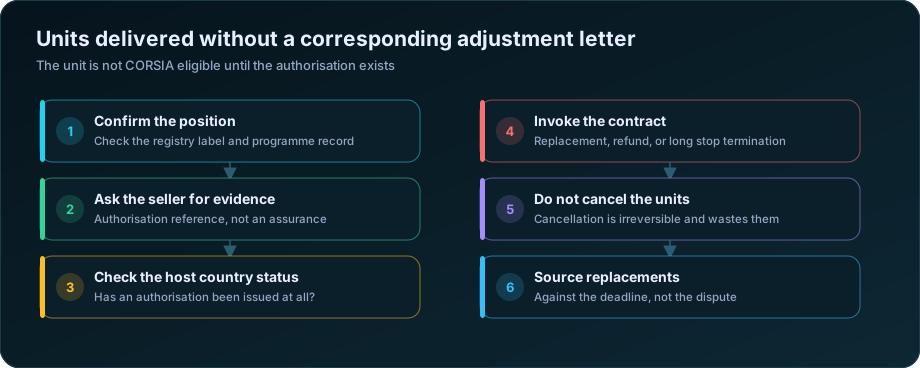
First: do not cancel them
This is the most important sentence in this article. Cancellation is irreversible across every major registry.
An operator holding units that are not eligible, facing a deadline, sometimes reasons that cancelling them at least demonstrates good faith. It does not. It permanently destroys an asset that still has voluntary-market value, without discharging the CORSIA obligation, which remains outstanding in full.
| Action | Consequence |
|---|---|
| Cancel ineligible units | Asset destroyed, obligation unchanged |
| Hold the units | Asset retained; eligibility may still be resolved |
| Return under contract | Recover payment if the contract permits |
| Sell into the voluntary market | Recover part of the value |
Hold, then decide. The units are worth something in every scenario except the one where they are cancelled.
The irreversibility point is examined in a registry cancellation error.
Establish the actual position
Before approaching the seller, know which of four situations applies. They have different remedies.
| Situation | Diagnosis | Outlook |
|---|---|---|
| Authorisation exists, paperwork lagging | Programme record shows authorisation; letter not issued to you | Good — administrative |
| Authorisation applied for, pending decision | Host country reviewing | Uncertain, possibly slow |
| Authorisation never applied for | No application on record | Poor — the seller has not started |
| Authorisation refused | Host country declined | These units will not become eligible |
Distinguishing them requires evidence rather than the seller's characterisation. Check the registry record directly, ask for the authorisation reference number, and where the host country publishes a register of authorisations, check it. A seller saying authorisation is "in process" without a reference number is describing an intention, not a status.
What to demand from the seller
| Request | Why |
|---|---|
| The authorisation reference number | Verifiable, unlike an assurance |
| A copy of the application, with its filing date | Establishes whether the process actually started |
| The host country's acknowledgement | Confirms it was received |
| A written status update with dates | Creates a record |
| Confirmation of the registry label position | The definitive eligibility marker |
Put every request in writing. If this becomes a contractual dispute, the record of what was asked and what was answered is what the position rests on.
The contractual remedies
What is available depends entirely on the contract, which is why the drafting matters so much.
| If the contract says | Remedy available |
|---|---|
| Delivery means transfer plus authorisation evidence | Delivery has not occurred; withhold payment |
| Seller warrants CORSIA eligibility | Breach of warranty; damages or replacement |
| A long stop date exists | Return the units and recover payment after that date |
| A replacement obligation exists | Seller must substitute eligible units |
| A two-tier price applies | Pay the lower voluntary price |
| Delivery means transfer only | Weak position — delivery has occurred |
The last row is the common and painful case, examined in detail in an offtake dispute over corresponding adjustments. Where delivery is defined as transfer alone and eligibility appears only in a recital, the seller has performed and the buyer's remedy is limited.
If payment has not yet been made, withhold it and negotiate from there. Recovering money already paid is a materially weaker position than declining to pay it.
Covering the obligation in the meantime
The deadline does not move while a dispute runs. Two things proceed in parallel:
The dispute, on its own timeline. Corresponding adjustment questions can take months, and a buyer waiting for resolution before securing compliance units will miss the deadline.
Compliance cover, immediately. Source replacement units, verified as eligible before purchase, sufficient to meet the obligation. If the disputed units later become eligible, they can be used for a subsequent period or sold.
The cost of holding both positions is real and smaller than the cost of missing an offsetting obligation and buying under enforcement pressure. See missing a CORSIA deadline.
Preventing it at the next purchase
| Control | Effect |
|---|---|
| Verify eligibility before payment, not after | The decisive control |
| Check the registry label yourself | Do not rely on the seller's description |
| Require the authorisation reference in the contract | Not a warranty of future authorisation |
| Stage payment against authorisation evidence | Retains leverage |
| Include a long stop date | Converts an open dispute into a defined outcome |
| Include a replacement obligation | Puts the sourcing burden on the seller |
The first is the whole answer. Verification before payment takes under an hour: confirm the crediting programme is ICAO-approved for that project type, confirm the vintage falls inside the eligibility window, obtain the authorisation reference, and check the registry record for the CORSIA eligible label. Any seller unable to satisfy all four is offering a voluntary-market unit.
For the checks themselves see CORSIA credit due diligence checklist and CORSIA eligible emissions units criteria; for contract terms, CORSIA offtake agreement terms; and for what authorisation involves, corresponding adjustments for CORSIA explained. Unit criteria are published on the ICAO CORSIA emissions units page.
Frequently Asked Questions
What should I do if carbon credits arrive without a corresponding adjustment letter?
Do not cancel them. Establish whether authorisation exists, is pending, was never applied for or was refused; demand the authorisation reference in writing from the seller; invoke whatever contractual remedy exists; and source replacement units to cover the obligation in parallel.
Can ineligible units be cancelled to show good faith?
No, and doing so is a permanent loss. Cancellation is irreversible, destroys an asset that retains voluntary-market value, and does not discharge the CORSIA obligation, which remains outstanding in full.
How do I tell whether authorisation is genuinely in process?
Ask for the application filing date, the host country's acknowledgement and a reference number. A seller describing authorisation as "in process" without a reference number is describing an intention rather than a status.
What contractual remedies exist for non-eligible delivery?
It depends on the drafting. Where delivery is defined as transfer plus authorisation evidence, delivery has not occurred and payment can be withheld. Where delivery means transfer alone and eligibility appears only in a recital, the buyer's position is weak.
Should I wait for the dispute to resolve before buying replacement units?
No. The compliance deadline does not move while a dispute runs. Secure verified eligible units immediately and pursue the dispute in parallel; disputed units that later become eligible can be used for a later period or sold.
How can this be prevented?
Verify eligibility before payment rather than after — confirm the programme is ICAO-approved for the project type, the vintage is within the eligibility window, an authorisation reference exists, and the registry record carries the CORSIA eligible label. The check takes under an hour.
Planning your CORSIA position? DSTechnoverse provides CORSIA carbon credit services for Indian operators and project developers — scope and readiness assessment, monitoring plans, data pipelines, verification support, unit sourcing and second-phase modelling. We are based in Indore, Madhya Pradesh and work across India.
Apply as a CORSIA buyer or seller
Talk to our carbon markets team about your position.