Case Study: An Offtake Dispute Over Corresponding Adjustments
· DSTechnoverse · CORSIA & Carbon Markets
Units were delivered on time and in full. The buyer refused payment because they were not CORSIA eligible. What the contract said, what it should have said, and how the dispute resolved.
An Indian project developer and an international buyer signed a multi-year offtake for a fixed annual volume at a fixed price. The first delivery tranche transferred on schedule: the correct number of units, the correct vintage, the correct project, into the buyer's registry account.
The buyer refused to pay. The units were not labelled CORSIA eligible, because the host country authorisation had not been issued. The developer's position was that delivery had occurred exactly as the contract described. The buyer's position was that it had contracted for CORSIA units and received something else.
Both were reading the contract correctly. That was the problem.
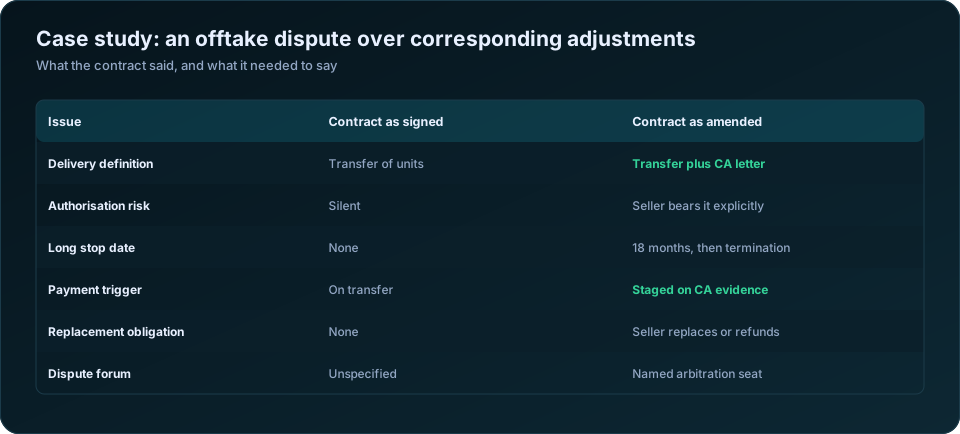
What the contract actually said
| Term | As drafted |
|---|---|
| Subject matter | "Verified carbon units from the Project" |
| Delivery | "Transfer of Units to the Buyer's registry account" |
| Payment | "Within 30 days of Delivery" |
| Eligibility | Recital referred to CORSIA; operative clauses did not |
| Authorisation | Not mentioned |
| Long stop date | None |
| Remedy for non-eligibility | None |
The recital said the parties intended the units for CORSIA use. Recitals are context, not obligation. Every operative clause was satisfied by transferring registered units, which is what happened.
This is the central drafting failure and it is extremely common: the commercial intent lived in the recitals while the legal obligations described a simpler transaction than the parties had in mind.
Where the authorisation stood
The host country had not refused authorisation. It had not decided.
| Status | Detail |
|---|---|
| Application submitted | Yes, by the developer |
| Government position | Under review, no timeline given |
| Programme registration | Complete and in good standing |
| Units issued | Yes, in the registry |
| CORSIA eligible label | Absent, pending authorisation |
| Developer's control over the outcome | None |
That last row is the substantive question underneath the legal one. Authorisation is a sovereign act. A developer can apply, can support the application, and cannot deliver it. So the commercial question is: which party bears the risk of a government decision that neither controls?
The contract did not answer. That is what made it a dispute rather than a claim.
How it resolved
The parties settled on amended terms rather than litigating, which was the right outcome for both — the developer needed the relationship for future tranches, and the buyer needed the volume.
| Element | Settlement |
|---|---|
| First tranche | Units retained by the buyer, held unpaid pending authorisation |
| Payment | 30% on transfer, 70% on the CA letter |
| Long stop | 18 months from transfer; buyer may return units and recover the 30% |
| Future tranches | Delivery redefined as transfer plus authorisation evidence |
| Price | Two-tier: a CORSIA price and a lower voluntary price if unauthorised |
| Risk allocation | Seller bears authorisation risk, priced accordingly |
The two-tier price is the element worth copying. Rather than arguing about whether a unit is worth the CORSIA price or nothing, the contract prices both outcomes. The buyer gets units at voluntary value if authorisation never arrives; the seller gets the CORSIA price if it does. Neither is left holding a total loss.
The clauses that should have been there
| Clause | What it must do |
|---|---|
| Definition of the unit | Specify CORSIA eligible, with the eligibility criteria named |
| Delivery definition | Transfer and evidence of authorisation with a CA commitment |
| Conditions precedent to payment | Registry label, authorisation reference, programme record |
| Authorisation risk allocation | Say explicitly which party bears it |
| Long stop date | A date after which the buyer may walk away |
| Replacement obligation | Seller substitutes eligible units or refunds |
| Price adjustment | A defined lower price if the unit is voluntary-only |
| Double-counting warranty | Seller warrants no other claim on the reduction |
| Registry mechanics | Named accounts, transfer method, cancellation instructions |
| Dispute resolution | Named forum, seat and governing law |
The delivery definition is the single most important. In a market where the unit's value depends on a government act after issuance, delivery cannot sensibly mean transfer alone. Contract drafting for these transactions is covered in CORSIA offtake agreement terms.
The commercial lesson for each side
For sellers. Do not sign a fixed-price CORSIA offtake unless you are prepared to bear authorisation risk or have priced it explicitly. If authorisation is uncertain, sell a two-tier contract or a voluntary-market contract with an upside sharing clause. Pretending the risk is not there does not remove it; it simply leaves it undefined until it crystallises.
For buyers. Make authorisation evidence a condition of payment, not a warranty you enforce afterwards. Recovering money from a developer whose credits turned out to be voluntary units is far harder than never paying it. And check the registry label yourself rather than relying on the seller's description — see CORSIA credit due diligence checklist.
For both. A long stop date is what converts an open-ended dispute into a defined outcome. Without one, an unresolved authorisation leaves both parties bound indefinitely to a transaction neither can complete.
For related material see corresponding adjustments for CORSIA explained, CORSIA credit price negotiation in India and units delivered without a corresponding adjustment letter. The ICAO emissions unit eligibility criteria define what the contract must ultimately deliver.
Frequently Asked Questions
What should delivery mean in a CORSIA offtake agreement?
Transfer of the units to the buyer's registry account and evidence of host country authorisation with a corresponding adjustment commitment. Defining delivery as transfer alone allows a seller to satisfy the contract with units that cannot be used for CORSIA.
Who bears the risk if host country authorisation is not granted?
Whichever party the contract says — and if it is silent, that becomes a dispute. Since the seller is closer to the host country process, sellers commonly bear it and price accordingly, but the allocation must be explicit rather than assumed.
What is a long stop date in a carbon offtake?
A date after which, if authorisation has not been obtained, the buyer may return the units and recover payments. It converts an indefinite dispute into a defined outcome and belongs in any contract where eligibility depends on a future government act.
Can a recital saying the units are for CORSIA create an obligation?
Generally not. Recitals describe context; operative clauses create obligations. Commercial intent expressed only in a recital, while the operative delivery clause describes a simpler transaction, is the drafting failure at the heart of most of these disputes.
What is a two-tier price structure for carbon credits?
A contract specifying one price if the unit becomes CORSIA eligible and a lower price if it remains a voluntary-market unit. It avoids an all-or-nothing dispute by pricing both outcomes at signature.
Should a buyer pay on transfer of units?
Not in full. Stage payment so that the majority falls due on evidence of authorisation. Recovering funds from a seller after the fact is considerably harder than withholding them against a condition that was never met.
Planning your CORSIA position? DSTechnoverse provides CORSIA carbon credit services for Indian operators and project developers — scope and readiness assessment, monitoring plans, data pipelines, verification support, unit sourcing and second-phase modelling. We are based in Indore, Madhya Pradesh and work across India.
Apply as a CORSIA buyer or seller
Talk to our carbon markets team about your position.