Case Study: A Registry Cancellation Error and Why It Could Not Be Undone
· DSTechnoverse · CORSIA & Carbon Markets
An operator cancelled units against the wrong compliance period. Cancellation is irreversible. What the error cost, how it was detected six weeks late, and the two-person control that prevents it.
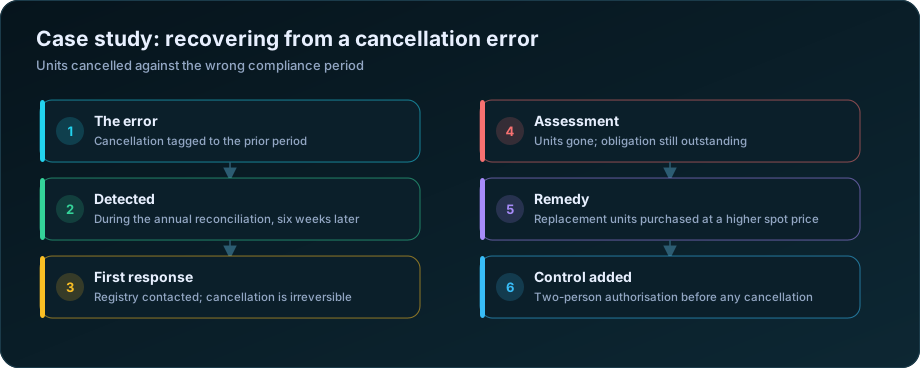
An operator holding sufficient eligible units to meet its offsetting requirement instructed cancellation in its registry account. The instruction was executed correctly by the registry. It was tagged to the wrong compliance period.
Cancellation is irreversible by design. The units were gone, the obligation they were meant to retire was still outstanding, and replacement units had to be purchased at a spot price well above what the original units had cost.
How the error happened
Nothing exotic. A single person, working against a deadline, in an unfamiliar interface.
| Contributing factor | Detail |
|---|---|
| Single operator with full authority | No second approval required |
| Compliance period a dropdown default | The prior period was pre-selected |
| No pre-cancellation checklist | Nothing forced verification of the period |
| Deadline pressure | Executed on the final day of the window |
| Unfamiliar interface | Second cancellation this person had ever performed |
| No confirmation review | The receipt was filed unread |
The dropdown default is the mechanical cause and the most instructive. An interface that pre-selects a value which is wrong in most circumstances will eventually produce this error, and the defence has to sit with the operator's process rather than the registry's design.
Why it was not detected for six weeks
The cancellation receipt, which stated the compliance period clearly, was filed without being read. It was treated as a confirmation that the transaction had completed rather than as a record to be checked.
Detection came during the annual reconciliation, when the outstanding obligation for the current period failed to clear. By then the units had been retired for six weeks.
| Detection opportunity | Why it was missed |
|---|---|
| Cancellation receipt on the day | Filed, not read |
| Registry account statement, month end | Not reviewed against the obligation |
| Internal compliance calendar | Marked complete on instruction, not on verification |
| Annual reconciliation | Where it was finally caught |
The compliance calendar entry marked complete on instruction rather than on verification is a control weakness that generalises well beyond registries. A task marked done when it is initiated, rather than when its result is confirmed, provides no assurance at all.
What the recovery involved
| Step | Outcome |
|---|---|
| Registry contacted | Cancellation confirmed irreversible |
| Programme approached | No mechanism to reverse or re-tag |
| Authority informed | Position acknowledged; obligation unchanged |
| Replacement units sourced | Purchased on the spot market |
| Price difference | Materially above the original acquisition cost |
| Cancellation re-executed | Correctly, with a second-person check |
| Total elapsed time | 5 weeks from detection |
The cancelled units were not wasted in an environmental sense — the emission reduction they represented was still retired, and no double-counting occurred. But they were retired against a period for which the operator had no obligation, so they delivered no compliance value. Commercially the loss was total.
Why cancellation is irreversible
This is not a registry design flaw. It is the point of the mechanism.
A cancelled unit is permanently removed from circulation, which is what gives a retirement its integrity. If cancellations could be reversed, a unit could be shown as retired, reversed, and used again — precisely the double-counting the architecture exists to prevent. Every registry across every major programme treats cancellation as final for this reason.
The practical consequence for operators: cancellation is the one action in the entire CORSIA cycle with no undo. Every control should be concentrated there. See CORSIA registry cancellation process and CORSIA registry account setup in India.
The controls that were added
| Control | Detail |
|---|---|
| Two-person authorisation | Preparer and approver, different individuals |
| Pre-cancellation checklist | Signed before any instruction is entered |
| Screenshot of the instruction screen | Retained before submission |
| Receipt verification within 24 hours | Against the checklist, by the approver |
| No cancellation in the final week | Buffer against deadline pressure |
| Quarterly registry statement review | Against the obligation ledger |
| Compliance calendar closed on verification | Not on instruction |
The pre-cancellation checklist covers six items, each confirmed against a source document rather than from memory:
- Compliance period, confirmed against the authority's requirement.
- Quantity, confirmed against the calculated obligation.
- Unit serial numbers, confirmed as CORSIA eligible.
- Vintage of each unit, confirmed within the eligibility window.
- Registry account, confirmed as the operator's own compliance account.
- Authorisation evidence on file for every unit.
It takes twenty minutes. The error it prevents cost the difference between a contracted price and a spot price on a full year's obligation.
The general lesson
Most CORSIA operational risk sits in reversible processes. A monitoring plan can be amended, an emissions report corrected before submission, a verification finding closed. Cancellation alone is final.
Allocate controls accordingly. An operator with an elaborate review process around its monitoring plan and a single person clicking through a cancellation screen has its controls almost exactly the wrong way round. For the wider control framework see CORSIA internal audit preparation and CORSIA board reporting and governance. Registry procedures are published by the individual programmes and summarised in the ICAO CORSIA documentation.
Frequently Asked Questions
Can a carbon credit cancellation be reversed?
No. Cancellation is permanent by design across every major registry. Reversibility would allow a unit to be shown as retired, reversed and used again, which is exactly the double-counting the system exists to prevent.
What happens if units are cancelled against the wrong compliance period?
They are permanently retired but deliver no compliance value for the period that actually required them. The obligation remains outstanding and replacement units must be purchased, typically at spot prices above the original acquisition cost.
How should registry cancellations be controlled?
Two-person authorisation with separate preparer and approver, a signed pre-cancellation checklist covering period, quantity, serials, vintage, account and authorisation evidence, a screenshot before submission, and receipt verification within 24 hours.
Why should cancellation not be left to the final week?
Because deadline pressure is a contributing factor in most cancellation errors, and because an error discovered with weeks in hand can be remediated by sourcing replacement units in an orderly way rather than at a distressed spot price.
How quickly should a cancellation receipt be checked?
Within 24 hours, by the approver, against the pre-cancellation checklist. Filing the receipt unread — treating it as confirmation that the transaction completed rather than a record to be verified — is how errors go undetected for weeks.
What is the highest-risk action in the CORSIA compliance cycle?
Registry cancellation, because it is the only step with no undo. Monitoring plans can be amended and reports corrected, but a cancelled unit cannot be recovered by any party through any process.
Planning your CORSIA position? DSTechnoverse provides CORSIA carbon credit services for Indian operators and project developers — scope and readiness assessment, monitoring plans, data pipelines, verification support, unit sourcing and second-phase modelling. We are based in Indore, Madhya Pradesh and work across India.
Apply as a CORSIA buyer or seller
Talk to our carbon markets team about your position.