Case Study: CORSIA Across a Group With Three Air Operator Certificates
· DSTechnoverse · CORSIA & Carbon Markets
An aviation group assumed it could report CORSIA at group level. Each AOC is a separate aeroplane operator, and the restructuring that followed changed thresholds, plans and verification scope.
An aviation group operating a scheduled passenger airline, a dedicated cargo carrier and a charter business under three separate Air Operator Certificates approached CORSIA as a single corporate exercise. One monitoring plan, one emissions report, one verification, one set of numbers rolled up at group level.
That is not how CORSIA works, and discovering it late required unpicking several months of work.
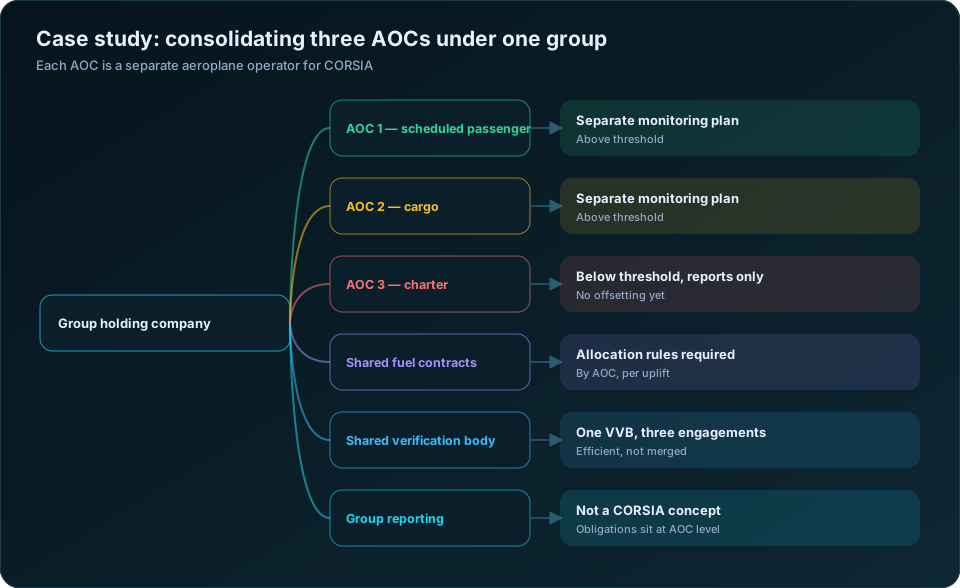
The operator is the AOC holder, not the group
CORSIA obligations attach to the aeroplane operator. In practice, for Indian operators, that is the entity holding the Air Operator Certificate — the legal person responsible for operating the aircraft, not the holding company that owns it.
| Group structure element | CORSIA treatment |
|---|---|
| Holding company | Not an aeroplane operator; no obligation |
| AOC 1, scheduled passenger | Separate operator; own plan, report, verification |
| AOC 2, cargo | Separate operator; own plan, report, verification |
| AOC 3, charter | Separate operator; assessed against threshold separately |
| Shared services | No CORSIA status |
| Consolidated financial reporting | Irrelevant to CORSIA |
The consequences run in several directions at once, and not all of them are unfavourable.
The threshold is assessed per AOC
This was the finding with the largest immediate effect.
| Entity | International CO2 (tonnes) | Position |
|---|---|---|
| AOC 1, scheduled | 186,000 | Above threshold |
| AOC 2, cargo | 41,000 | Above threshold |
| AOC 3, charter | 7,300 | Below threshold |
| Group total | 234,300 | Not a CORSIA concept |
The charter business, at 7,300 tonnes, sits below the 10,000 tonne threshold and has no offsetting obligation. Assessed as part of a group total of 234,300 tonnes, it would have been swept into the compliance perimeter unnecessarily — with a monitoring plan, verification cost and offsetting requirement it does not owe.
Correcting the structure therefore reduced the group's compliance burden rather than increasing it. That is not always the direction of travel, but it is common enough that groups should check rather than assume.
The charter AOC still needs the threshold monitored, for the reasons set out in a business aviation operator crossing the threshold.
Shared fuel contracts need allocation rules
The group negotiated fuel centrally, which is commercially sensible and creates a CORSIA problem. A single supplier contract covering three operators produces invoices that must be attributed correctly.
| Issue | Resolution adopted |
|---|---|
| One supplier account across three AOCs | Sub-accounts opened per AOC |
| Uplifts recorded against the group entity | Aircraft registration used as the allocation key |
| Aircraft transferred between AOCs | Effective date recorded; uplifts split at that date |
| Shared handling agreements | Data clause requiring AOC identification per uplift |
| Consolidated monthly invoice | Annex requested showing per-uplift AOC attribution |
The aircraft transfer case caused the most difficulty. An aircraft moved from the charter AOC to the scheduled AOC mid-year has emissions belonging to two different operators, split at the transfer date. Without a documented effective date and a rule for splitting, that year's data cannot be attributed cleanly to either — the same attribution problem examined in who reports for leased aircraft.
What can be shared, and what cannot
Separate operators does not mean duplicated effort everywhere. The group ended up with a sensible split.
| Element | Shared or separate |
|---|---|
| Monitoring plan | Separate, per AOC — but from a common template |
| Data pipeline and systems | Shared infrastructure, segregated data |
| Emissions report | Separate, per AOC |
| Verification body | Same VVB, three separate engagements |
| Verification fieldwork | Partly combined, reducing cost |
| Internal procedures and training | Shared |
| Offsetting unit procurement | Centralised purchasing, allocated per AOC |
| Registry accounts | Separate, per operator |
Centralised procurement with per-AOC allocation is the arrangement that captures most of the group benefit. Buying units at group scale improves pricing and counterparty access, while cancellation happens in each operator's own registry account against its own obligation. See CORSIA unit procurement process in India and CORSIA registries and cancellation.
Using one verification body across all three, with partly combined fieldwork, reduced total verification cost by roughly a fifth against three unrelated engagements — while keeping the three opinions properly separate.
What the restructuring cost
| Item | Effort |
|---|---|
| Reworking one group plan into three | 12 working days |
| Supplier sub-account setup | 4 weeks elapsed, low effort |
| Historic data re-attribution by AOC | 19 working days |
| Additional verification engagements | Net increase of about 30% on a single engagement |
| Charter AOC removed from perimeter | Net saving |
The re-attribution of historic data was the painful part. Two years of fuel and flight records had been captured against a group identifier, and separating them retrospectively by AOC required aircraft registration mapping with effective dates for every transfer.
The lesson for group structures
Establish the CORSIA perimeter before any data work begins. The questions are short:
- How many AOCs does the group hold?
- Which aircraft are operated under each, and with what effective dates?
- What is each AOC's international CO2 against the threshold, separately?
- Where are fuel contracts held, and how are uplifts attributed?
- Which registry accounts are needed, and in whose name?
Answering these in week one costs a day. Answering them in month eight cost this group roughly thirty working days of rework.
For the underlying definitions see CORSIA scope and thresholds and how CORSIA works; for governance across entities, CORSIA board reporting and governance. The operator definition is set out in the ICAO CORSIA implementation elements.
Frequently Asked Questions
Can an airline group report CORSIA at group level?
No. CORSIA obligations attach to the aeroplane operator, which for Indian operators is the AOC holder. A group with three AOCs has three separate operators, each with its own monitoring plan, emissions report, verification and registry account.
Is the CORSIA threshold assessed per AOC or per group?
Per operator, meaning per AOC. An AOC below 10,000 tonnes of international CO2 has no offsetting obligation even if other AOCs in the same group are well above it. Assessing at group level can pull entities into the perimeter unnecessarily.
How do you handle fuel contracts shared across several AOCs?
Open supplier sub-accounts per AOC, use aircraft registration as the allocation key, and require the supplier to provide a per-uplift annex identifying the operating AOC. Record effective dates whenever an aircraft moves between AOCs.
What happens when an aircraft transfers between AOCs mid-year?
Its emissions split at the transfer date between the two operators. This requires a documented effective date and a written allocation rule, otherwise that year's data cannot be attributed cleanly to either operator.
Can several AOCs in a group use the same verification body?
Yes, and it is usually efficient. Fieldwork can be partly combined, reducing total cost by roughly a fifth against three unrelated engagements, while the three verification opinions remain properly separate.
Should offsetting units be bought centrally for a group?
Central procurement with per-AOC allocation captures better pricing and counterparty access. Cancellation must still happen in each operator's own registry account against its own obligation, since the obligation itself is never a group-level one.
Planning your CORSIA position? DSTechnoverse provides CORSIA carbon credit services for Indian operators and project developers — scope and readiness assessment, monitoring plans, data pipelines, verification support, unit sourcing and second-phase modelling. We are based in Indore, Madhya Pradesh and work across India.
Apply as a CORSIA buyer or seller
Talk to our carbon markets team about your position.