CORSIA Emission Factors and Fuel Types: Getting From Kilograms to CO2
· DSTechnoverse · CORSIA & Carbon Markets
The conversion from fuel mass to CO2 is a single factor for conventional jet fuel and considerably more involved for sustainable aviation fuel. What applies to each, and where claims fail.
Once fuel mass is established, converting it to CO2 is arithmetic. For conventional jet fuel it is one multiplication with a fixed factor, and it is the least contentious step in the whole CORSIA calculation.
For sustainable aviation fuel it is not arithmetic at all. It is a claim, requiring certification, traceability and documentation that most operators underestimate — and an unsupported claim is worth nothing.
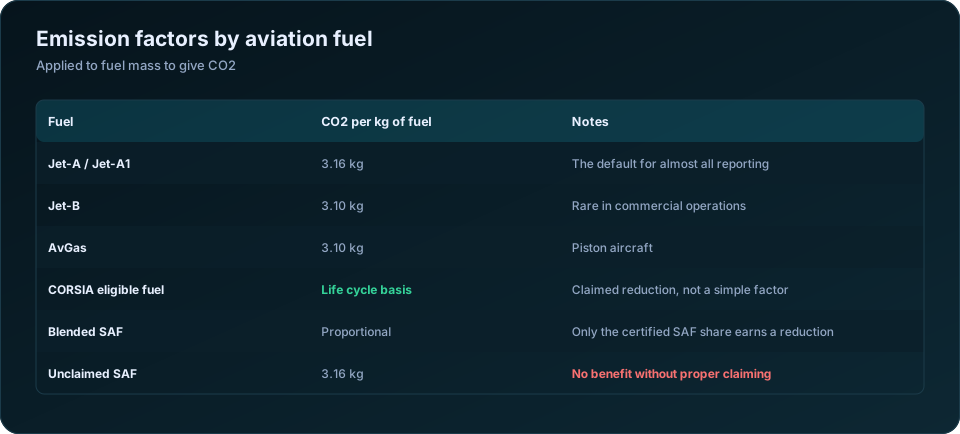
Conventional fuels
| Fuel | CO2 per kilogram of fuel | Where used |
|---|---|---|
| Jet-A and Jet-A1 | 3.16 kg | Almost all commercial jet operations |
| Jet-B | 3.10 kg | Rare, cold-weather operations |
| AvGas | 3.10 kg | Piston-engine aircraft |
For the overwhelming majority of reporting, 3.16 is the number. It reflects the carbon content of kerosene and its complete combustion, and it does not vary by aircraft, engine, altitude or operating condition — because the carbon in the fuel becomes CO2 regardless of how efficiently the engine converts the energy.
This is worth stating because operators sometimes expect an efficiency credit at this step. Efficiency shows up as less fuel burned, not as a lower factor per kilogram.
CORSIA eligible fuels are a different mechanism
A CORSIA eligible fuel does not carry a lower combustion factor. The carbon in the molecule still becomes CO2. The benefit is applied as a reduction in the offsetting requirement, calculated from the life cycle emissions of that fuel relative to a conventional baseline.
| Step | Detail |
|---|---|
| The fuel is burned | CO2 reported at the standard factor |
| The fuel is certified | Under an approved sustainability certification scheme |
| Its life cycle value is established | Feedstock, production, transport and combustion |
| The difference from the baseline | Becomes the claimable reduction |
| Applied against | The offsetting requirement, not reported emissions |
The distinction matters for reporting. An operator using SAF reports the same CO2 as one using conventional fuel for the same mass burned, and claims a reduction separately. Reporting lower emissions because SAF was used is incorrect and will be a verification finding.
What a SAF claim requires
| Requirement | Detail |
|---|---|
| Certification | Under an approved sustainability certification scheme |
| Life cycle emissions value | Established and documented for the specific batch |
| Chain of custody | Traceability from production through to uplift |
| Quantity by fuel type | Actual mass of certified fuel, not blended volume |
| Neat versus blended | Only the certified SAF share earns a reduction |
| No double claiming | The same fuel cannot be claimed elsewhere |
| Documentation retained | Proof of sustainability for the claimed batch |
The blending point causes the most confusion. SAF is supplied blended with conventional jet fuel, commonly at low percentages. A tonne of blended fuel is not a tonne of SAF, and the reduction applies only to the certified sustainable share. Operators occasionally claim on the blended quantity, which is a material overstatement.
Chain of custody is the other frequent failure. The claim requires traceability from the production facility through the supply chain to the specific uplift, which depends on the supplier operating a certified mass balance system and issuing proof of sustainability documentation. A supplier stating that its fuel contains SAF, without that documentation, does not support a claim.
For the certification landscape see ISCC CORSIA certification guide and CORSIA eligible fuels.
Where SAF claims fail
| Failure | Consequence |
|---|---|
| Claiming on blended volume rather than certified share | Material overstatement of the reduction |
| No proof of sustainability documentation | Claim rejected entirely |
| Certification scheme not approved for CORSIA | Claim rejected |
| Chain of custody broken at a handling stage | Claim unsupported |
| Same fuel claimed under another scheme | Double claiming; both claims at risk |
| Fuel quantity by type not separately recorded | No basis for the calculation |
| Using CERT for reporting | No actual fuel data to support a claim |
The last row connects to method selection. A claim requires actual fuel quantity by fuel type, so an operator reporting through the CERT tool has no data to support one — see the ICAO CERT tool.
What the monitoring plan must say
| Element | Content |
|---|---|
| Emission factors used | By fuel type, with the source |
| Fuel types uplifted | Including any eligible fuels |
| How fuel type is identified per uplift | Documentation from the supplier |
| SAF claim process, if applicable | Certification, chain of custody, calculation |
| Record retention for claims | Proof of sustainability, retained |
| Treatment of blends | How the certified share is established |
Setting this out in advance is what makes a claim verifiable. An operator that begins uplifting SAF without amending its monitoring plan has taken on a claim it cannot document — and adding a fuel type is generally a material change requiring resubmission, as covered in changes to a CORSIA monitoring plan.
For the strategic question of SAF against offsets see CORSIA SAF vs offsets strategy. Fuel eligibility criteria are published on the ICAO CORSIA sustainable aviation fuels page.
Frequently Asked Questions
What emission factor is used for jet fuel under CORSIA?
3.16 kilograms of CO2 per kilogram of Jet-A or Jet-A1. It reflects the carbon content of the fuel and does not vary with aircraft, engine or operating condition — efficiency appears as less fuel burned, not as a lower factor.
Does sustainable aviation fuel have a lower emission factor?
No. The combustion CO2 is reported at the standard factor. The benefit is applied separately as a reduction in the offsetting requirement, calculated from the fuel's certified life cycle emissions relative to a conventional baseline.
Can I claim a SAF reduction on blended fuel?
Only on the certified sustainable share, not on the blended quantity. SAF is typically supplied at low blend percentages, and claiming on the total blended mass is a material overstatement.
What documentation does a SAF claim need?
Certification under an approved sustainability scheme, a documented life cycle emissions value for the batch, unbroken chain of custody from production to uplift, actual mass by fuel type, and proof of sustainability documentation retained for the claim.
Why do SAF claims get rejected?
Most often for claiming on blended rather than certified volume, missing proof of sustainability documentation, a certification scheme not approved for CORSIA, a break in chain of custody, or the same fuel being claimed under another scheme.
Does the monitoring plan need to mention SAF?
Yes, before any claim is made. Adding a fuel type is generally a material change requiring resubmission, and an operator uplifting SAF without amending its plan has taken on a claim it cannot document.
Planning your CORSIA position? DSTechnoverse provides CORSIA carbon credit services for Indian operators and project developers — scope and readiness assessment, monitoring plans, data pipelines, verification support, unit sourcing and second-phase modelling. We are based in Indore, Madhya Pradesh and work across India.
Apply as a CORSIA buyer or seller
Talk to our carbon markets team about your position.